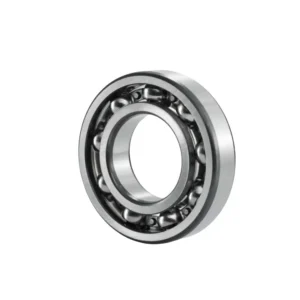

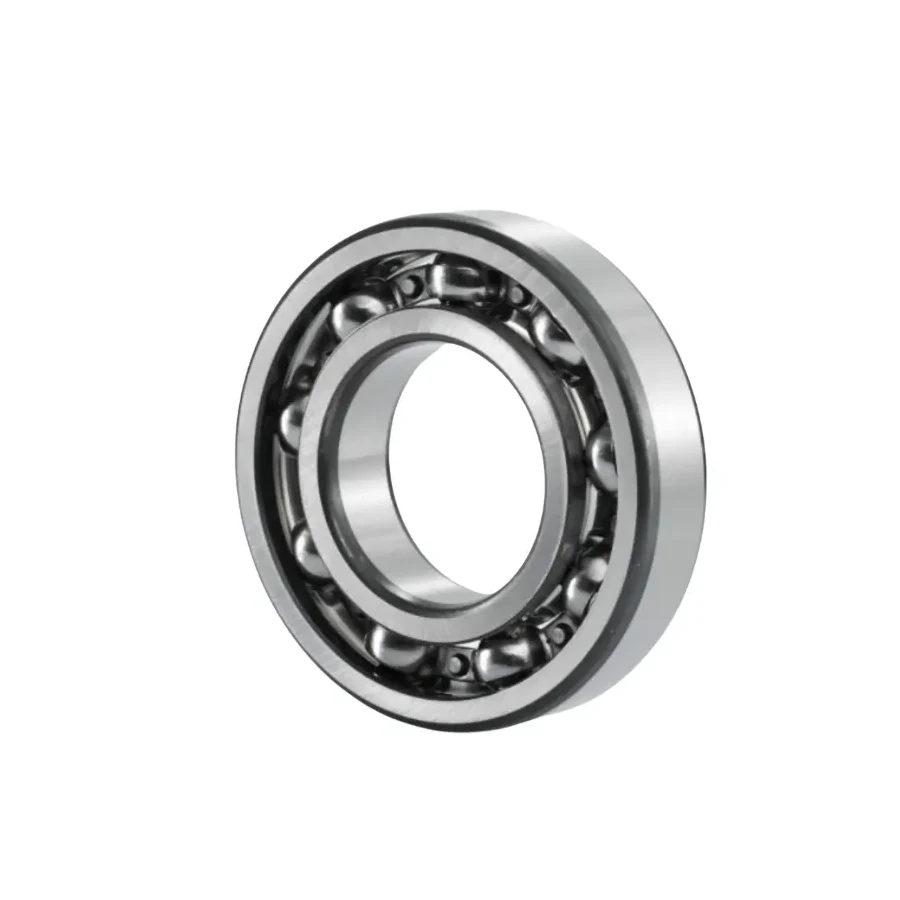
Routing servo power harnesses, vacuum hoses, pneumatic manifolds, or fiber-optic slip rings straight through the axis of a 6-axis industrial robot wrist, radar pedestal, or high-speed packaging indexer requires a wide 110 mm hollow bore without bulky outer castings. Weighing a featherlight 0.60 kg across an ultra-thin 110 × 140 × 16 mm cross-section (only 15 mm radial wall thickness), the ZQM 61822 thin-section deep groove ball bearing (JIS equivalent 6822) supplies 28.1 kN dynamic capacity (Cr), 26 kN static rating (C0r), and crisp low-torque speed up to 4,300 rpm grease or 5,000 rpm oil.
61822 Technical Specifications & Dimensions
| Parameter Category | Technical Parameter (Symbol) | Catalogue Reference Value |
|---|---|---|
| Boundary Dimensions & Weight | Bore diameter (d) | 110 mm |
| Boundary Dimensions & Weight | Outside diameter (D) | 140 mm |
| Boundary Dimensions & Weight | Width (B) | 16 mm |
| Boundary Dimensions & Weight | Reference mass (Weight) | 0.60 kg |
| Load Ratings & Limiting Speeds | Basic dynamic load rating (Cr) | 28.1 kN |
| Load Ratings & Limiting Speeds | Basic static load rating (Cor) | 26 kN |
| Load Ratings & Limiting Speeds | Limiting speed (grease) | 4300 rpm |
| Load Ratings & Limiting Speeds | Limiting speed (oil) | 5000 rpm |
| Abutment & Fillet Dimensions | Shaft abutment diameter (da) | 115 mm |
| Abutment & Fillet Dimensions | Housing abutment diameter (Da) | 135 mm |
| Abutment & Fillet Dimensions | Minimum chamfer dimension (r12) | 1.0 mm |
| Abutment & Fillet Dimensions | Maximum fillet radius (ra) | 1 mm |
| Calculation Factors | Calculation factor (f0) | 14 |
Data source: ZQM Bearings online catalogue database (factory PDF catalogue v1). Load ratings, limiting speeds, and parameters without individual test records serve as catalogue reference values; verify shaft/housing shoulders (da, db, Da), tolerances, internal clearance, and drawings prior to ordering.
Ultra-Thin 15 mm Section Engineering & Weight Economics of 61822
Compared to a standard 6022 on the exact same 110 mm bore (2.09 kg, 170 mm OD), the 61822 slashes rotating mass by 71% and trims 30 mm from outer diameter—unlocking sleek mechatronic packaging while introducing unique structural sensitivities:
- 0.60 kg Low-Inertia Envelope: Minimal mass and slim 16 mm width let servo actuators accelerate and index faster with smaller drive motors and lower harmonic-reducer torque demand.
- 5,000 rpm Oil / 4,300 rpm Grease Agility: Compact ball complement keeps frictional drag remarkably low for smooth rotary encoder tracking, radar scanning, and continuous blister-pack turret indexing.
- Extreme Housing-Roundness Sensitivity: Thin steel rings cannot self-stiffen against imperfect castings—any lobing, ovality, or taper machined into an aluminum robot arm or steel turret bore transfers almost 1-to-1 into the raceway, causing tight spots and jerky torque.
- Emergency-Stop Static Check (26 kN & f0 = 14): While continuous dynamic loads on robotics and radar rings are light, sudden e-stop deceleration spikes must stay safely within the 26 kN static threshold and f0 = 14 axial load model.
ISO 61822 / JIS 6822 Cross-Reference Matrix
| Brand | Primary Code | Bore d | OD D | Width B | Naming & Seal Note |
|---|---|---|---|---|---|
| ZQM | 61822 | 110 mm | 140 mm | 16 mm | ISO 18-series open base; shields/seals per inquiry |
| SKF | 61822 | 110 mm | 140 mm | 16 mm | DIN 625 / ISO 618 series nomenclature |
| FAG / Schaeffler | 61822 | 110 mm | 140 mm | 16 mm | Thin-section deep groove standard |
| NSK | 6822 | 110 mm | 140 mm | 16 mm | JIS 68-series prefix for identical 110×140×16 envelope |
| NTN / Koyo | 6822 | 110 mm | 140 mm | 16 mm | Available open, ZZ shielded, and 2RS/LLU sealed |
Nomenclature notice: European ISO catalogs list this 110 × 140 × 16 mm envelope as 61822 whereas Japanese JIS catalogs designate the same nominal boundary as 6822. Always verify precision class (P0/P6/P5), radial clearance, and contact vs non-contact seal drag before substituting across manufacturers.
Precision Machining & Mounting Rules for Thin-Wall 61822 Rings
- Grind ISO 286-1 IT5/IT6 Dimensional Seats & ISO 1101 Roundness/Cylindricity: Grind mating seats to tight roundness and cylindricity tolerances (ideally ≤ 0.004–0.006 mm out-of-round). Never press a 61822 into an un-ground welded tube or distorted split clamp housing.
- Avoid Heavy Interference Fits: Excessive shaft interference stretches the thin inner ring radially and eliminates internal clearance rapidly. Use light transition fits (e.g., h5/j5 shaft, H6/J6 housing) or calibrated anaerobic retaining compound paired with clamping locknuts when aluminum housings expand faster than steel rings.
- Observe Tight 1 mm Fillet & Shoulder Clearances: With a 15 mm total radial wall, abutment margins are narrow: hold shaft shoulder to da ≥ 115 mm, housing shoulder to Da ≤ 135 mm, and strictly keep corner fillets to ra ≤ 1 mm inside the 1.0 mm minimum chamfer.
- Select Low-Torque Synthetic Grease: For precision turrets and rotary radar drives, specify low-viscosity PAO/ester synthetic grease (20–25% fill) to keep starting and running torque crisp even in cold outdoor environments.
Designing a hollow-shaft cobot joint, medical scanner gantry, or rotary packaging turret? Send precision class, seal torque limits, and housing alloy details to our precision bearing specialists for tailored 61822 / 6822 supply options.
Hollow-Shaft Robotics & Indexer Turret 61822 FAQ
Related Selection & Comparison: For standard radial rigidity on a 110 mm bore, compare the 6022 deep groove ball bearing, or explore ultra-large thin-section designs such as our 670 mm 618/670 F1 bearing and ZQM Metrology & Roundness Lab.
Are 61822 and 6822 the same bearing size?
Yes in nominal ISO 15 boundary dimensions: both measure 110 mm bore × 140 mm OD × 16 mm width. “61822” follows DIN/ISO 18-series naming (SKF, FAG, ZQM), while “6822” is the JIS 68-series shorthand used by NSK, NTN, and Koyo.
Why did our newly installed 61822 feel tight and notched right after assembly into an aluminum housing?
Thin-section rings mirror housing geometry immediately. Out-of-round bore machining, uneven mounting bolt torque near the bearing pocket, or an overly tight press fit collapses the radial clearance and creates periodic torque ripple.
Can a single 61822 support heavy overturning moment loads on a cantilevered radar dish?
A single 16 mm wide thin-section ball bearing has limited moment stiffness on its own. Mount two 61822 bearings spaced apart along the hollow mast (or specify paired angular contact / crossed-roller designs) to resist cantilevered tipping moments cleanly.
Why is ra ≤ 1 mm so critical on a 61822 shaft shoulder?
Because the 61822 has only a 1.0 mm minimum chamfer and 5 mm radial abutment ledge (da = 115 mm on a 110 mm bore), an oversized 1.5–2 mm lathe fillet will push the thin inner ring crooked and ruin runout accuracy instantly.