

On large spherical roller bearings, pumping grease through a housing side cover rarely pushes fresh lubricant past the outer roller row into the loaded center plane. Instead, grease channels around the side cavity while rollers near the mid-plane starve or run hot.
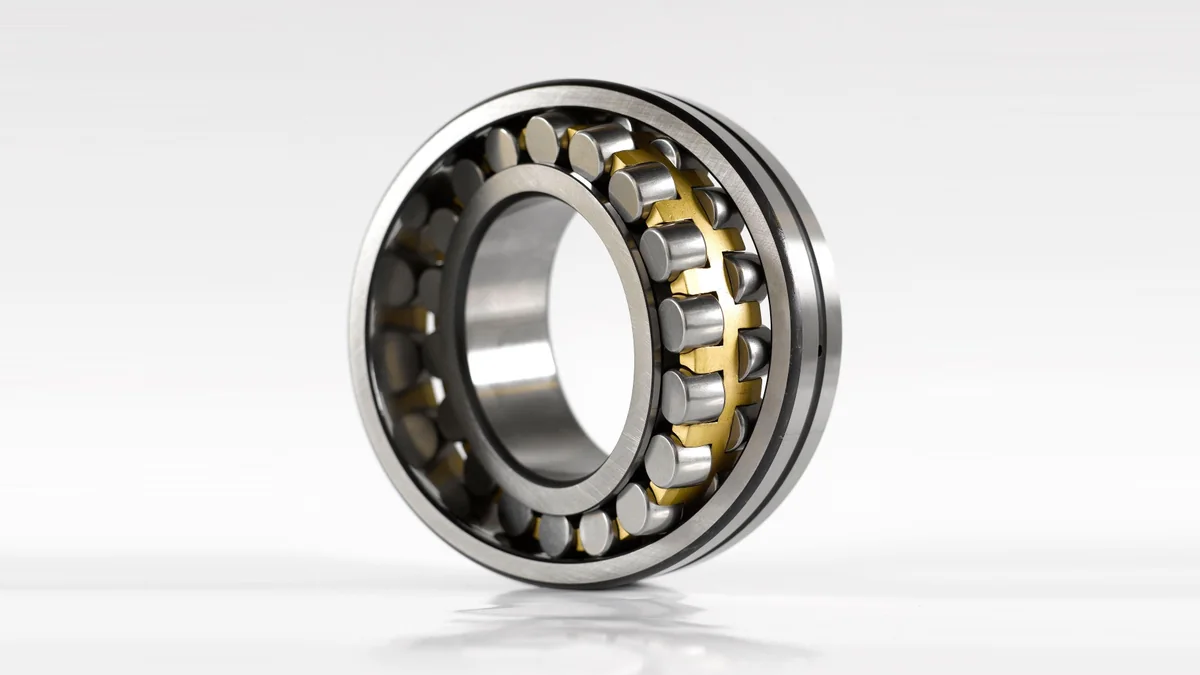
W33 identifies outer-ring lubrication features. Check the groove, oil-hole arrangement and compatible housing ports for the exact bearing execution; these features alone do not establish a safe operating speed.
1. How W33 Works Inside the Bearing
The W33 groove and oil holes provide a lubricant entry path. W33 does not identify a sealing system; supply ports, sealing and discharge paths depend on the complete housing arrangement.
- Fresh grease or pressurized oil enters between both roller sets at minimum radial pumping resistance;
- Centrifugal rotation throws lubricant outward across both raceways, purging degraded oxidized grease and wear fines toward the side seals;
- In machined-brass-cage designs (
CA/W33) as well as stamped-steel-cage designs (CC/W33), central feed flow cools the highest-shear contact zone at the roller ends and guide ring.
- Feeds center plane between both roller rows
- Important Field Check: Align housing grease port with W33 groove
- Grease Reference Speed — 22256CA/W33: 630 rpm | 23080CA/W33: 480 rpm (limited by grease base-oil bleed & churning heat)
- Oil Reference Speed — 22256CA/W33: 800 rpm | 23080CA/W33: 600 rpm (circulating oil carries friction heat & wear debris out)
2. Catalogue Data Comparison: Grease vs Oil Limiting Speed (r/min)
The listed catalogue speed values vary by model and lubrication method. The 22340 example in the table differs by approximately 18%; it is not evidence of a universal model-dependent gain. A catalogue comparison does not guarantee an increase in permissible operating speed.
| Bearing Model | Dimensions (d x D x B/H) | Limiting Speed (Grease) | Limiting Speed (Oil) | Oil Speed Headroom |
|---|---|---|---|---|
| 24036 CA/W33 | 180 x 280 x 100 mm | 950 r/min | 1,200 r/min | +26% |
| 22340 CA/W33 | 200 x 420 x 138 mm | 850 r/min | 1,000 r/min | +18% |
| 22256 CA/W33 / CC/W33 | 280 x 500 x 130 mm | 630 r/min | 800 r/min | +27% |
| 24152 CA/W33 | 260 x 440 x 180 mm | 600 r/min | 800 r/min | +33% |
| 23080 CA/W33 | 400 x 600 x 148 mm | 480 r/min | 600 r/min | +25% |
| 23084 CA/W33 | 420 x 620 x 150 mm | 450 r/min | 560 r/min | +24% |
293/500 (Thrust SRB — non-W33 comparison; see 29326E) |
500 x 750 x 150 mm | 340 r/min | 520 r/min | +53% (oil circulation) |
The 293/294 thrust-bearing example is a separate comparison and is not a W33 example. Retain the source definitions when distinguishing reference speed and limiting speed. Confirm the applicable catalogue, load, lubricant and thermal conditions before selecting an operating speed.
3. Choosing Grease vs Circulating Oil in Real Equipment
- Stay on grease with W33 relubrication when: Operating speeds stay comfortably below roughly 70%–80% of the grease limiting rating, external steam/dust sealing relies on a clean grease purge barrier at labyrinth seals (e.g., quarry conveyors, crushers, slow-to-medium paper felt rolls), and ambient heat is moderate.
- Move to oil bath or circulating oil cooling when: Operating speed approaches or exceeds the grease rating (such as 22256 running above 630 r/min), process heat conducts down the shaft (dryer cylinders, kiln drives), or heavy vertical thrust bearings (like 293 series and 29426EM) generate high roller-end sliding friction.
4. Four Field Checks Before Commissioning a W33 Housing
- Line up the housing grease nipple with the outer-ring W33 groove: Never assume an older non-W33 housing port lands directly over the W33 center groove—check offset on stepped housing seats.
- Leave purge escape space on both sides: Pumping fresh grease through the W33 center hole with blocked labyrinth drain ports bursts seals or packs the housing completely solid, causing sharp churning spikes (a leading cause of thermal bearing failure).
- Relubricate slowly while rotating (safely guarded): Adding grease to a stationary large bearing pockets grease unevenly until startup churn spikes bearing temperature.
- Watch grease compatibility on regreasing: Changing thickener chemistries (for example lithium complex to polyurea or calcium sulfonate) without purging can soften or bleed oil prematurely.
Share your bearing model, operating r/min, load, and lubrication layout with ZQM Bearings before finalizing grease vs circulating-oil specifications or housing port layouts.
Frequently Asked Questions
1. Can a bearing with W33 be used in a housing designed for side greasing?
Yes, as long as the grease path can reach the roller space or housing ports are blocked/converted appropriately, though feeding directly through the W33 outer-ring groove provides much more uniform lubrication between both roller rows.
2. Why is the oil limiting speed higher than the grease limiting speed?
Grease stays largely inside the bearing cavity and retains frictional heat at higher surface speeds, whereas circulating or bath oil conducts heat away from the raceway contact zone and reduces viscous drag when viscosity and oil level are properly controlled.
3. How often should large W33 spherical roller bearings be relubricated?
Relubrication intervals depend on shaft speed relative to limiting speed, operating temperature, moisture, and dust exposure—not calendar time alone. High-dust crushers and hot dryer rolls require shorter intervals and continuous monitoring of purge temperature.
4. Does W33 weaken the outer ring under heavy radial load?
Standard W33 groove depths and oil hole diameters are factored into the outer-ring wall design for medium and large spherical roller bearings; simply verify housing bore roundness and support across the outer-ring width.