

Choosing between a machined brass cage and a stamped steel cage directly affects bearing running temperature, roller guidance under vibration, and service life in heavy crushers, vibrating screens, and mill gearboxes. Rather than treating CA, CC, MB, and E cages as interchangeable suffixes, procurement engineers need clear mechanical criteria grounded in catalogue ratings and dimensional tolerances.
In the ZQM Wafangdian manufacturing program, every spherical roller bearing cage type is matched to specific shock levels, speed thresholds, and W33 relubrication demands—and verified before assembly on our coordinate measuring machines (CMM) to hold pocket pitch and guide-ring concentricity within drawing tolerances.
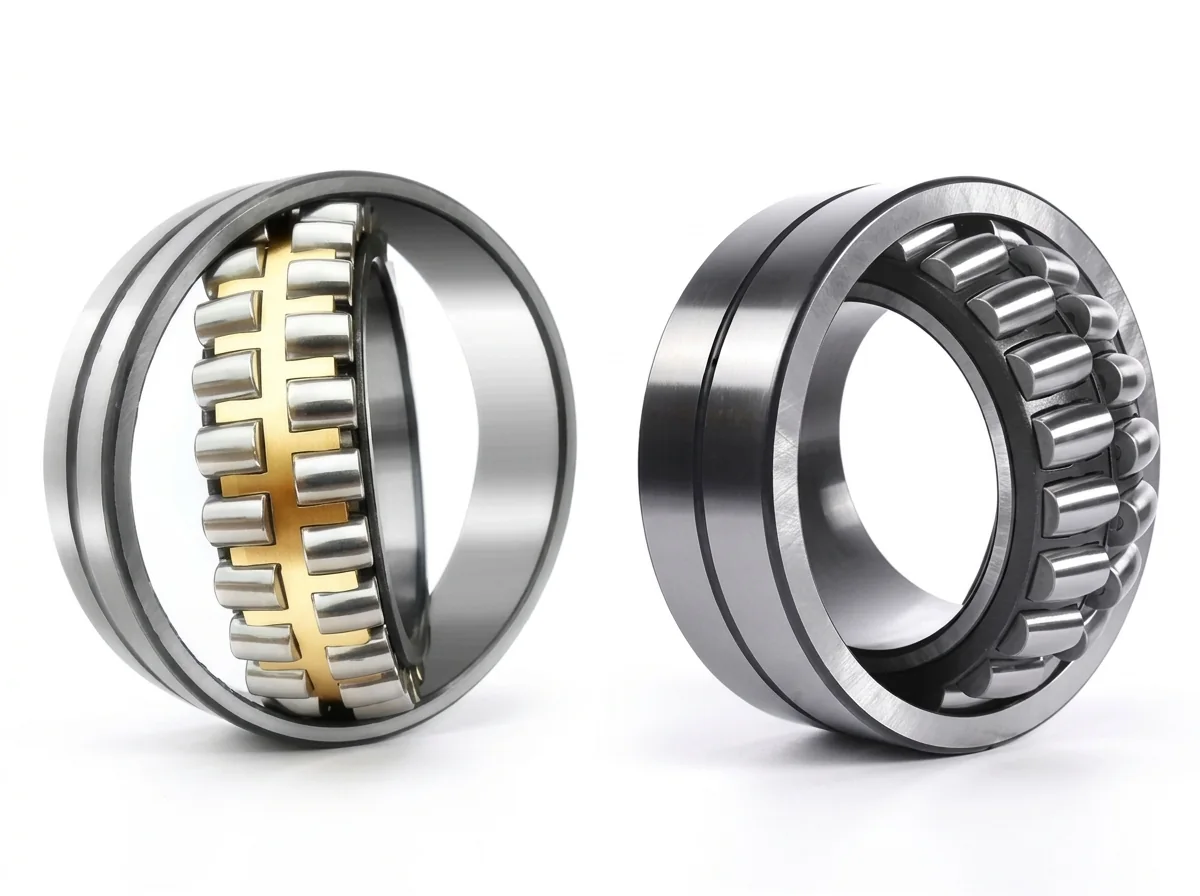
Structural Comparison: CA vs CC vs MB vs E Cages
Modern double-row spherical roller bearings rely on two distinct design philosophies: machined solid brass cages (CA and MB) engineered for high vibration inertia and boundary lubrication, versus pressed window-type steel cages (CC and E) optimized for light cage mass, continuous oil flow, and higher maximum roller load ratings in compact sections.
CA — One-Piece Machined Brass Cage
- Prong-type solid brass body piloted on inner ring shoulders or guide ring
- Flanged inner ring stabilizes rollers under combined axial-radial shock
- Preferred on bores d ≥ 200 mm for quarry crushers, paper mills & conveyors
- Featured ZQM model: 22256 CA/W33 (280×500×130 mm, 110 kg)
CC — Two-Piece Stamped Steel Window Cage
- Pressed window steel halves + floating inner guide ring eliminate fixed center rib friction
- Self-guiding symmetrical rollers minimize skewing and running heat
- Lower mass lowers centrifugal skidding during rapid acceleration
- Featured ZQM model: 22256 CC/W33 (280×500×130 mm)
MB — Two-Piece Machined Brass Cage (Inner-Ring Guided)
- Split machined brass cage halves riding directly on inner-ring lands
- Robust pocket bridges resist severe vibratory screen & eccentric shaft loads
- Standard option on large-bore Series 223/231 heavy mine hoists or screens
- Available with specialized vibratory clearance & bronze-grade options
E — Reinforced Pressed Steel Design
- Optimized internal geometry increases roller length/diameter within ISO envelope
- Window-style pressed steel cage with precision-guided roller path
- Higher dynamic capacity Cr on medium bores without sacrificing speed
- Verify outer-ring lubrication (W33) & housing tolerance before cross-swapping
Head-to-Head Catalogue Data Across ZQM Series 222, 223 & 230/240
Before selecting a cage suffix solely from competitor brochures, compare identical envelope boundaries across ZQM catalogue entries. For example, both ZQM 22256 CA/W33 and ZQM 22256 CC/W33 share the exact ISO 15 Series 222 nominal envelope (280 × 500 × 130 mm) and W33 oil groove/holes, yet serve different shock and relubrication profiles.
| ZQM Model | Legacy Code | Dimensions d×D×B (mm) | Cr / C0r (kN) | Grease / Oil Speed (rpm) | Mass (kg) | Cage & Bore Note |
|---|---|---|---|---|---|---|
| 22256 CA/W33 | 53556KH | 280 × 500 × 130 | 2,280 / 3,650 | 630 / 800 | 110 | One-piece machined brass CA; K = 1:12 |
| 22256 CC/W33 | 53556KH (CC ref) | 280 × 500 × 130 | ISO Series 222* | Series 222 ref* | Series 222* | Pressed steel window CC + guide ring |
| 22252 CA/W33 | 53552KH | 260 × 480 × 130 | 2,180 / 3,400 | 670 / 850 | 104 | One-piece brass CA; heavy conveyor/crusher |
| 22340 CA/W33 | 53640KH | 200 × 420 × 138 | 2,000 / 2,990 | 850 / 1,000 | 92.6 | Heavy Series 223 brass CA; vibrator option |
| 23080 CA/W33 | 3053180KH | 400 × 600 × 148 | 2,970 / 5,900 | 480 / 600 | 146 | Wide-section brass CA; K = 1:12 taper opt. |
| 24056 CA/W33 | 4053156KH | 280 × 420 × 140 | Verified in 240 Series | Oil / Grease spec | Verify sheet | Series 240 tapered option is 1:30 (K30) |
Notice the taper distinction on the final row: across standard Series 222, Series 223, and Series 230/232 bearings, a tapered bore carries suffix K (1:12 taper), whereas Series 240 and Series 241 ultra-wide bearings utilize a gentler K30 (1:30 taper) geometry to keep inner ring wall thickness uniform under mounting interference.
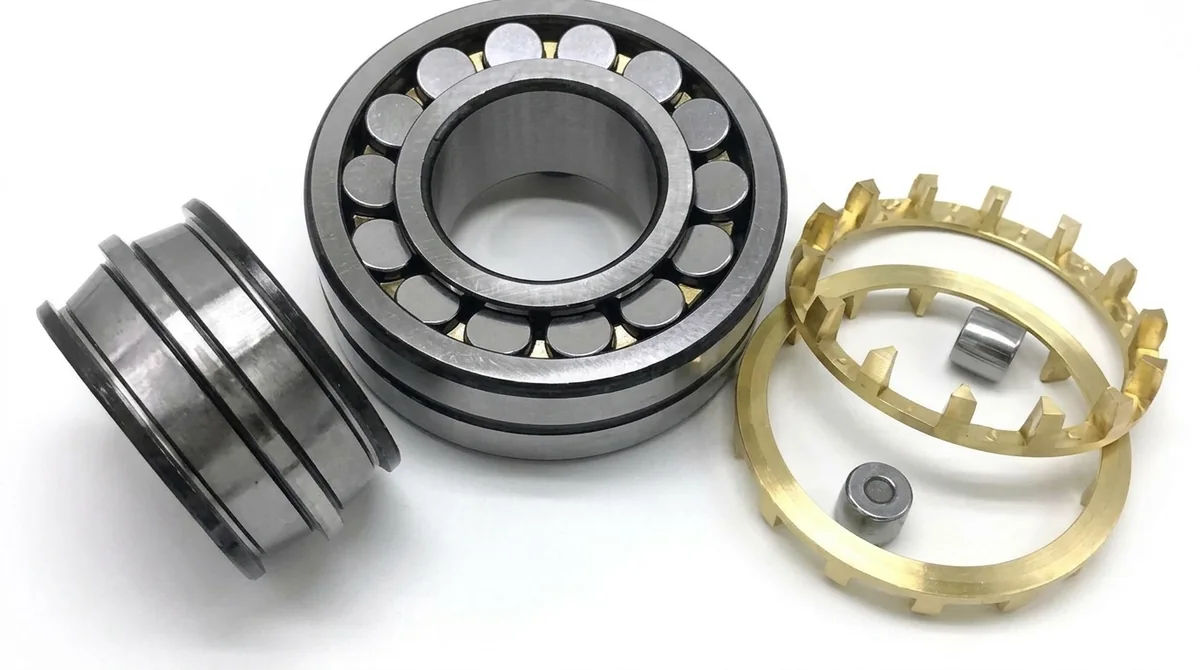
Evaluating Cage Selection: Vibration, Lubrication, and Structural Dynamics
Under heavy vibration and severe dynamic loads, cage suitability cannot be judged by material alone—it depends on specific pocket geometry, guiding land method, lubrication regime, and shock acceleration profiles. For example, specialized vibrating screen bearings (such as SKF VA405 designs) utilize surface-hardened stamped steel window cages, whereas machined solid brass (CA and MB) designs remain widely specified under the following operating conditions:
- High-G Vibrating Screens & Primary Jaw Crushers: Rapid centrifugal reversing accelerations excite cyclic bending fatigue across thin stamped cage bridges. A solid machined brass prong or split MB section offers higher damping mass and tear resistance—especially when paired with specialized radial clearance (C3 or C4) and tighter outer-ring OD/inner-ring bore tolerances.
- Boundary Lubrication & Contaminated Pulp/Mining Housings: Machined brass provides lower dry-sliding adhesive seizure risk against hardened steel rollers during cold starts or intermittent grease replenishment cycles, reducing catastrophic cage fracture before scheduled maintenance stops.
- Large-Bore Service (d ≥ 300 mm): Above 300 mm bore—such as 23160 CA/W33 (300 × 500 × 160 mm, 125 kg) and 22272 CA/W33 (360 × 650 × 170 mm, 255 kg)—single-piece or split machined brass delivers rigid pocket support without custom stamping tooling constraints.
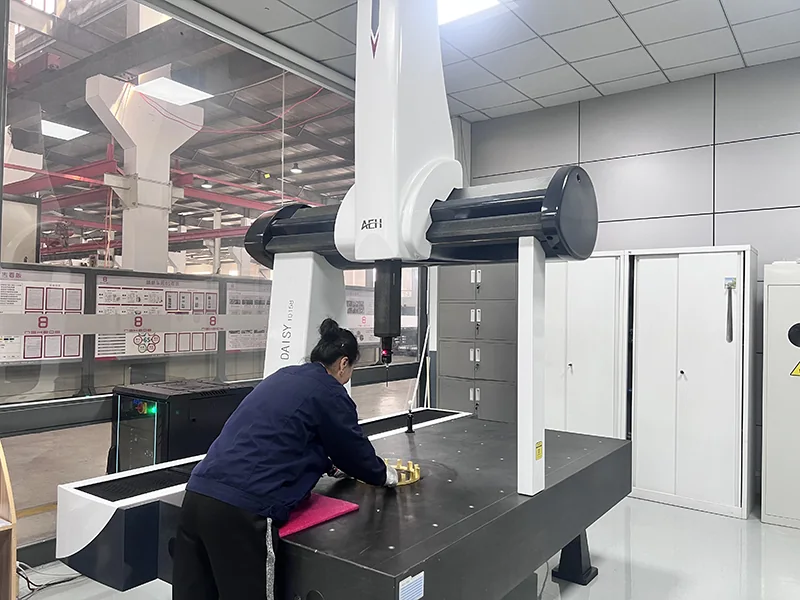
ZQM Factory Metrology: How We Verify Machined Brass Cages
Brass cage durability depends heavily on raw bronze alloy soundness, pocket clearance consistency, and guide-surface concentricity. At ZQM’s Wafangdian facility, every lot of large machined CA/MB brass cages undergoes bridge coordinate measuring machine (CMM) inspection before matching with ground inner rings, outer rings, and barrel roller sets—preventing uneven pocket pinch that can cause localized thermal runaways even inside properly lubricated W33 housings.
4-Point Specification Checklist Before Requesting a Quote
- Confirm Exact Cage & Suffix Code: Specify whether existing equipment runs CA/W33 (one-piece machined brass), CC/W33 (pressed steel), or MB (two-piece machined brass), plus bore type (cylindrical vs. K 1:12 or K30 1:30).
- Share Vibration & Shock Profile: Advise if the bearing mounts in a vibrating screen, jaw/cone crusher, continuous caster, or steady gearbox so we confirm cage alloy and clearance (C0, C3, C4).
- Verify Lubrication & Thermal Operating Window: State grease type vs. circulating oil flow rate, shaft speed (rpm), and steady operating temperature.
- Attach Part Drawing or Legacy Code: Send original engineering prints or stamped codes (e.g., 53556KH -> 22256 CA/W33) for dimensional and shoulder abutment (da, Da) verification.
Need Engineering Selection Between CA, CC, and MB Cages?
Send your bearing designation, equipment type, and target radial clearance to ZQM’s Wafangdian application engineering team for factory-verified datasheets and batch lead-time confirmation.