

Selecting the wrong tapered bore ratio or mounting sleeve on a heavy-duty spherical roller bearing is one of the fastest ways to fracture an inner ring or lose shaft clamping under load. In heavy industrial equipment—from vibrating screens and crushers to paper mill rolls—engineers routinely encounter two distinct ISO taper standards: 1:12 (suffix K) and 1:30 (suffix K30), paired with either an H adapter sleeve or an AH withdrawal sleeve.
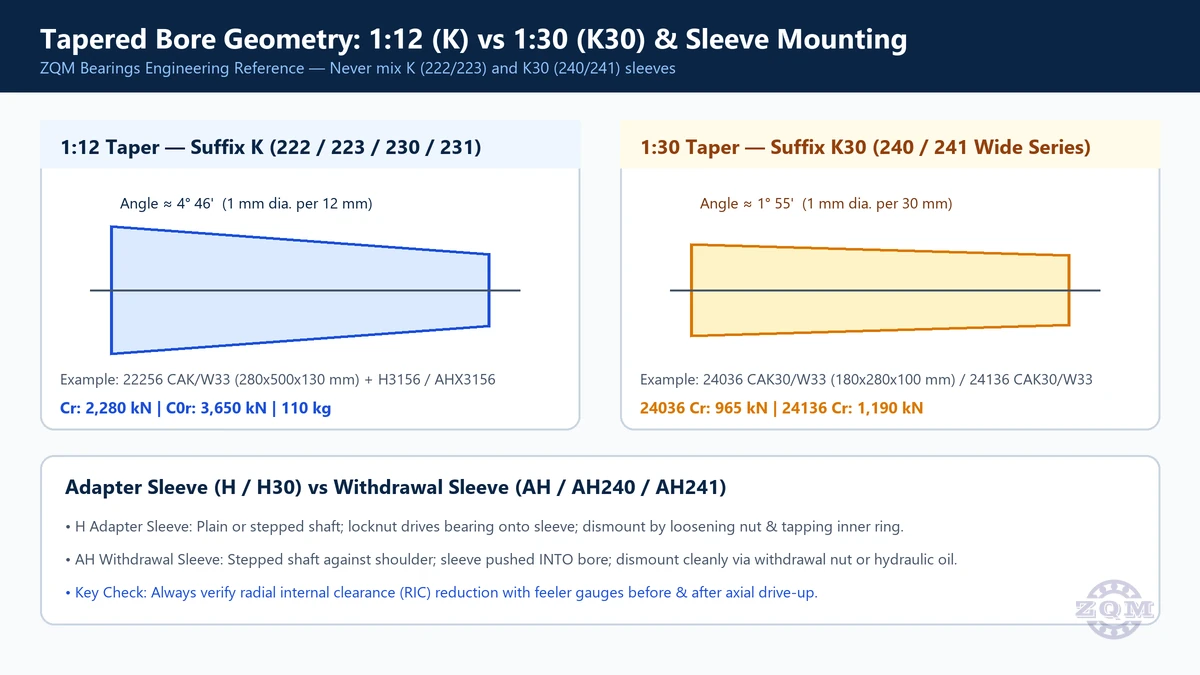
1:12 (K) vs 1:30 (K30): Why Series Determines Taper
In ISO spherical roller bearing nomenclature, the taper ratio is tied directly to the bearing’s cross-sectional series:
- 1:12 Taper (Suffix K): Standard across 222 series, 223 series, 230, 231, and 232 spherical roller bearings. For example, a 22256 CA/W33 (280 × 500 × 130 mm, Cr 2,280 kN, C0r 3,650 kN, 630/800 rpm, 110 kg) ordered with a tapered bore carries the designation 22256 CAK/W33.
- 1:30 Taper (Suffix K30): Widely used on wide, low-section heavy series such as 240 series and 241 series (cross-brand taper matching must always be confirmed by consulting the manufacturer’s sleeve and bearing compatibility table rather than assuming K30 is restricted to specific series). For instance, 24036 CA/W33 (180 × 280 × 100 mm, Cr 965 kN, C0r 1,750 kN, 950/1,200 rpm, 22.7 kg) and 24136 CA/W33 (180 × 300 × 118 mm, Cr 1,190 kN, C0r 2,040 kN, 900/1,200 rpm, 33.1 kg) become 24036 CAK30/W33 and 24136 CAK30/W33 in tapered bore form.
Critical Engineering Rule: Because the 240 and 241 series have a thinner inner ring wall, a steeper 1:12 taper would create excessive hoop stress and reduce section thickness at the large-bore edge, causing fretting corrosion and inner ring cracking.
Adapter Sleeve (H) vs Withdrawal Sleeve (AH)
| Feature | Adapter Type (H / H30 / H31) | Withdrawal Type (AH / AH240 / AH241) |
|---|---|---|
| Shaft Requirement | Plain cylindrical or stepped shaft (no shoulder needed for axial positioning) | Stepped shaft with abutment shoulder on the inboard side |
| Mounting Action | Locknut pulls/pushes bearing onto the tapered bush | Hydraulic nut or end plate pushes tapered bush into the bearing bore |
| Dismounting Method | Loosen locknut a few turns, tap inner ring off the taper | Thread withdrawal nut onto external threads (or use hydraulic oil ducts on large bores) |
| Best Fit | Pillow blocks, plummer blocks, long transmission shafts | Heavy gearboxes, mill rolls, large bores requiring clean hydraulic dismounting |
Bore-to-Journal Matching & Mounting Sequence
Before placing an order or assembling a rotor shaft, match the adapter or withdrawal series, shaft journal tolerance, and bearing taper ratio together rather than treating mounting bushes as interchangeable:
- Matching Taper Ratio to Journal Geometry: A 22256 CAK/W33 (280 mm nominal bore, 1:12 K taper) pairs with a 1:12 adapter unit (such as H31 series) or a 1:12 withdrawal unit, clamping onto a cylindrical or stepped shaft journal. By contrast, a 24036 CAK30/W33 or 24136 CAK30/W33 (180 mm nominal bore, 1:30 K30 taper) must be paired by checking the manufacturer’s official sleeve matching table for complete bearing and sleeve designations, rather than relying solely on sleeve prefix designations (such as H30/H240) to determine taper ratio. Attempting to force a 1:30 bearing onto a 1:12 taper concentrates contact pressure at one edge of the bore and risks splitting the inner ring during drive-up.
- H Locknut Mounting vs AH Hydraulic Nut Sequence: On medium H-series adapters, clean the shaft and tapered mating surfaces, apply only a light film of oil to the threads and nut face, and tighten the locknut until the inner ring reaches the target clearance reduction, then bend the lockwasher tab or secure the locking clip. On large AH withdrawal units, drive the tapered bush between the stepped shaft shoulder and the bearing bore using a hydraulic nut backed against a shaft end-plate or locknut. Avoid hammer impacts on large bores, which cock the bush and score the journal.
- Controlled Oil-Injection Dismounting: When removing an AH withdrawal unit equipped with oil ducts, pump hydraulic oil into the supply grooves to form an oil film between the mating tapers before advancing the withdrawal nut. Always leave a retaining locknut loosely threaded on the shaft end with a few millimeters of axial gap so the bush cannot eject suddenly when taper friction breaks.
Measuring Radial Internal Clearance (RIC) Reduction
Driving a tapered bore bearing too far up the taper eliminates radial internal clearance, leading to thermal seizure; under-driving leaves insufficient interference and causes inner ring creep. Follow a repeatable shop-floor verification workflow:
- Baseline Unmounted Check: Stand the bearing upright on a clean worktable, rotate the inner ring several turns to seat the rollers, and insert feeler gauge blades simultaneously over the top unloaded rollers of both rows to record the initial unmounted RIC (CN, C3, or C4).
- Controlled Axial Drive-Up: Advance the locknut or hydraulic nut in small increments, rotating the outer ring between steps so rollers settle evenly in the raceways. Re-measure clearance across the unloaded zone after each increment.
- Residual Clearance & Housing Check: Stop drive-up once the measured clearance reduction and minimum residual RIC match your bearing series engineering sheet and expected shaft-to-housing temperature differential. In split plummer blocks, re-check clearance after torquing cap bolts to verify the housing bore is not pinching the outer ring.
Frequently Asked Questions
Can you mount a 1:30 K30 bearing onto a 1:12 K adapter sleeve?
No. A 1:30 K30 bore (such as 24036 CAK30/W33 or 24136 CAK30/W33) and a 1:12 K sleeve do not share the same cone angle. Mating mismatched tapers leaves only a narrow band of line contact, causing uneven expansion, fretting, and inner ring fracture under load.
When should engineers choose an AH withdrawal sleeve over an H adapter sleeve?
Choose an AH withdrawal sleeve when the shaft has an inboard abutment shoulder and maintenance crews need hydraulic-nut mounting or oil-injection dismounting on heavy gearboxes or mill rolls. Choose an H adapter sleeve for plain cylindrical shafts and split pillow blocks where axial location can be set anywhere along the shaft.
Why is feeler-gauge RIC reduction preferred over torque-only tightening on tapered bore bearings?
Thread friction on locknuts and tapered bushes varies widely with surface finish and lubrication, so nut torque alone cannot predict inner ring expansion accurately. Measuring radial internal clearance reduction directly with feeler gauges verifies actual interference fit and prevents overheating from over-tightening.
Need Tapered Bore Bearings & Matched Sleeves?
Send your bearing designation, shaft diameter, and clearance requirement (CN, C3, or C4). ZQM Bearings supplies K and K30 spherical roller bearings with matched adapter or withdrawal sleeves and dimensional inspection reports.