
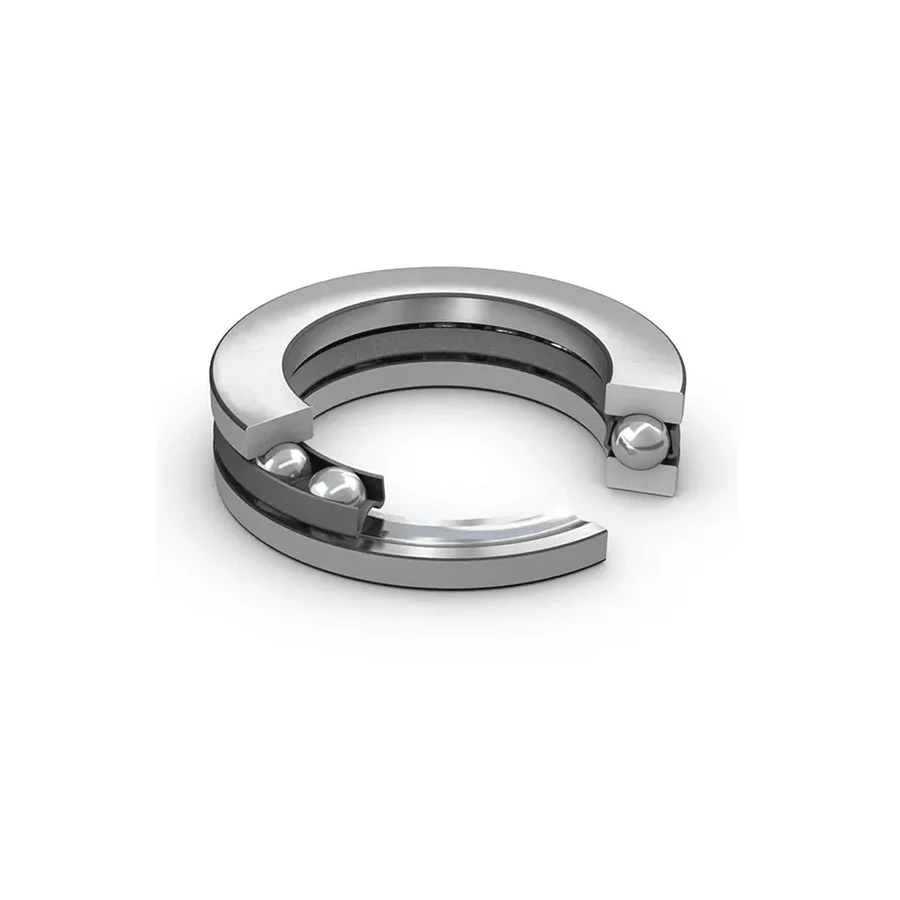
The 51212 thrust ball bearing (60 × 95 × 26 mm, ISO 104 Dimension Series 12) upgrades a 60 mm axial arrangement from thin light-duty washers to a substantially deeper ball groove, thicker 17.5 mm radial wall, and robust 26 mm total stack height (H). Tailored for heavy-duty trapezoidal screw-jack lifting nuts and vertical drilling press quills, it absorbs repetitive downward feeding or lifting thrust cleanly under strictly unidirectional pure axial load (Fr = 0) with zero tapered-bore configuration.
| ISO 104 Series 12 Spec | Symbol | 51212 Nominal Value | Screw-Jack / Drill-Quill Notes |
|---|---|---|---|
| Shaft Washer Bore | d | 60 mm | Close fit on rotating screw sleeve / spindle quill |
| Housing Washer OD | D | 95 mm | 10 mm larger OD than light 51112 (85 mm) |
| Total Assembled Height | H | 26 mm | Height H (not B); 9 mm taller than 51112 |
| Load Boundary | Pure Axial Only | Fr = 0 Unidirectional | Zero radial support; zero angular tilt |
| Separable Three-Piece | Shaft vs Housing | Housing Bore D1 > 60 mm | Never reverse shaft and housing washers |
| Axial Capacity & Grade | Ca / C0a / Tolerance | Factory Print Confirmed | Verified per steel/brass cage & duty at quote |
51212 Medium-Series Depth for Cyclic Lifting Nuts & Drill-Press Quills
Industrial worm-gear trapezoidal screw jacks elevating press platens, stage lifts, and rolling-mill guides cycle back and forth under substantial axial weight every shift. Similarly, heavy pillar and radial-arm vertical drilling presses push twist drills through thick structural steel plate at moderate quill speeds, concentrating pure upward drill-feed reaction directly onto the spindle thrust collar. Where light Series 11 units (51112 at 85 × 17 mm) hit contact-stress ceilings under repeated cycling, the medium Series 12 51212 packs larger balls inside a 95 × 26 mm envelope for markedly improved fatigue endurance.
Discipline around load isolation and speed remains non-negotiable. On a vertical drill quill, lateral cutting chatter and belt side-pull must be carried entirely by radial cylindrical or deep-groove bearings so the 51212 sees strictly Fr = 0 and perfectly square abutment shoulders. Likewise, on fast spindle idle retracts, keep light axial spring preload engaged so balls never lift off the groove and skid—and remember that ultra-high-rpm CNC machining centers require angular contact ball bearings rather than flat-seat thrust balls. Exact dynamic/static axial capacities (Ca/C0a), precision face-runout options, and pressed steel vs machined brass retainers are finalized on the ZQM drawing at quotation.
51212 Brand Cross-Reference & Legacy 8212 Code Verification
Machine-tool rebuilders and linear-actuator OEMs comparing 60 × 95 × 26 mm replacements against legacy Chinese prints (8212) align on these ISO 104 Series 12 designations:
| Brand / Code System | ISO 104 Base Code | Rebuild & Specification Check |
|---|---|---|
| ZQM Bearings | 51212 | Drawing verifies D1 bore, steel/brass cage & Ca/C0a |
| SKF | 51212 | Medium Series 12; check pressed steel vs brass cage |
| FAG / Schaeffler | 51212 | Confirm face-thickness runout grade for drill quills |
| NSK / NTN / KOYO | 51212 | Verify axial Ca/C0a ratings for cyclic jack service |
| Legacy GB Code | 8212 | Former Chinese drill-press & screw-jack code |
Interchange Boundary Statement: Equivalent codes match ISO 104 boundary geometry (60 × 95 × 26 mm) exclusively. Washer runout precision, retainer alloy, and axial ratings Ca/C0a differ across brands and must be validated against original machinery blueprints before installation.
Washer Identification, Lubrication Mode & Opposed Screw-Jack Pairs
When overhauling lifting jacks or drilling spindles inside precision machining and heavy workshop environments, measure both flat washers before assembly: the shaft washer has the snug 60 mm bore locking onto the rotating nut sleeve or spindle collar, whereas the housing washer carries a larger clearance bore (D1 > 60 mm) seated squarely inside the stationary gearbox casting. Inverting the two rings traps the stationary ring against the rotating shaft and ruins the gearbox immediately.
Lubrication follows speed: slow trapezoidal screw jacks thrive on high-viscosity EP2 lithium-complex grease packed generously around the ball cage, while continuously spinning vertical drill quills benefit from clean circulating gear oil or metered oil drip to flush away heat. If a screw jack works both in compression (lifting) and tension (hanging loads), fit two opposed 51212 bearings straddling the worm-wheel collar or move to a double-direction 522/523 thrust ball bearing.
Specifying 51212 Bearings for Jack Manufacturers & Machine Shops
Send us five details for rapid drawing confirmation: application type (screw jack vs drill quill), cyclic axial load and operating rpm, single vs paired opposed mounting, retainer preference (pressed steel or machined brass), and batch size. ZQM engineering validates housing clearance D1 and Ca/C0a ratings on a formal print prior to production.
Request 51212 Technical Drawing & Quote
51212 Selection Questions for Screw Jacks & Drilling Presses
Related Selection & Comparison: Compare compact 51112 (85 × 17 mm) or heavy Series 13 51312 (110 × 35 mm) on the same 60 mm shaft, review our Quality Control Lab, or browse Thrust Ball Bearings.
When should a 60 mm screw jack upgrade from 51112 to 51212?
Step up from 51112 (85 × 17 mm) to 51212 (95 × 26 mm) whenever repetitive vertical lifting cycles or heavier drill-feed forces require larger balls, deeper raceway grooves, and longer fatigue life inside a medium Series 12 housing.
How does a vertical drilling press quill isolate side drill forces from the 51212?
Because the 51212 supports strictly pure axial feed thrust (Fr = 0), drill-press spindles mount independent radial ball or roller bearings above and below the quill to absorb all lateral cutting deflection.
How do mechanics prevent reversing the 51212 shaft and housing washers inside a jack gearbox?
Measure the inner bores with calipers prior to drop-in: the 60 mm bore shaft washer mounts on the rotating worm-gear hub, while the oversized-bore housing washer (D1 > 60 mm) seats stationary in the gearbox wall.
Why add light spring preload to a 51212 on a vertical drill-press spindle?
During rapid unloaded quill retraction, light axial preload keeps the thrust balls seated tightly inside the raceway grooves so centrifugal action cannot trigger skidding or cage chatter.
What bearing layout supports screw jacks carrying both push and pull axial loads?
Single-direction 51212 units handle one direction only; bidirectional jacks mount two opposed 51212 bearings flanking the nut flange or use a dedicated double-direction 522/523 thrust ball bearing.