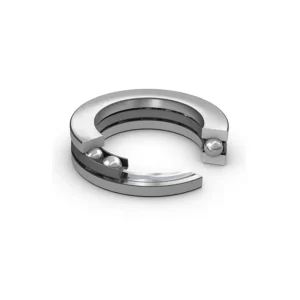

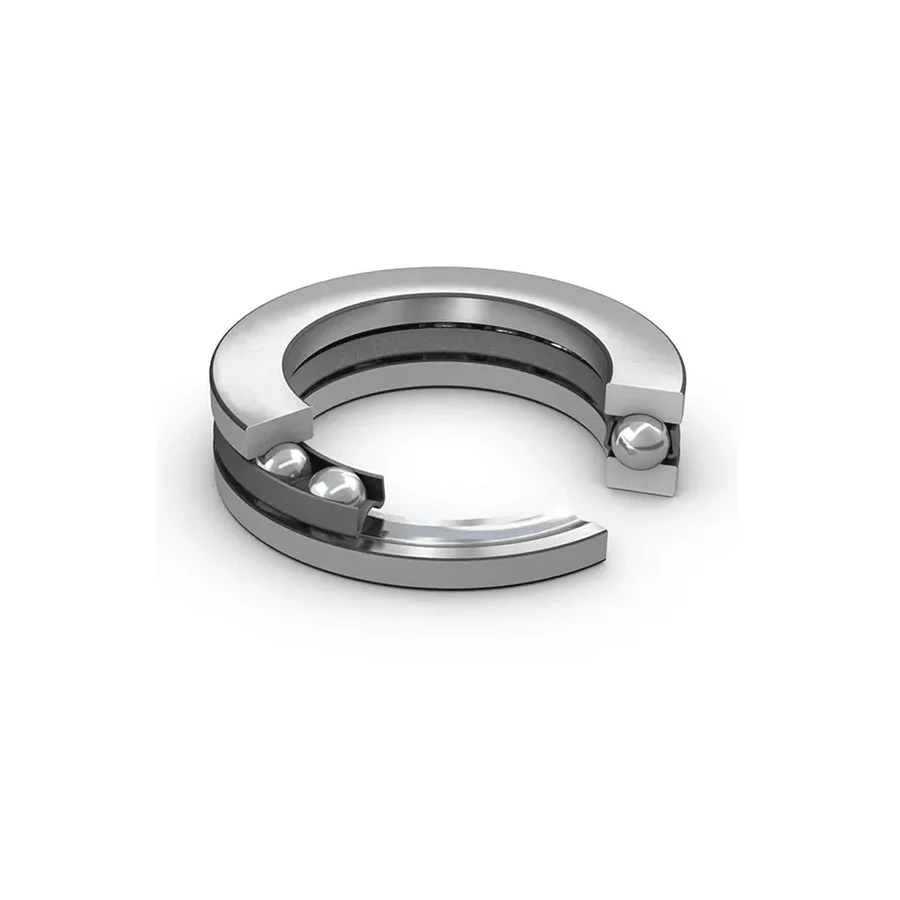
The 51112 thrust ball bearing (60 × 85 × 17 mm, ISO 104 Dimension Series 11) compresses single-direction axial thrust support into an ultra-compact 17 mm total height (H) and 12.5 mm radial wall around a 60 mm bore. Tailored for industrial gate-valve stem actuators and low-profile rotary indexing fixtures, its three separable components—a close-fitting shaft washer, a ball-and-cage assembly, and an oversized-bore housing washer—carry strictly unidirectional pure axial force (Fr = 0) with zero tapered bore options.
| ISO 104 Series 11 Parameter | Symbol | 51112 Nominal Spec | Valve / Indexer Notes |
|---|---|---|---|
| Shaft Washer Bore | d | 60 mm | Close fit on rotating valve sleeve or arbor |
| Housing Washer OD | D | 85 mm | Slim 12.5 mm single-side radial wall |
| Assembled Total Height | H | 17 mm | Height H (not width B); fits tight yokes |
| Load Direction Rule | Pure Axial Only | Fr = 0 Unidirectional | Zero radial capacity & zero angular tilt |
| Separable Ring Check | Shaft vs Housing | Housing Bore D1 > 60 mm | Anti-reversal rule: never swap the two rings |
| Axial Ratings & Retainer | Ca / C0a / Cage | Factory Drawing Verified | Static C0a, dynamic Ca & grade at quote |
51112 Ultra-Compact 17 mm Stack for Valve Yokes & Indexing Fixtures
Mid-size pipeline gate valves (DN150–DN300) and compact rotary tooling fixtures leave scarce headroom between the bronze yoke-nut flange or indexing platen and the cast bonnet shoulder. At only 17 mm tall and 85 mm across, the 51112 slips cleanly over a 60 mm threaded sleeve or locating spigot, slashing handwheel closing torque and letting compact electric actuators seat the gate reliably without tripping torque switches.
Three strict mechanical laws govern every flat-seat 51112 installation. First, radial load capacity is strictly zero (Fr = 0)—dedicated bronze guide sleeves or radial bearings must carry any stem side-thrust or tool clamping eccentricity. Second, flat seating washers offer zero misalignment forgiveness, so both abutment faces must be machined square to the axis to avoid overloading a handful of balls. Third, single-direction thrust ball bearings are meant for slow intermittent turning or static seating, never high-speed spindles where centrifugal force flings balls outward into skidding failure. Verified axial capacities (Ca and static seating C0a), pressed steel vs machined brass retainers, and face-runout precision grades are confirmed on ZQM’s engineering drawing at quotation.
51112 Cross-Reference & Legacy 8112 Code Identification
Valve overhaul crews and fixture builders cross-referencing European, Japanese, and legacy Chinese blueprints (8112) align on these ISO 104 Series 11 codes:
| Brand / Standard | ISO 104 Code | Service & Drawing Verification |
|---|---|---|
| ZQM Bearings | 51112 | Drawing confirms D1 clearance bore, cage & Ca/C0a |
| SKF | 51112 | Flat-seat Series 11; verify steel vs brass retainer |
| FAG / Schaeffler | 51112 | Confirm precision runout grade for indexing platens |
| NSK / NTN / KOYO | 51112 | Check static seating safety C0a & corrosion packing |
| Legacy GB Code | 8112 | Former Chinese valve & machine-tool blueprint code |
ISO Dimensional Disclaimer: Brand alignment above verifies ISO 104 nominal envelope dimensions (60 × 85 × 17 mm) exclusively. Raceway thickness tolerance, cage material, and axial ratings Ca/C0a vary across makers and must be confirmed against original engineering prints prior to substitution.
Anti-Reversal Washer Assembly, Preload & Bidirectional Valve Thrust
When assembling valve bonnets or tooling fixtures across precision machine-tool and industrial process facilities, measure both loose washers with calipers before dropping them over the 60 mm sleeve. The shaft washer has the exact 60 mm bore that registers on the rotating collar; the housing washer carries an intentionally enlarged bore (D1 > 60 mm) so it rests stationary inside the housing pocket without rubbing the spinning shaft. Reversing the two rings binds the stationary housing washer onto the shaft and destroys the assembly on the very first rotation.
Keep modest continuous axial preload during fixture indexing so balls never skid when direction pauses. Because a single 51112 resists thrust in one direction only, rising-stem gate valves that generate heavy axial force on both opening and closing strokes must either mount two opposed 51112 bearings flanking the yoke-nut collar or step up to a double-direction 522/523/524 thrust ball bearing.
Ordering 51112 Bearings for Valve Actuators & Tooling OEMs
Share your actuation type (manual handwheel, electric valve actuator, or rotary fixture), peak static seating force, single vs paired opposed layout, preferred steel or brass retainer, and batch volume. Our engineering desk provides a verified drawing listing housing bore D1 and Ca/C0a values before manufacturing.
Request 51112 Drawing & Actuator Quote
51112 Engineering Questions for Valves & Indexing Fixtures
Related Selection & Comparison: Need deeper grooves on the same 60 mm shaft? Compare medium Series 12 51212 (95 × 26 mm) or smaller 50 mm 51110 (70 × 14 mm), inspect our Quality Inspection Center, or browse Thrust Ball Bearings.
How do technicians tell the 51112 shaft washer from the housing washer during assembly?
Check the inner bore diameter: the shaft washer measures 60 mm for a snug fit on the rotating collar, while the housing washer has a larger clearance bore (D1 > 60 mm) so it seats inside the stationary housing without contacting the shaft.
Can a 51112 absorb lateral bending from an off-center gate-valve stem?
No. A 51112 carries strictly pure axial force (Fr = 0) and tolerates zero angular tilt; lateral stem forces must be isolated using bronze guide bushings or separate radial bearings.
How do rising-stem gate valves handle thrust in both closing and opening directions?
Because 51112 is single-direction only, valve yokes install two opposed 51112 bearings above and below the yoke-nut flange—or specify a dedicated double-direction 522/523 thrust ball bearing.
When should a 60 mm shaft switch from 51112 (85 × 17 mm) to 51212 (95 × 26 mm)?
Keep 51112 when axial stack height is restricted near 17 mm under light-to-moderate thrust; step up to 51212 whenever repetitive lifting cycles or higher axial loads justify a 26 mm tall medium-series envelope.
Why is minimum axial preload still needed on a slow rotary indexing fixture?
Maintaining light axial seating keeps every ball engaged smoothly inside its raceway groove, preventing skidding and micro-scuffing during rapid start-stop indexing moves.