
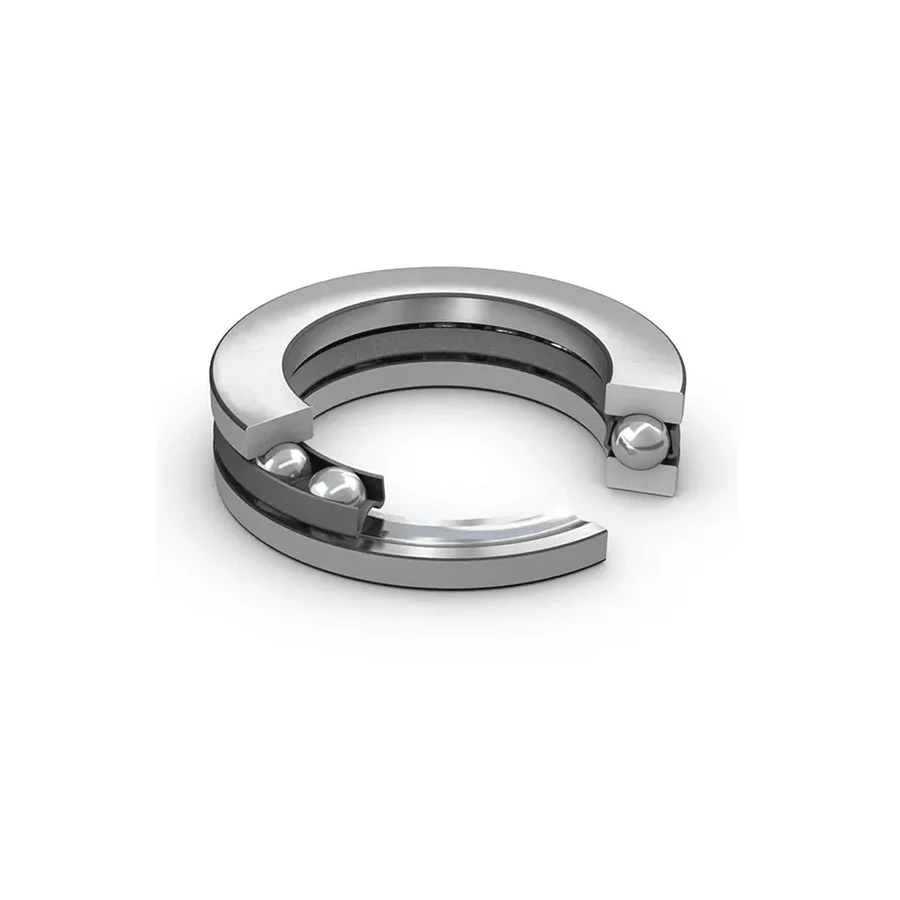
The 51110 thrust ball bearing (50 × 70 × 14 mm, ISO 104 Dimension Series 11) delivers an ultra-compact 14 mm total height (H) around a 50 mm shaft for CNC rotary indexing tables, hydraulic fixture clamping collars, and slow-turning machining tombstones. Engineered strictly for unidirectional axial loading (Fr = 0), its three separable parts—a shaft-fitted washer, a larger-bore housing washer, and a caged ball assembly—drop cleanly into shallow machined counterbores.
| ISO 104 Parameter | Symbol | 51110 Nominal | Series 11 Design Notes |
|---|---|---|---|
| Shaft Washer Bore | d | 50 mm | Tight/transition fit on rotating shaft |
| Housing Washer OD | D | 70 mm | Extra-light 10 mm radial wall width |
| Total Assembled Height | H | 14 mm | Ultra-slim axial stack profile |
| Load Direction | Unidirectional Axial | Fr = 0 Only | Zero radial load & zero misalignment capacity |
| Separable Components | 3-Piece Flat Seat | Shaft / Ball-Cage / Housing | Housing washer bore D1 > d (never reverse) |
| Axial Ratings & Tolerance | Ca / C0a / Grade | Factory Drawing Verified | Cage alloy, P6/P5 option & Ca/C0a at quote |
51110 Slim Axial Stack & Zero-Misalignment Fixture Mechanics
Compact 4th-axis rotary indexers and manual collet-clamping rings leave virtually no vertical space between the rotating platen and the cast baseplate. Fitting a bulky radial-thrust combination wastes valuable Z-axis machining clearance on vertical machining centers. At just 14 mm high with a 70 mm outer diameter, the 51110 absorbs pure downward clamping force cleanly during slow indexing strokes while a separate radial bushing or needle bearing centers the spigot.
Two mechanical boundaries are non-negotiable on a flat-seat 51110: first, it carries zero radial force (Fr = 0) and tolerates zero shaft-to-base misalignment—any out-of-square counterbore concentrates clamping pressure onto a handful of balls and indents the flat washers immediately. Second, because single-direction thrust ball bearings suffer centrifugal ball skidding at elevated speeds, 51110 is strictly intended for low-speed intermittent indexing or static clamping, never high-rpm CNC milling spindles. Precision class (standard P0 or upgraded P6/P5), pressed steel vs machined brass retainer, and verified axial capacities (Ca / C0a) are issued on the formal ZQM factory drawing upon quotation.
51110 Cross-Reference & Legacy 8110 Mapping
Machine-tool builders and fixture shops servicing European, Japanese, and domestic indexing heads routinely match ISO 104 Series 11 codes against legacy Chinese designation 8110:
| Brand / Standard | Nominal ISO 104 Code | Common Cage / Precision Notes |
|---|---|---|
| ZQM Bearings | 51110 | Drawing confirms pressed steel/brass cage & Ca/C0a |
| SKF | 51110 | Standard flat-seat Series 11; verify precision suffix |
| FAG / Schaeffler | 51110 | Check P5/P6 face runout grade for indexers |
| NSK / NTN / KOYO | 51110 | Confirm housing washer bore D1 & retainer execution |
| Legacy GB Code | 8110 | Former Chinese machine-tool blueprint designation |
Interchange Disclaimer: Listed equivalents verify ISO 104 nominal envelope parity (50 × 70 × 14 mm) exclusively. Washer thickness runout, cage material, and axial ratings Ca/C0a vary across producers and must be confirmed against fixture drawings before replacement.
Washer Orientation, Preload Discipline & Bidirectional Options
During fixture assembly across precision machinery workshops, machinists must inspect both flat washers before dropping them over the 50 mm arbor. The shaft washer has the tighter 50 mm bore that registers squarely on the rotating shoulder; the housing washer carries a visibly larger clearance bore (D1 > 50 mm) so it seats strictly in the stationary base without rubbing the spinning shaft. Reversing those two rings causes immediate metallic seizure on the very first turn.
Even on intermittent indexing tables, maintain light continuous axial preload so balls stay firmly seated in their raceway grooves rather than skidding during rapid-table reversals. If your workholding fixture sees axial pulling force in both upward and downward directions, replace the single-direction 51110 arrangement with a double-direction thrust series (522/523/524) or a QJ four-point contact ball bearing.
Specifying 51110 for Machine-Tool & Workholding Orders
When requesting pricing or technical sign-off, specify required tolerance accuracy (standard or precision face-runout grade), pressed steel vs machined brass cage preference, lubricant type (clean oil-mist vs light fixture grease), and order lot size. Our engineering team provides the verified drawing—including housing bore D1 and axial Ca/C0a values—prior to shipment.
Request 51110 Drawing & Precision Quote
51110 Engineering FAQ for Indexing Tables & Fixtures
Related Selection & Comparison: For heavier vertical axial loads on a 50 mm shaft, step up to Series 12 51210 (78 × 22 mm), explore precision table layouts in Precision Machine Tools, or browse Thrust Ball Bearings.
How do I tell the shaft washer apart from the housing washer on a 51110?
Measure both inside diameters with calipers: the shaft washer matches the nominal 50 mm bore for a snug shaft fit, whereas the housing washer has a larger clearance bore (D1 > 50 mm) so it never contacts the rotating shaft.
Can a 51110 carry side cutting forces on a rotary indexing table?
No. Single-direction flat-seat thrust ball bearings support pure axial force (Fr = 0) exclusively. Side cutting and radial centering loads must be carried by an independent radial cylindrical or needle roller bearing.
Why is 51110 unsuitable for high-speed CNC machining spindles?
At high rotational speeds, centrifugal force flings the thrust balls outward against the groove shoulders, triggering severe skidding and overheating. High-speed spindles require angular contact ball bearings instead.
What bearing replaces 51110 if clamping load reverses in both axial directions?
For bidirectional axial loads, specify a double-direction thrust ball bearing (522/523/524 series) or a QJ four-point contact ball bearing matched to your envelope.