

Spherical roller thrust bearings in the 293 and 294 dimension series carry the highest axial load density of any rolling bearing family while compensating for shaft bending and housing seat misalignment. Selecting between them—or sizing a horizontal or vertical thrust arrangement—requires matching bore-to-height envelope, minimum axial load, and oil lubrication flow rather than bore diameter alone.
- Compact Axial & Radial Footprint: Lower sectional height H (58 mm at 130 mm bore; 85 mm at 200 mm bore) fits space-constrained gearboxes and pump pedestals.
- Higher Reference Speeds: Lighter roller mass allows 1,000 r/min (grease) and 1,500 r/min (oil) on 29326.
- Load Profile: Catalog dynamic/static ratings of 740 / 2,450 kN at 130 mm bore; suited to steady thrust loads at moderate speeds.
- Mass Efficiency: 8.48 kg catalog reference mass for 29326 versus 28.3 kg for 29426.
- Maximum Axial & Shock Capacity: Larger roller diameter and contact length push 29426 ratings to 1,330 / 3,900 kN (+79.7% dynamic vs. 29326).
- Heavier Abutment Support: Requires larger shaft shoulder da min (195 mm vs. 170 mm) and housing recess Da max (225 mm vs. 195 mm).
- Thermal & Centrifugal Limits: Higher roller inertia sets lower limiting speeds (850 r/min grease / 1,200 r/min oil on 29426).
- Typical Applications: Plastic extruders, hydroelectric vertical turbines, marine propulsion thrust blocks, and vertical pulverizers.
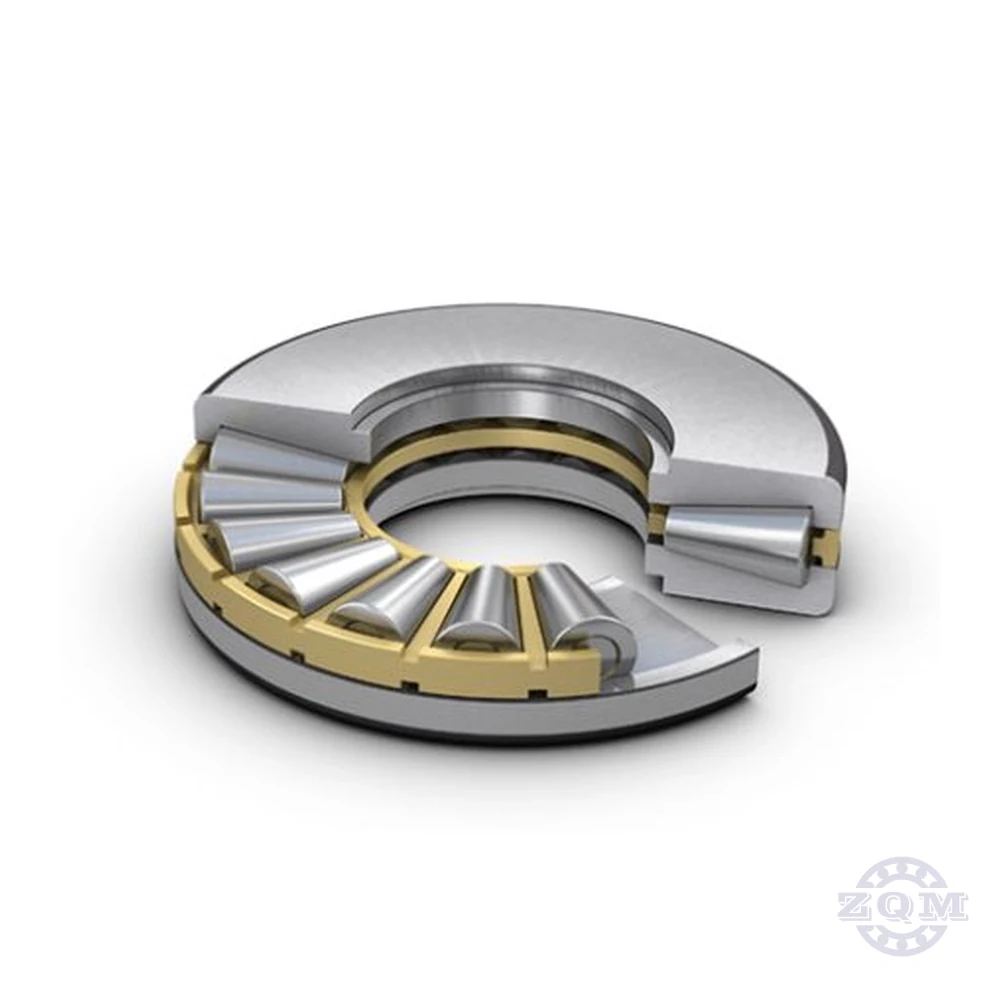
1. Envelope & Load Density: Why Bore Diameter Alone Misleads
Although 29326E and 29426EM both fit a 130 mm shaft journal, their outer diameter differs by 45 mm (225 mm vs. 270 mm) and overall height H differs by 27 mm (58 mm vs. 85 mm). At 200 mm bore, moving from 29340 to 29440 nearly triples component mass from 28.5 kg to 83.5 kg. Upgrading from 293 to 294 during an overhaul is only feasible if the housing pocket, shaft shoulder da, and axial shaft-stack clearances accommodate the larger cross-section.
| Designation | Series | Dimensions d × D × H (mm) | Load Ratings* Cr / Cor (kN) | Speed Grease / Oil (r/min) | Center Offset S (mm) | Abutment da min / Da max (mm) | Ref. Mass (kg) |
|---|---|---|---|---|---|---|---|
| 29326E (29326) | 293 Medium | 130 × 225 × 58 | 740 / 2,450 | 1,000 / 1,500 | 76 | 170 / 195 | 8.48 |
| 29426EM (29426) | 294 Heavy | 130 × 270 × 85 | 1,330 / 3,900 | 850 / 1,200 | 81 | 195 / 225 | 28.3 |
| 29330 | 293 Medium | 150 × 250 × 60 | 870 / 2,900 | 950 / 1,400 | 87 | 195 / 215 | 11.5 |
| 29430 | 294 Heavy | 150 × 300 × 90 | 1,580 / 4,900 | 800 / 1,100 | 92 | 220 / 250 | 27.9 |
| 29340 | 293 Medium | 200 × 340 × 85 | 1,570 / 5,450 | 700 / 950 | 116 | 265 / 295 | 28.5 |
| 29440 | 294 Heavy | 200 × 400 × 122 | 2,290 / 8,150 | 600 / 800 | 122 | 290 / 335 | 83.5 |
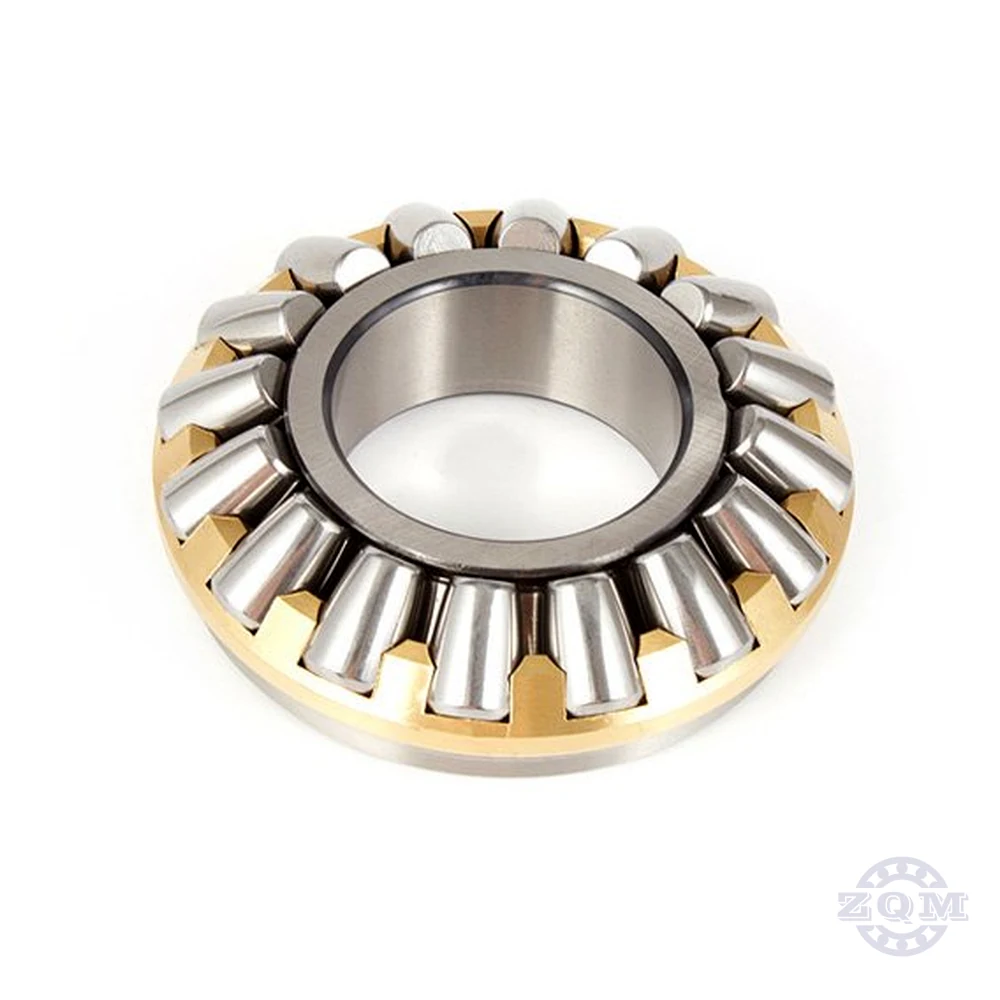
2. Self-Aligning Geometry, Load Center S, and Combined Radial Loads
In a spherical roller thrust bearing, asymmetrical barrel rollers run at a steep contact angle (around 50°) between a conical shaft washer raceway and a sphered housing washer raceway. The center of the spherical raceway lies on the shaft axis at offset distance S measured from the back face of the shaft washer (76 mm for 29326; 81 mm for 29426). Because the housing washer is sphered, the assembly accommodates moderate shaft deflection and housing angular misalignment without edge-loading the rollers—provided the radial guide bearing and housing allow the seat to articulate smoothly.
Unlike flat cylindrical roller thrust bearings (811/812 series), spherical roller thrust bearings can sustain simultaneous radial load alongside primary unilateral axial thrust—typically up to Fr ≤ 0.55 Fa under steady loading. However, they carry axial load in one direction only and are separable (shaft washer + roller/cage assembly separate from housing washer). They cannot substitute for a radial spherical roller bearing where radial forces dominate or axial loads reverse without an opposed paired thrust bearing.
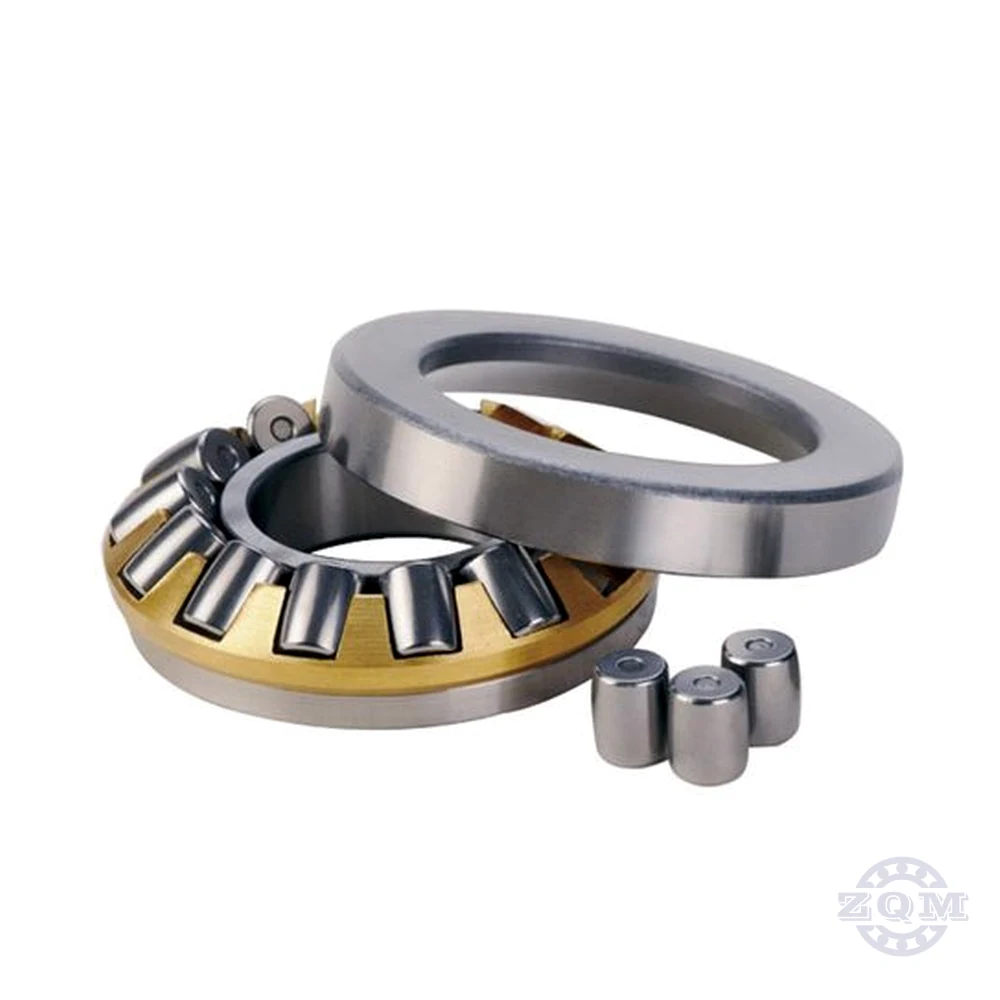
3. Minimum Axial Load (Fa min) and Skidding Prevention
Heavy asymmetrical rollers experience outward centrifugal force proportional to rotational speed squared. If applied axial load drops too low during no-load startup, coast-down, or light-duty operation, centrifugal force pulls the rollers away from proper rolling traction on the raceway, causing smearing and rapid surface distress between the roller large end and the shaft-washer guide flange.
- Vertical Shafts: Static rotor weight plus downward hydraulic/process thrust usually maintains minimum axial load continuously, but unloaded start/stop transients must still be checked against calculation.
- Horizontal or Variable-Load Shafts: When external thrust can drop near zero or reverse, apply spring-loaded preload on the idle housing washer or mount two thrust bearings against each other with controlled axial preload.
- Oversizing Risk: Selecting an oversized 294 bearing purely “for safety margin” on a lightly loaded high-speed shaft raises Fa min and friction torque unnecessarily—verify actual operating loads before jumping from 293 to 294.
4. Oil-Bath Circulation vs. Grease Lubrication & Cage Selection
Because sliding contact always occurs between the roller large end and the shaft-washer guide flange, thermal generation is higher than in radial roller bearings. Catalogue ratings clearly show this gap: oil limiting speeds are 33% to 50% higher than grease speeds (for example, 1,500 vs. 1,000 r/min on 29326 and 1,200 vs. 850 r/min on 29426). In vertical oil-bath housings, designers must also ensure adequate oil-sump submergence height and upper-flange venting channels so trapped air does not block oil circulation across the roller ends.
Cage design should match actual speed, shock load, and supplier specification. While E-series configurations frequently use a pressed steel cage or machined cage depending on size and factory execution, EM designations designate a heavy one-piece machined brass cage designed for higher vibration and severe thrust shocks. Always verify the exact stamped suffix and cage material on the factory confirmation drawing—cross-brand suffix letters must never be assumed identical without verification.
5. Procurement Verification Checklist Before Ordering
- Complete Designation & Suffix: Specify full markings (e.g., 29326E vs. 29426EM) plus any custom clearance or precision class required by the equipment drawing.
- Abutment & Shoulder Clearance: Confirm shaft shoulder diameter meets da min and housing bore/recess clears Da max (as well as radial clearance around the housing washer OD when self-alignment is active).
- Operating Loads & Speed Profile: Provide minimum/peak axial load Fa, radial component Fr, shaft orientation (vertical vs. horizontal), and operating speed in r/min.
- Lubrication & Quality Documents: Confirm oil viscosity / circulating flow or EP grease grade, quantity, delivery destination, and any batch dimensional/material inspection records agreed in the contract.
Need engineering verification on 293 or 294 series sizing, vertical sump lubrication compatibility, or exact suffix configuration? Send your part designation, operating load/speed profile, or housing drawing to our engineering team via the ZQM Bearings Contact Page.