

Searching by bore diameter alone—such as specifying a 300 mm shaft or 200 mm shaft—leaves engineers facing four or more ISO spherical roller bearing dimension series (239, 230, 240, 231, 232, 222, and 223). Each series trades outside diameter D, width B, roller size, radial/axial load rating (Cr / Cor), and limiting speed differently. Selecting the wrong cross-section either over-stresses rollers in heavy crusher drives or wastes radial housing space in compact gearboxes.
1. How ISO Spherical Roller Dimension Series Balance Bore, OD, and Width
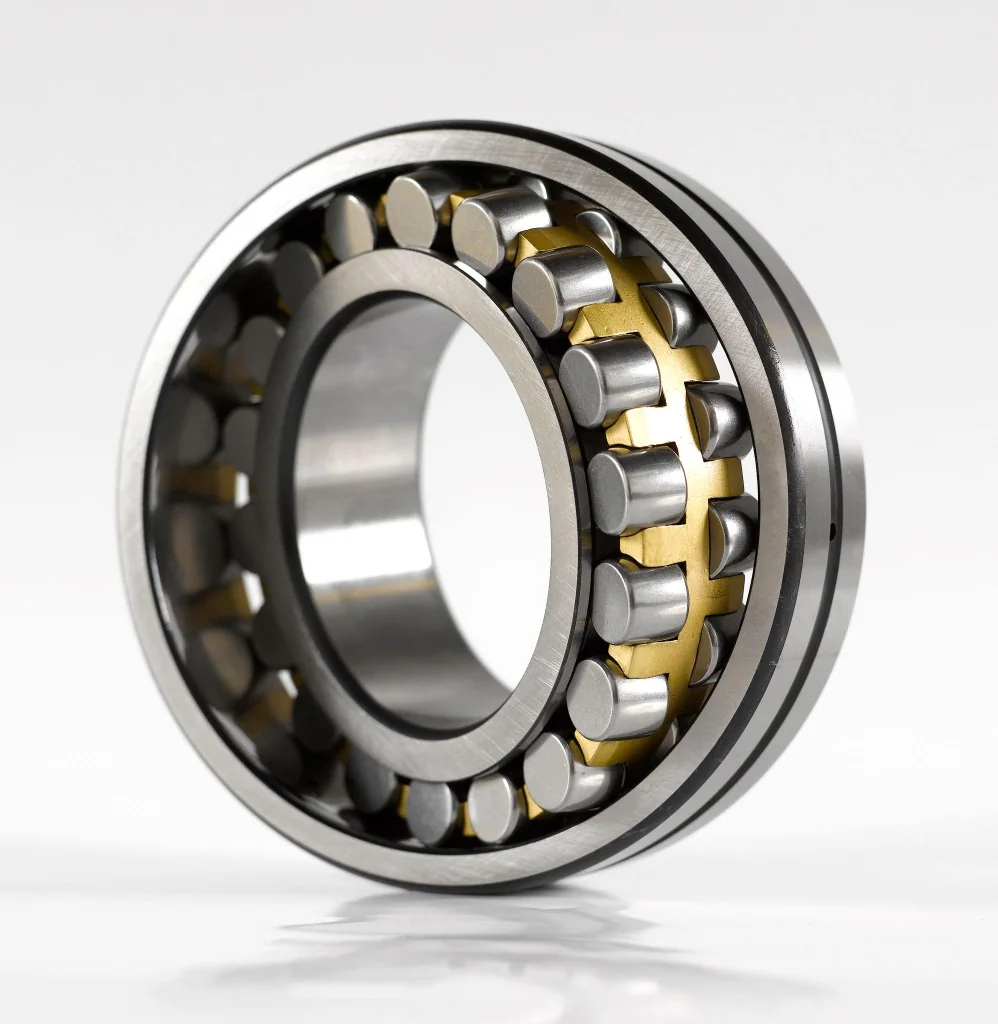
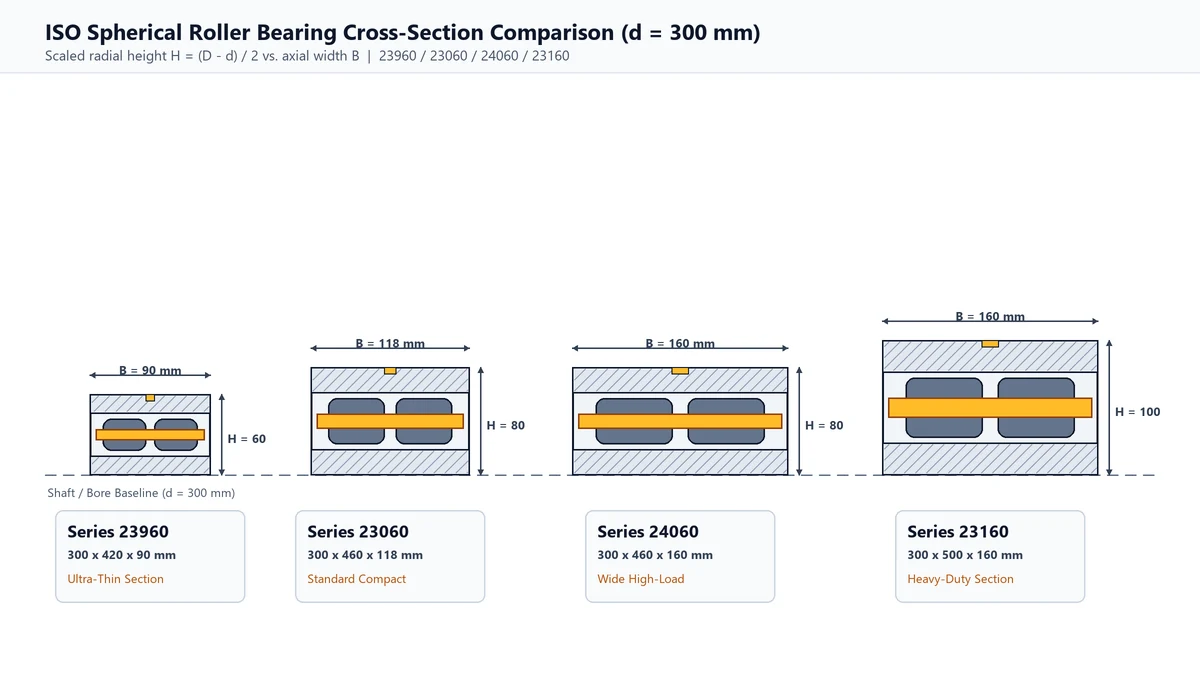
Under ISO 15 boundary conventions, the first two digits after the type prefix 2 define the width and diameter envelope progression around the same bore d. Across ZQM Bearings’ Wafangdian production range, buyers most often cross-shop compact 239/230/240 drives against heavier 231/232/222/223 industrial layouts:
- 239 Series (Ultra-Thin Section): Lowest radial height and mass (e.g., 23960CA/W33 at 38.2 kg) with the highest speed ceiling (710 grease / 900 oil r/min), suited to light-to-moderate radial loads and hollow spindles.
- 230 Series (Standard Wide Compact): Balanced cross-section (23060CA/W33 at 70.5 kg) for conveyor pulleys, fans, and medium paper-mill rolls.
- 222 Series (Medium General Purpose): Higher dynamic capacity per mm bore than 230 when larger housing OD is acceptable (e.g., 22256CA/W33 brass cage vs. 22256CC/W33 steel cage).
- 240 Series (Same OD as 230, Wider B): Shares 230’s outside diameter (460 mm at 300 bore) while increasing width from 118 to 160 mm (24060CA/W33), raising static rating Cor from 3,700 to 4,600 kN when housing OD cannot grow.
- 231 & 232 Series (Larger OD + Wide Body): Steps up housing diameter to 500 mm on 23160CA/W33 (Cor 4,800 kN) and steepens load capacity for crushers and rolling gearboxes.
- 223 Series (Extra-Heavy Shock Duty): Largest section height and roller diameter per bore (e.g., 22340CA/W33, 200×420×138 mm, Cr 2,000 kN) for vibrating screens and jaw crushers.
2. Verified ZQM Catalog Benchmark at Three Real Shaft Bores (300 mm, 280 mm, 200 mm)
Every value below is taken directly from ZQM Bearings’ catalog database and published product pages—showing exact trade-offs buyers face when choosing between adjacent series on the same shaft size:
| Bore Group | ZQM Product / Model | Series | Dimensions d×D×B (mm) | Ratings* Cr / Cor (kN) | Calc. Factor e / Y1 / Y2 | Ref. Speed* Grease / Oil (r/min) | Ref. Mass (kg) |
|---|---|---|---|---|---|---|---|
| 300 mm | 23960CA/W33 | 239 | 300 × 420 × 90 | 1,230 / 2,490 | 0.19 / 3.5 / 5.2 | 710 / 900 | 38.2 |
| 300 mm | 23060CA/W33 | 230 | 300 × 460 × 118 | 1,920 / 3,700 | 0.24 / 2.8 / 4.2 | 670 / 850 | 70.5 |
| 300 mm | 24060CA/W33 | 240 | 300 × 460 × 160 | 2,310 / 4,600 | 0.32 / 2.1 / 3.1 | 530 / 710 | 93.6 |
| 300 mm | 23160CA/W33 | 231 | 300 × 500 × 160 | 2,670 / 4,800 | 0.31 / 2.2 / 3.3 | 500 / 670 | 125 |
| 280 mm | 24056CA/W33 | 240 | 280 × 420 × 140 | 1,880 / 3,800 | 0.31 / 2.2 / 3.3 | 600 / 800 | 66.4 |
| 280 mm | 24156CA/W33 | 241 | 280 × 460 × 180 | 2,640 / 5,000 | 0.37 / 1.8 / 2.7 | 560 / 750 | 115 |
| 280 mm | 22256CA/W33 | 222 | 280 × 500 × 130 | 2,280 / 3,650 | 0.25 / 2.7 / 4.0 | 630 / 800 | 110 |
| 200 mm | 24140CA/W33 | 241 | 200 × 340 × 140 | 1,570 / 2,670 | 0.39 / 1.8 / 2.6 | 800 / 1,000 | 51.3 |
| 200 mm | 23240CA/W33 | 232 | 200 × 360 × 128 | 1,660 / 2,750 | 0.34 / 2.0 / 2.9 | 750 / 1,000 | 57.1 |
| 200 mm | 22340CA/W33 | 223 | 200 × 420 × 138 | 2,000 / 2,990 | 0.34 / 2.0 / 2.9 | 850 / 1,000 | 92.6 |
3. Why Cage Execution & Taper Geometry Must Be Checked Alongside Series
Three engineering traps frequently surface when buyers review ZQM’s Wafangdian catalog quotations:
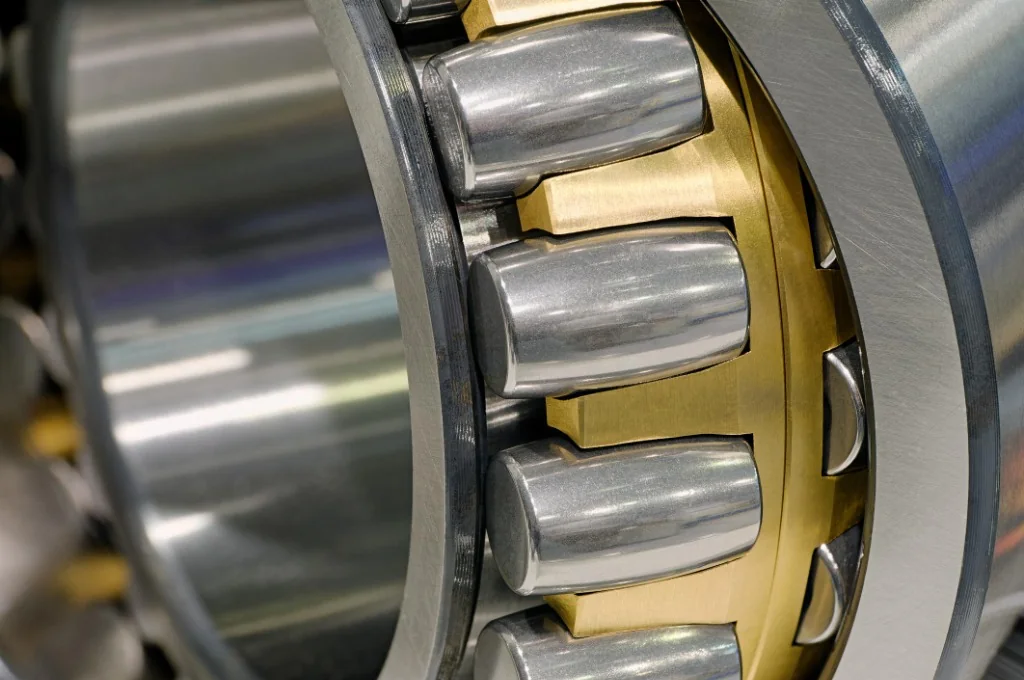
- Brass (CA) vs. Pressed Steel (CC) Availability: At 280 mm bore, ZQM supplies both 22256CA/W33 (one-piece machined brass cage) and 22256CC/W33 (stamped window steel cage). Under high vibration or boundary lubrication, solid brass guides roller skew differently than stamped steel—confirm cage suffix before ordering replacements.
- 1:12 (K) vs. 1:30 (K30) Taper Split: If switching from a
23060K(1:12 taper) to a higher-capacity24060on a tapered shaft or adapter sleeve, check the taper code carefully—240and241tapered-bore designs are1:30 (K30), incompatible with a 1:12 shaft seat. - Axial Load Capacity (e and Y1/Y2): Wider series such as
24060(e = 0.32) carry steeper contact angles than23960(e = 0.19), making them stronger against combined axial thrust as well as radial loads—critical in helical gearboxes.
4. ZQM Wafangdian QC, Series Catalogs & Quotation Workflow
Supported by our Wafangdian ISO 9001 / ISO 14001 manufacturing base and Ningbo export engineering desk, ZQM Bearings confirms bore/OD tolerances, radial clearance (C0, C3, C4), W33 oil groove geometry, and contracted dimensional, hardness, or ultrasonic checks against each purchase order before release. Confirm these four points before requesting a quotation:
- Full Designation & Suffixes: State exact series, brass or steel cage suffix (
CA / MBvs.CC), bore type (K1:12 vs.K301:30 vs. cylindrical), precision class (P0 / P6), and clearance (C0 / C3 / C4). - Shaft, Housing & Abutment Geometry: Share shaft journal and housing bore tolerances plus shoulder fillet radii (da / Da / ra) so series changes never interfere with existing pedestals or sleeves.
- Duty Cycle & Lubrication Method: Note operating speed (r/min), peak shock/radial/axial loads, temperature delta, and grease vs. circulating oil feed for
W33relubrication. - Quantity, Delivery & Inspection Scope: Confirm batch volume, target port/schedule, and contracted inspection documentation.
Need Cross-Series Verification for a 239 / 230 / 240 / 231 / 232 Replacement?
Send your shaft diameter, housing bore, axial envelope, and operating load/speed to ZQM Bearings engineering for a factory-verified dimension and clearance recommendation.