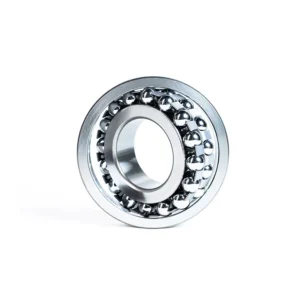

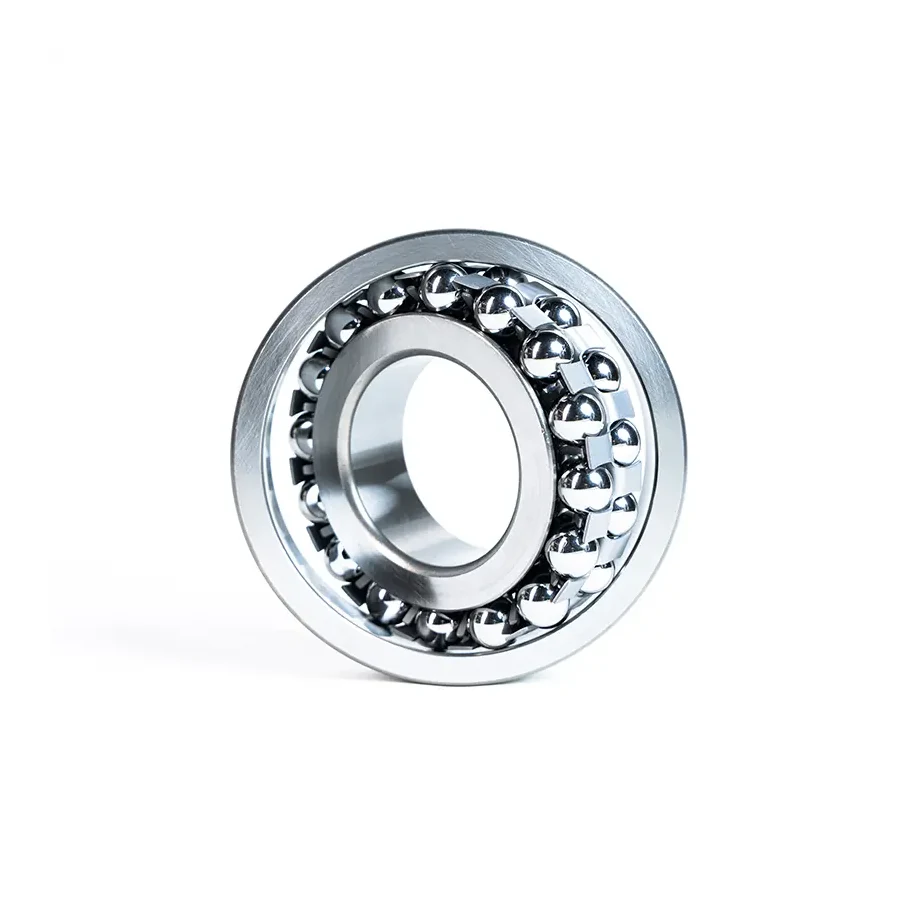
The 1210 self-aligning ball bearing (50 × 90 × 20 mm, ISO 15 Series 02) accommodates structural twisting across tall bucket-elevator towers and long grain transfer augers where outdoor temperature swings warp bolted steel housings. Note its verified 20 mm nominal width—slimmer than the wide 2210 variant—paired with either a 50 mm cylindrical bore or a 1210K 1:12 tapered bore designed for 45 mm plain shafting via an H210 adapter sleeve.
| ISO 15 Attribute | Code | 1210 Specification | Engineering Notes |
|---|---|---|---|
| Inner Bore | d | 50 mm | Straight cylindrical journal fit |
| Outer Diameter | D | 90 mm | ISO 15 Dimension Series 02 |
| Nominal Ring Width | B | 20 mm | Verified 20 mm (distinct from 2210 = 23 mm) |
| Tapered Execution | 1210K | 1:12 Tapered Bore | Mounts on 45 mm shaft with H210 sleeve |
| Alignment Envelope | Sphered Outer Track | ~2.5° Static / Dynamic | Double-row ball (point contact, p = 3) |
| Ratings, Weight & Cage | Cr / C0r / Mass | Confirmed on Factory Print | Issued per chosen cage & clearance at quote |
1210 Angular Forgiveness on Grain Leg Head Shafts
Bucket elevators standing 25 to 40 meters above country grain silos experience sun-heated south casings and shaded north plates every harvest afternoon. That differential thermal expansion bows the head-section sheet steel, skewing the two pillow-block mounting pads out of coplanarity. A rigid ball bearing locks up rapidly under such geometric twist, driving casing temperatures upward inside combustible grain-dust zones.
Inside the 1210, two rows of rolling balls articulate smoothly inside a ground spherical outer track, compensating for roughly 2.5 degrees of angular misalignment without inducing binding torque. Because sliding friction stays minimal, running temperature stays noticeably cooler than comparable roller alternatives during uninterrupted autumn harvest runs. Depending on silo ambient heat and lubrication regime, buyers specify stamped steel retainers, machined brass cages, or polyamide cages (respecting polyamide’s ~120 °C limit), with final load ratings and tolerance class documented on our pre-production drawing.
1210 International Equivalent Designations & Width Verification
When sourcing replacement bearings during a tight harvest turnaround, verify the 20 mm width carefully so a 23 mm wide 2210 is not ordered by mistake into a shallow housing recess:
| Manufacturer / Standard | Cylindrical Bore | 1:12 Tapered Bore | Verification Note |
|---|---|---|---|
| ZQM Bearings | 1210 | 1210K | 20 mm width; cage & clearance per order print |
| SKF | 1210 ETN9 | 1210 EKTN9 | E-design ball set with polyamide TN9 cage |
| FAG / Schaeffler | 1210-TVH | 1210-K-TVH | TVH polymer retainer; confirm steel option if needed |
| NSK | 1210 | 1210K | Check suffix for pressed steel vs polymer cage |
| NTN / KOYO | 1210 | 1210K | Confirm C3 clearance when specified for dust zones |
Interchange Boundary: Cross-listed codes match ISO 15 envelope dimensions (50 × 90 × 20 mm) exclusively. Because internal geometry, cage polymer chemistry, and clearance grades differ between producers, treat this chart as a dimensional starting point rather than automatic functional equivalence.
Agricultural Auger Sealing, Dust Exclusion & Sleeve Installation
Grain dust, chaff, and fertilizer fines are highly abrasive yet easily ignite if a starved bearing overheats. On horizontal intake augers and vertical elevator head pulleys within bulk handling operations, engineers favor split plummer blocks equipped with double-lip or V-ring auxiliary seals purged regularly with clean EP2 lithium grease. Purging creates a fresh grease collar that blocks husks from reaching the open 1210 raceways.
Where elevator shafts are fabricated from unstepped 45 mm bar stock, mounting a 1210K on an H210 sleeve eliminates precision shoulder grinding. Remember that self-aligning ball bearings excel at forgiving misalignment under moderate radial belt or bucket weight; if a heavy commercial terminal elevator carries extreme head-pulley tension or jarring shock loads, evaluate upgrading the housing to accept a 22210 spherical roller unit instead.
Ordering 1210 Bearings for Agribusiness OEMs & Silo Maintenance
To receive a rapid, accurate quotation ahead of planting or harvest season, share your required bore configuration (50 mm straight 1210 or 1210K with H210 sleeve), housing width confirmation (20 mm vs 23 mm), preferred steel or polyamide cage, clearance code (CN or C3), and target delivery schedule. We validate all engineering details on a formal factory drawing before shipment.
Inquire About 1210 Stock & Engineering Specs
1210 Technical Questions for Grain Handling Equipment
Related Selection & Comparison: Compare heavier 50 mm blower & shaft options via 1310 (110 × 27 mm) and extra-wide 2310 (110 × 40 mm), or explore all Self-Aligning Ball Bearings.
Is the width of a 1210 bearing 20 mm or 23 mm?
Per ISO 15 Dimension Series 02, the standard 1210 width is strictly 20 mm. The 23 mm width belongs to the wider Series 22 bearing (2210), which will not fit inside narrow housings machined specifically for a 1210.
Why does low operating temperature matter so much on grain elevator bearings?
Airborne grain dust poses an explosion hazard when contacting hot housing surfaces. Because the 1210 uses low-friction double-row balls that absorb casing warp without binding, it runs cooler than misaligned rigid bearings when properly lubricated.
What shaft diameter pairs with the 1210K tapered bore and H210 adapter sleeve?
Combining a 1210K (1:12 taper) with a metric H210 adapter sleeve mounts the 50 mm nominal bearing cleanly onto a 45 mm diameter plain shaft.
Should I choose CN or C3 clearance for an outdoor agricultural conveyor?
Standard CN works well on light, low-speed augers with loose housing fits, while C3 is frequently requested when adapter-sleeve drive-up or afternoon sun heating narrows internal radial clearance—confirm the exact fit on your assembly drawing.