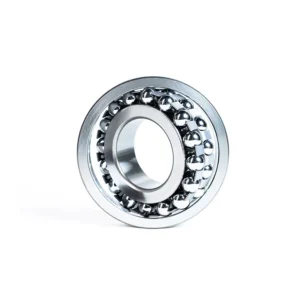

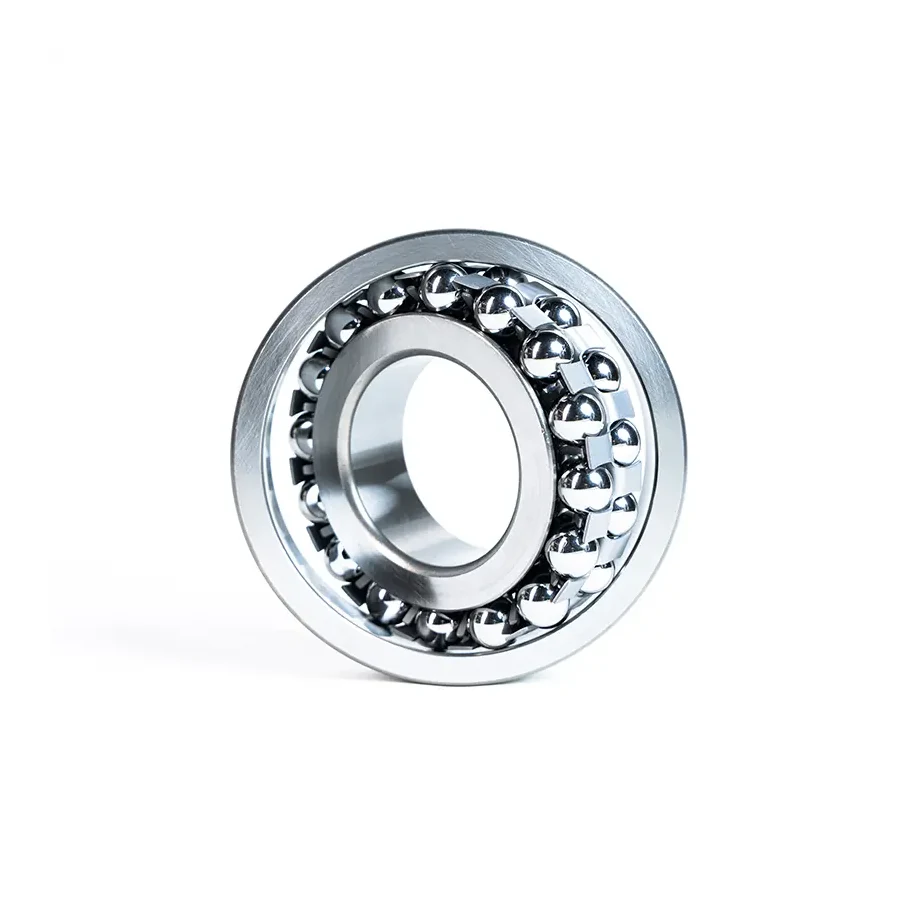
The 1212 self-aligning ball bearing (60 × 110 × 22 mm, ISO 15 Dimension Series 02) supports long multi-pedestal transmission shafts running across spinning frames, carding lines, and rapier weaving halls. Because factory concrete slabs settle unevenly over decades, several bearing stands along a single 60 mm drive line rarely sit in geometric perfection; the 1212 absorbs those angular errors smoothly while keeping parasitic drag low during 24-hour textile shifts.
| Boundary Parameter | Symbol | 1212 Value | Standard / Technical Note |
|---|---|---|---|
| Bore Diameter | d | 60 mm | ISO 15 Cylindrical Bore |
| Outside Diameter | D | 110 mm | ISO 15 Series 02 Nominal |
| Width | B | 22 mm | Slim 12-Series Axial Profile |
| Tapered Variant | 1212K | 1:12 Tapered Bore | Fits 55 mm plain shaft via H212 sleeve |
| Internal Contact | Double-Row Ball | Sphered Outer Ring | Low-drag point contact (p = 3) |
| Load & Speed Ratings | Cr / C0r / rpm | Factory Drawing Verified | Issued per cage & clearance grade at quote |
1212 Low-Heat Kinematics for Continuous Textile Mill Shifts
Powering dozens of spindles or loom take-up beams from a common 60 mm line shaft demands minimal friction losses. Every extra watt dissipated inside a binding bearing warms up the pedestal, degrades grease oil bleed, and increases electricity cost across a mill operating 8,000+ hours annually. With two rows of hardened steel balls rolling inside a spherical outer track, the 1212 pivots effortlessly to reconcile up to ~2.5° of pedestal slope.
Compared against tapered or spherical roller units of identical 60 mm bore, the 1212 generates far less churning heat at brisk line-shaft velocities—provided shock loading remains light and purely radial-dominant. Glass-fiber reinforced polyamide retainers perform quietly in climate-controlled weaving sheds (staying well under polyamide’s ~120 °C continuous ceiling), whereas stamped steel cages serve hot sizing or dyeing ranges. Exact dynamic and static capacities, speed limits, and retainer materials are formalized on the ZQM factory print prior to order confirmation.
1212 Cross-Reference & Mill Spares Standardization
Textile maintenance storerooms stocking European looms alongside Asian ring-spinning frames commonly consolidate 60 × 110 × 22 mm spares around these ISO 15 base identifiers:
| Brand / Code System | Straight Bore | 1:12 Tapered Bore | Engineering Verification |
|---|---|---|---|
| ZQM Bearings | 1212 | 1212K | Cage, clearance & tolerance confirmed per drawing |
| SKF | 1212 ETN9 | 1212 EKTN9 | Polyamide TN9 retainer; E-series ball complement |
| FAG / Schaeffler | 1212-TVH | 1212-K-TVH | TVH polymer cage; confirm steel option for dryers |
| NSK / NTN | 1212 | 1212K | Match retainer and C3 suffix to machine manual |
| Legacy GB Code | 1212 | 11212 | Classic Chinese engineering blueprint code |
Standardization Caveat: Identical ISO 15 boundary sizes (60 × 110 × 22 mm) confirm housing-envelope compatibility only—never assume interchangeable load ratings, internal ball count, or high-temperature cage limits without reviewing original machine drawings.
Multi-Pedestal Line-Shaft Alignment & Lint Protection
In spinning and weaving halls across modern industrial manufacturing plants, airborne cotton lint and synthetic fibers wrap around exposed shafts and wick base oil out of unshielded housings. Installing open 1212 bearings inside clean SNL 512 split pedestals fitted with non-contact labyrinth flingers keeps fibers away from the grease reservoir without adding lip-seal friction heat.
When spanning long unmachined 55 mm line shafts, technicians mount 1212K bearings onto H212 adapter sleeves so intermediate stands can be positioned anywhere along the bar. Design only one pedestal as the axially fixed locating stand; leave every remaining stand free to float axially so seasonal mill temperature changes never bind the shaft thermally.
Sourcing 1212 & 1212K Spares for Textile Plants
When preparing annual maintenance contracts or OEM loom builds, specify bore style (60 mm cylindrical 1212 vs 1212K with H212 sleeve), retainer material (steel or polyamide), radial clearance (CN or C3), grease compatibility, and batch volume. Our technical office verifies every specification on a signed drawing before dispatching your shipment.
Submit Your 1212 Mill Specification & Inquiry
1212 Frequently Asked Questions for Line-Shaft Maintenance
Related Selection & Comparison: For wider 28 mm radial support on a 60 mm line-shaft (including optional -2RS seals), compare 2212, decode K/TN9/2RS suffixes in our Bearing Suffix Decoder, or browse Self-Aligning Ball Bearings.
How many pedestals on a 1212 line shaft should be axially located?
Always locate exactly one bearing axially using housing locating rings, and leave all other 1212 pedestals on the same shaft axially free so thermal elongation does not generate destructive parasitic thrust.
What shaft size works with a 1212K tapered bearing and H212 adapter sleeve?
The 1212K carries a 1:12 tapered bore that locks onto a 55 mm plain commercial shaft when installed with a metric H212 adapter sleeve.
Why not substitute a 22212 spherical roller bearing on a high-speed spinning shaft?
A 22212 handles far heavier shock loads, yet its roller-to-raceway contact produces higher churning friction and requires stricter minimum radial loading. On lightly loaded, fast-spinning textile shafts, the 1212 runs cooler and wastes less power.
Does ZQM supply matched grease-compatible C3 clearance versions of 1212?
Yes. Both CN and C3 radial clearance classes—along with stamped steel or polyamide retainers—are confirmed on our pre-order engineering drawing to fit your mill operating temperature and shaft interference.