
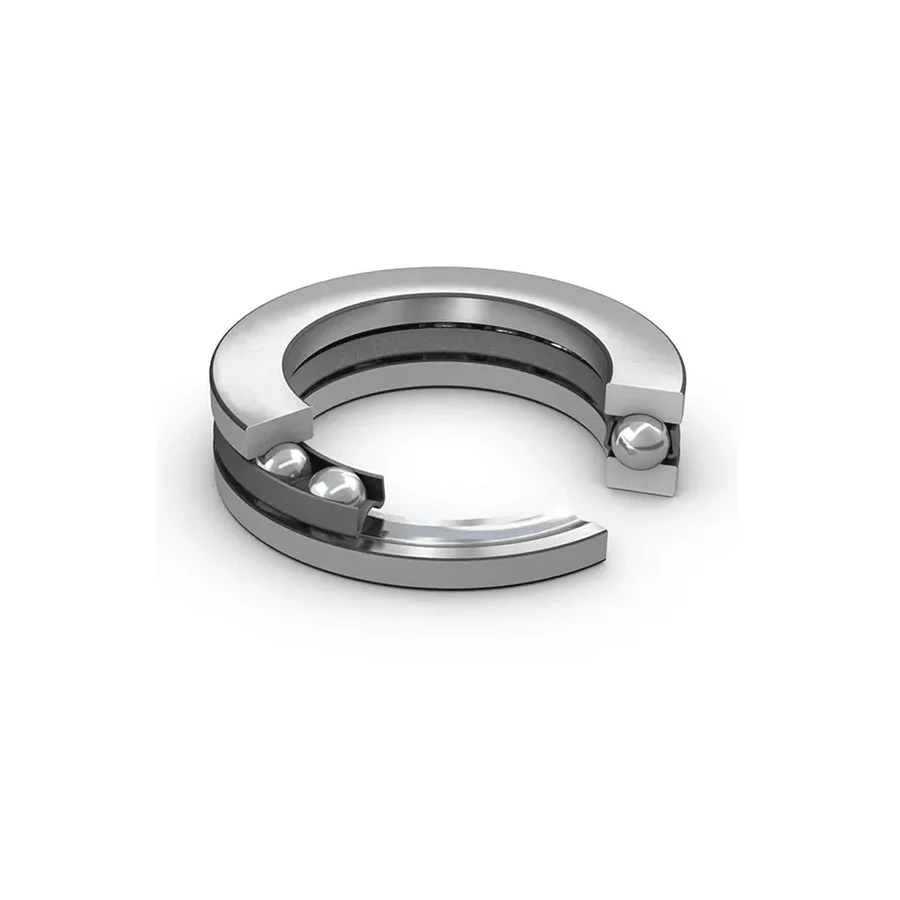
The 51220 thrust ball bearing (100 × 150 × 38 mm, ISO 104 Dimension Series 12) gives 100 mm vertical slurry tank agitators, mineral leaching thickeners, and wastewater flocculation mixers a massive 38 mm total height (H) and 150 mm outer seat—far sturdier than extra-light 51120 (135 × 25 mm). Mounted inside the top drive pedestal, it shoulders continuous downward impeller weight plus axial pumping thrust (Fr = 0) across 24/7 hydrometallurgical and chemical shifts.
| ISO 104 Attribute | Symbol | 51220 Value | Vertical Agitator Notes |
|---|---|---|---|
| Shaft Washer Bore | d | 100 mm | Fits 100 mm vertical agitator shaft |
| Housing Washer OD | D | 150 mm | Broad 25 mm radial section width |
| Total Assembled Height | H | 38 mm | Heavy Series 12 ball & washer stack |
| Loading Constraint | Pure Downward Axial | Fr = 0 Unidirectional | No radial impeller whip; zero tilt |
| Separable Assembly | 3-Piece Flat Seat | Housing Bore D1 > 100 mm | Never reverse shaft & housing rings |
| Axial Ratings & Cage | Ca / C0a / Cage | Factory Drawing Verified | Steel or brass cage & Ca/C0a at quote |
51220 Downward Hydraulic Thrust & Minimum Preload Stability
Top-entering vertical mixers spanning 6-meter slurry tanks suspend hundreds of kilograms of shafting and pitched hydrofoil blades from a single overhead bearing lantern. Depending on impeller pitch direction, fluid pumping action adds steady downward axial force onto the dead shaft weight. Inside the 100 × 150 × 38 mm Series 12 profile, the 51220 houses deep ball raceways built to sustain uninterrupted slow-speed axial thrust with low friction heat.
Agitator designers must watch two subtle failure modes carefully: first, if upward-pumping impellers partially buoy the shaft weight during high-viscosity batches, net axial load on the 51220 can dip below the minimum axial load needed to hold the balls in pure rolling contact—triggering centrifugal ball skidding and raceway smearing. Always verify downward thrust stays positive (or apply spring preload). Second, long cantilevered agitator blades create ferocious radial bending whip when passing liquid surface levels; independent upper and lower radial bearings MUST isolate 100% of that bending load so the flat-seat 51220 encounters strictly Fr = 0 and zero misalignment. Unsuitable for high-speed spindles; confirmed Ca/C0a capacities and steel vs machined brass cages are verified on the factory drawing at quote.
51220 Cross-Reference & Process-Plant Spares Table
Chemical plants, alumina refineries, and mining concentrators maintaining 100 mm top-entry agitators regularly cross-check these ISO 104 codes (legacy Chinese blueprint code 8220):
| Brand / Standard | ISO 104 Designation | Process Agitator Verification Notes |
|---|---|---|
| ZQM Bearings | 51220 | Drawing confirms Ca/C0a, D1 bore & retainer alloy |
| SKF | 51220 | Flat-seat Series 12; verify pressed steel vs M brass cage |
| FAG / Schaeffler | 51220 | Confirm minimum axial load check under light batch fill |
| NSK / NTN / KOYO | 51220 | Verify oil-bath vs grease-lubricated lantern spec |
| Legacy GB Code | 8220 | Older Chinese mineral-processing mixer drawings |
Dimensional Disclaimer: Matching ISO 104 designations confirms 100 × 150 × 38 mm exterior envelope equivalence only. Retainer strength, raceway finish, and dynamic/static axial capacities Ca/C0a differ across makers and require verification against agitator gearbox blueprints before substitution.
Lantern Sealing, Washer Orientation & Bidirectional Impeller Cases
Above steaming lime-slurry tanks and mining and chemical processing vessels, rising vapor corrodes thrust pedestals unless double-lip shaft seals and breather desiccants isolate the lantern housing. Because the 51220 separates cleanly into three components, overhaul crews can inspect ball grooves thoroughly during scheduled tank turnarounds.
Verify washer bores meticulously during rebuilds: seat the close-fitting 100 mm shaft washer onto the rotating agitator hub, and drop the oversized-bore housing washer (D1 > 100 mm) squarely onto the flat stationary pedestal step so the vertical shaft never rubs the stationary ring. If your mixer reverses rotation or generates net upward hydraulic lift that exceeds shaft weight, never rely on a single 51220—specify a double-direction thrust ball bearing (522/523/524) or a QJ four-point contact ball bearing instead.
Specifying 51220 for Agitator OEMs & Concentrator Maintenance
Provide your shaft rpm, net downward axial thrust range (minimum and peak), lubrication mode (oil bath vs grease), preferred cage material (pressed steel or solid machined brass), and quantity. Our engineering office delivers the verified factory drawing—including housing clearance bore D1 and Ca/C0a ratings—ahead of production.
Request 51220 Agitator Drawing & Quote
51220 Technical FAQ for Slurry Tank Agitators & Mixers
Related Selection & Comparison: If your 100 mm vertical agitator shaft carries simultaneous radial load or deflection, upgrade to the self-aligning 29320 thrust roller bearing; for compact valve stems compare 51120.
Why is minimum axial load critical on a 51220 vertical agitator bearing?
If upward fluid lift reduces net downward force too close to zero while the mixer spins, centrifugal force pushes balls out of pure rolling track, causing skidding, cage stress, and rapid raceway smearing.
Can a 51220 absorb radial whip from a long submerged slurry impeller?
No. A 51220 flat-seat thrust ball bearing provides zero radial load capacity (Fr = 0) and zero misalignment allowance. Rigidly spaced upper and lower radial bearings must carry all radial impeller forces.
What differentiates 51220 from 51120 on a 100 mm vertical shaft?
Both share a 100 mm bore, but Series 12 51220 increases OD from 135 mm to 150 mm and height H from 25 mm to 38 mm, giving dramatically higher continuous axial stamina for 24/7 tank mixers.
How do rebuild mechanics prevent reversing the 51220 shaft and housing washers?
Inspect both inside diameters: the shaft washer matches the 100 mm shaft journal tightly, whereas the housing washer has a noticeably wider bore (D1 > 100 mm) so it clears the spinning shaft completely.