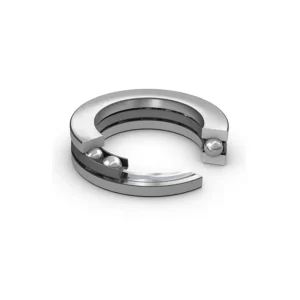

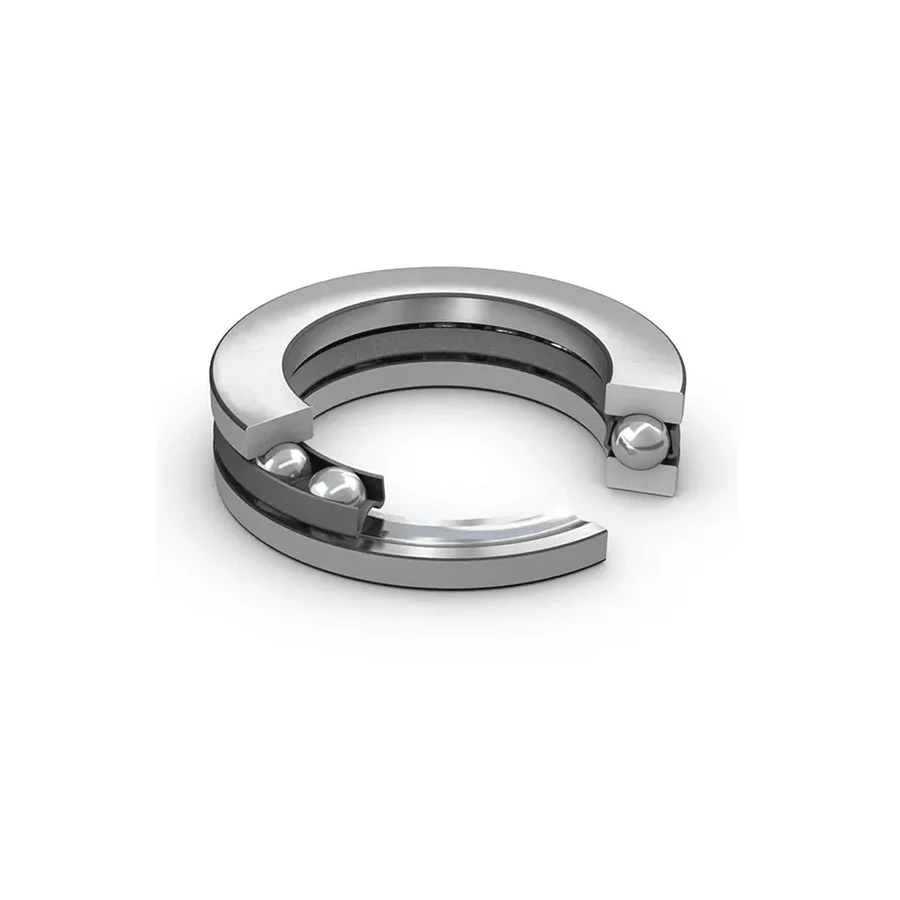
The 51120 thrust ball bearing (100 × 135 × 25 mm, ISO 104 Dimension Series 11) provides a generous 100 mm bore inside a slim 135 mm outer envelope and 25 mm total height (H) for large-diameter pipeline gate-valve actuators, sluice-gate yoke sleeves, and power-plant damper handwheel stems. Operating under slow, intermittent quarter-turn or rising-stem seating torque, it converts heavy unidirectional stem thrust (Fr = 0) into smooth, low-effort actuation.
| ISO 104 Attribute | Symbol | 51120 Value | Valve-Actuator Context |
|---|---|---|---|
| Shaft Washer Bore | d | 100 mm | Clears large threaded yoke nut / stem |
| Housing Washer OD | D | 135 mm | Extra-light Series 11 compact OD |
| Total Assembled Height | H | 25 mm | Fits compact valve yoke bonnets |
| Permissible Loading | Pure Axial Only | Fr = 0 Unidirectional | No radial support; zero angular tilt |
| Separable Structure | 3-Piece Flat Seat | Housing Bore D1 > 100 mm | Do not reverse shaft & housing washers |
| Static/Dynamic Axial Ratings | C0a / Ca / Cage | Factory Drawing Verified | Static seating C0a & cage confirmed at quote |
51120 Rising-Stem Seating Torque & Static Capacity Focus
When closing a DN400–DN800 high-pressure water, steam, or petrochemical gate valve, the bronze yoke nut generates tremendous downward or upward axial wedging force at nearly zero rotational speed. Without low-friction thrust support inside the bonnet yoke, manual operators cannot break the wedge free and electric multi-turn actuators trip on over-torque alarms. Because a 51120 encircles a 100 mm threaded stem sleeve within only a 17.5 mm radial wall, it keeps the entire valve topworks compact and economical.
Valve-yoke selection hinges primarily on static axial load safety (C0a) during final wedge seating rather than high-speed fatigue—in fact, single-direction thrust ball bearings are never built for high-speed spindles. Every valve designer must enforce strict mechanical boundaries: radial stem bending loads must be absorbed by bronze guide bushings so the 51120 sees strictly Fr = 0, and yoke housing faces must be faced flat and perpendicular because a flat-seat thrust bearing offers zero misalignment tolerance. For motorized valves whose closing and opening strokes reverse heavy axial thrust in both directions, pair two opposed 51120 bearings inside a double-pocket yoke (with proper preload) or evaluate a dedicated double-direction 522/523/524 thrust unit. Confirmed C0a/Ca figures, pressed steel vs brass cages, and corrosion-protection options are verified on the factory drawing at quotation.
51120 Cross-Reference & Valve Yoke Spares Standardization
Pipeline maintenance contractors and valve-actuator OEMs cross-reference ISO 104 Series 11 sizes against legacy Chinese blueprints carrying code 8120:
| Manufacturer / Standard | ISO 104 Base Code | Valve Service Notes |
|---|---|---|
| ZQM Bearings | 51120 | Factory print verifies C0a/Ca, D1 bore & cage |
| SKF | 51120 | Flat-seat Series 11; verify steel vs brass retainer |
| FAG / Schaeffler | 51120 | Check outdoor grease & protective packaging |
| NSK / NTN / KOYO | 51120 | Verify static seating factor against actuator torque |
| Legacy GB Code | 8120 | Classic Chinese industrial valve blueprint code |
Dimensional Notice: Listing these equivalent designations confirms identical ISO 104 boundary geometry (100 × 135 × 25 mm) only. Static axial capacity C0a, washer steel heat treatment, and cage execution vary across manufacturers and must be validated before replacing critical pipeline valve parts.
Outdoor Yoke Protection, Washer Fitment & Grease Retention
Pipeline valves standing along outdoor tank farms, hydroelectric intakes, and energy and heavy-process facilities sit idle for months before a sudden emergency shutoff. Water condensation inside the yoke cap rusts ball grooves rapidly unless the 51120 cavity is completely packed with rust-inhibited EP2 grease and protected by top-stem O-rings or weather boots.
During yoke assembly, check washer bore diameters carefully: slide the close-fitting 100 mm shaft washer onto the rotating yoke sleeve, and seat the larger-bore housing washer (D1 > 100 mm) inside the stationary bonnet pocket so the yoke sleeve never binds against the stationary washer. Even on slow motorized actuators, keep modest spring or nut preload on the bearing so unloaded balls do not rattle or skid during rapid travel strokes.
Ordering 51120 Bearings for Valve Manufacturers & Plant Overhauls
Share your valve stem seating load, actuation style (manual handwheel vs electric actuator), single vs paired opposed layout, preferred steel or machined brass cage, and order volume. Our engineers provide a formal factory drawing stating verified axial C0a/Ca ratings and housing bore D1 before manufacturing.
Request 51120 Valve-Actuator Drawing & Quote
51120 Technical FAQ for Pipeline Valves & Actuators
Related Selection & Comparison: Compare heavy-duty 100 mm axial options via 51220 (150 × 38 mm) or self-aligning roller thrust via 29320 (170 × 42 mm), and explore all Thrust Ball Bearings.
How do rising-stem gate valves handle thrust in both opening and closing directions with 51120?
A single 51120 takes axial thrust in one direction only. Rising-stem valve yokes either install two opposed 51120 bearings above and below the yoke-nut flange, or switch to a double-direction thrust ball bearing (522/523/524 series).
Why is static axial capacity (C0a) more critical than dynamic rating on valve stems?
Gate valves operate intermittently at very low speed yet hit peak seating force at standstill when wedging shut. Adequate C0a prevents permanent brinelling dents on the raceways that cause jerky handwheel torque.
What happens if the 51120 shaft washer and housing washer are swapped inside a valve bonnet?
The housing washer features an oversized bore (D1 > 100 mm) to clear the rotating sleeve. Installing it on the rotating sleeve causes severe eccentricity, while placing the tight 100 mm shaft washer against the stationary bonnet causes shaft rubbing and seizure.
Can a 51120 compensate for a bent gate-valve stem?
No. Flat-seat ISO 104 thrust ball bearings have zero radial load capability (Fr = 0) and zero misalignment tolerance; bent stems must be straightened and guided by separate radial bushings.