

Single-row metric tapered roller bearings across the 302, 322, and 323 dimension series share separable cup-and-cone geometry, yet mismatched width codes or improper axial adjustment remain two of the top causes of wrong replacement orders and premature gearbox overheating. Knowing how overall assembly width T interacts with ring widths B and C, paired spread (DB vs. DF), and thermal endplay growth protects both uptime and procurement accuracy.
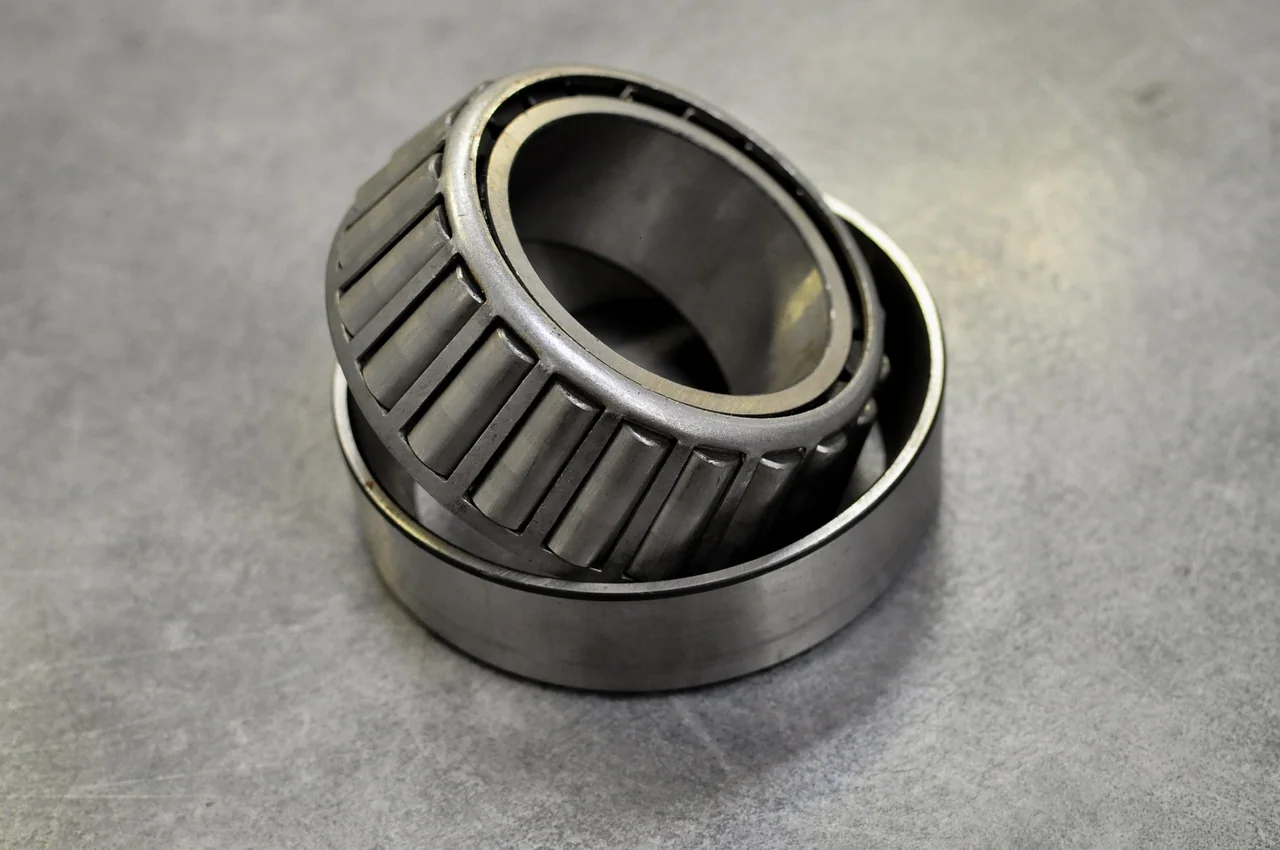
- Same Shaft & Housing Bore: Both fit 100 mm shaft and 180 mm housing bore, making caliper checks of d and D insufficient for identification.
- 12 mm Width Split at 100 mm Bore: 30220 measures T = 37 mm (B = 34, C = 29), whereas 32220 measures T = 49 mm (B = 46, C = 39).
- Load Gain in 322 Heavy Width: Longer rollers raise 32220 ratings to 325 / 450 kN vs. 255 / 330 kN on 30220 (+27.5% dynamic Cr).
- 120 mm Bore Equivalent: 30224 (T = 43.5 mm) vs. 32224 (T = 61.5 mm) — an 18 mm axial difference.
- Larger Housing Envelope: At 100 mm bore, 32320 jumps to 215 mm OD and T = 77.5 mm (12.7 kg vs. 3.78 kg on 30220).
- High Axial & Radial Density: 32324 reaches 770 kN dynamic (Cr) and 1,060 kN static (Cor) within 120 × 260 × 90.5 mm.
- Calculation Factor Note: Heavy-section 303/323 sizes show e = 0.35 and Y = 1.7 (vs. e = 0.42–0.44, Y = 1.4 on 302/322) across metric tapered series—confirm the actual Fa/Fr load ratio before selection (steep-angle thrust duties use 313-series designs).
- Paired Adjustment Required: Single-row TRBs leave the factory without preset axial clearance—clearance or preload is set on the shaft during assembly.
1. Understanding T vs. B vs. C in Separable Cup-and-Cone Bearings
Unlike single-piece radial ball or cylindrical bearings, a single-row tapered roller bearing consists of two separable sub-units: the cone assembly (inner ring, tapered rollers, and cage, width B) and the cup (outer ring, width C). Because the cup and cone overlap axially, T, B, and C represent different dimensions and must each be verified individually against the specific bearing catalogue data.
Three practical traps arise during maintenance and purchasing:
- Retainer & Cage Overhang: Because T exceeds both B and C, the cone large-rib face and cup back face define the installed axial stack—check shaft shoulder limits (da max / db min) and housing abutments (Da max / Db min) so spacers and seals do not foul the stamped cage.
- Same Bore & OD, Different Width (302 vs. 322): A 30224 (120 × 215 × 43.5 mm) and 32224 (120 × 215 × 61.5 mm) share identical shaft and housing diameters; ordering strictly by “120 × 215” risks an 18 mm width mismatch.
- Sub-Unit Mixing Risk: Although ISO 355 standardizes nominal envelope dimensions on metric tapered sizes, internal roller crowning, cage profile, and T stack tolerances vary between suppliers unless controlled. Avoid pairing an old cup with a new cone across different batches or brands without checking contact pattern and stand-out tolerance.
| Designation | Series | d × D × T (mm) | Cone B / Cup C (mm) | Load Center a (mm) | Factor e / Y / Y0 | Ratings* Cr / Cor (kN) | Ref. Mass (kg) |
|---|---|---|---|---|---|---|---|
| 30220 | 302 | 100 × 180 × 37 | 34 / 29 | 36.1 | 0.42 / 1.4 / 0.79 | 255 / 330 | 3.78 |
| 32220 | 322 | 100 × 180 × 49 | 46 / 39 | 41.5 | 0.42 / 1.4 / 0.79 | 325 / 450 | 5.05 |
| 32320 | 323 | 100 × 215 × 77.5 | 73 / 60 | 53.2 | 0.35 / 1.7 / 0.96 | 565 / 755 | 12.7 |
| 32024X | 320X | 120 × 180 × 38 | 38 / 29 | 39.7 | 0.46 / 1.3 / 0.72 | 242 / 405 | 3.27 |
| 30224 | 302 | 120 × 215 × 43.5 | 40 / 34 | 44.4 | 0.44 / 1.4 / 0.76 | 335 / 450 | 6.28 |
| 32224 | 322 | 120 × 215 × 61.5 | 58 / 50 | 52.0 | 0.44 / 1.4 / 0.76 | 440 / 635 | 9.00 |
| 30324 | 303 | 120 × 260 × 59.5 | 55 / 46 | 50.0 | 0.35 / 1.7 / 0.96 | 535 / 655 | 13.9 |
| 32324 | 323 | 120 × 260 × 90.5 | 86 / 69 | 62.4 | 0.35 / 1.7 / 0.96 | 770 / 1,060 | 21.8 |
2. Back-to-Back (DB / “O”) vs. Face-to-Face (DF / “X”) Arrangements
Because tapered rollers generate an induced axial thrust whenever radial load is applied, a single-row tapered roller bearing must always be opposed by a second bearing facing in the opposite axial direction. How those two bearings face each other directly alters effective bearing spread—governed by load-center distance a measured from the cone back face:
- Back-to-Back (DB / O-Arrangement): Pressure cones diverge outward toward the shaft centerline, placing effective load centers outside the bearing pair. Even closely spaced bearings gain a wide moment arm, making DB ideal for bevel pinion shafts, overhung pulleys, and high-rigidity spindle heads.
- Face-to-Face (DF / X-Arrangement): Pressure cones converge inward between the two bearings, reducing effective spread. DF tolerates slight housing-bore misalignment better and simplifies assembly when axial endplay is adjusted via outer-ring cover shims rather than an inner shaft locknut.
- Thermal Expansion Watchpoint: In a DB arrangement, if a steel shaft heats significantly warmer than a cooler cast housing, axial shaft growth tends to close clearance and increase preload unless sufficient cold endplay is specified. Conversely, DF pairs can loosen slightly under a hot-shaft gradient—evaluate steady-state temperature rise before locking preload specs.
3. Setting Axial Endplay vs. Preload on the Shop Floor
Unlike radial deep-groove or cylindrical bearings that carry built-in C0/C3 radial clearance at manufacture, single-row tapered roller bearings rely on technician adjustment after press-fitting the cones and seating the cups. Using a dial indicator on the shaft end while oscillating the shaft axially—always rotating the shaft at least several turns while lightly tapping or seating the rollers against the cone guide rib—prevents false readings from skewed rollers.
- Positive Axial Endplay: Standard for heavy industrial gearboxes and general-purpose conveyor shafts subject to normal thermal expansion gradients; preserves oil film thickness and avoids thermal runaway.
- Light Axial Preload: Used on precision helical/bevel pinion shafts and stiff gearboxes where zero deflection under reversing torque is critical; verify running temperature and oil-circulation cooling before specifying preload, as excessive tightening escalates drag torque and fatigue rapidly.
4. Buyer & Maintenance RFQ Verification Checklist
- Full Dimensions (d × D × T / B / C): Never rely on d × D alone—confirm whether your housing takes 320X, 302, 322, 303, or 323 widths, plus chamfer clearances r1,2 min and r3,4 min.
- Matched Pair vs. Single Row: Clarify whether you need single-row loose cups and cones, a factory-matched DB/DF pair with intermediate spacer, or matched tolerance class.
- Operating Conditions & Documentation: Share speed (r/min), oil viscosity or grease type, target radial/axial loads, quantity, destination port, and any agreed dimensional inspection records.
Sourcing 302, 322, or 323 metric tapered roller bearings or matching 322 series specifications for OEM production or gearbox maintenance? Share your bearing designations, dimensional stack, and order quantity with our engineering team on the ZQM Bearings Contact Page.