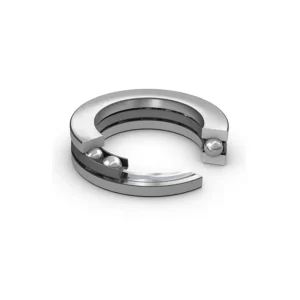
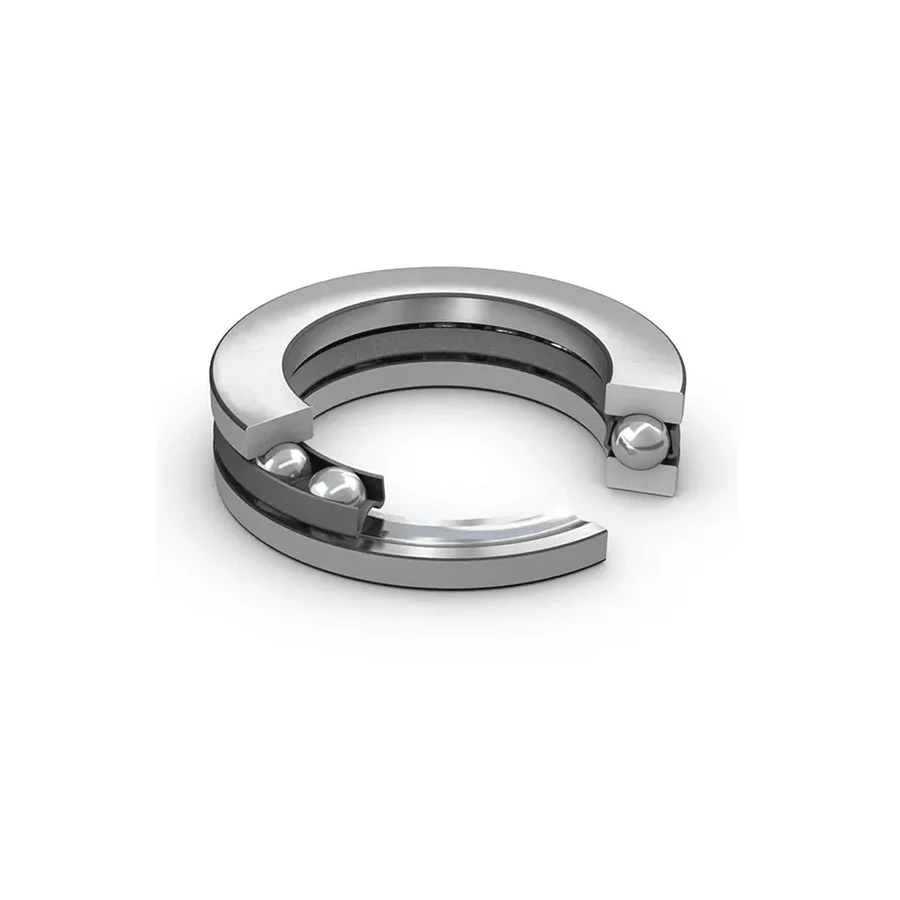
The 51312 thrust ball bearing (60 × 110 × 35 mm, ISO 104 Dimension Series 13) upgrades the 60 mm bore envelope into true steel-mill territory—expanding dramatically beyond light 51212 (60 × 95 × 26 mm) to a 110 mm outer seat and 35 mm total height (H). Engineered for steel-coil upender turntable pivots, C-hook swivels, and heavy ladle-crane hook trunnions, it absorbs abrupt unidirectional lifting and tipping shocks (Fr = 0) under punishing melt-shop duty.
| ISO 104 Specification | Symbol | 51312 Nominal | Series 13 Melt-Shop Notes |
|---|---|---|---|
| Shaft Washer Bore | d | 60 mm | Matches 60 mm heavy forged trunnion |
| Housing Washer OD | D | 110 mm | 15 mm larger OD than light 51212 |
| Total Height | H | 35 mm | 9 mm taller heavy-ball section vs 51212 |
| Permissible Loading | Pure Axial Only | Fr = 0 Unidirectional | No radial force; zero tilt tolerance |
| Separable 3-Piece Design | Flat Seat | Housing Bore D1 > 60 mm | Never swap shaft & housing washers |
| Axial Ratings & Cage | Ca / C0a / Cage | Factory Drawing Verified | Solid brass vs steel cage & C0a at quote |
51312 Heavy Series 13 Shock Stamina vs 51212 in Steelworks
When a 25-ton hot-rolled steel coil settles onto a C-hook swivel or a molten-metal ladle crane brakes abruptly during pouring, instantaneous vertical deceleration multiplies static axial load sharply. Light Series 12 bearings (51212) can suffer raceway brinelling under repeated crane-brake impacts, leaving notch marks that lock up hook rotation. Upgrading to Series 13 51312 boosts section height to 35 mm and widens the radial footprint to 25 mm per side, accommodating substantially larger balls and deeper grooved washers engineered for severe shock stamina.
Even with Series 13 ruggedness, fundamental ISO 104 flat-seat rules apply without exception: side-load bending moments during coil tilting must be isolated onto dedicated radial bronze bushings or cylindrical roller bearings so the 51312 bears strictly Fr = 0, and the trunnion thrust shoulder must be precision-machined flat because flat-seat washers have zero misalignment tolerance. High-temperature melt-shop radiant heat favors solid machined brass (M/MP) or heavy pressed steel cages confirmed on our factory engineering print alongside verified axial ratings (Ca / C0a). Never misapply 51312 to high-speed rotary spindles, and maintain sufficient seating preload so balls never skid when empty hooks rotate.
51312 Brand Cross-Reference & Legacy 8312 Identification
Steel-plant crane maintenance crews consolidating European, Japanese, and domestic metallurgical spares (legacy Chinese blueprint code 8312) verify these ISO 104 Series 13 codes:
| Brand / Standard | ISO 104 Base Code | Metallurgical Service Checkpoints |
|---|---|---|
| ZQM Bearings | 51312 | Drawing confirms brass/steel cage, D1 bore & C0a/Ca |
| SKF | 51312 / 51312 M | M denotes machined brass cage for heavy shock/heat |
| FAG / Schaeffler | 51312 / 51312-MP | MP = solid window-type brass cage; check heat spec |
| NSK / NTN / KOYO | 51312 | Verify static axial safety factor for ladle cranes |
| Legacy GB Code | 8312 | Traditional Chinese steel-mill crane blueprint code |
Dimensional Notice: Listing these equivalent designations confirms ISO 104 nominal envelope identity (60 × 110 × 35 mm) strictly. Cage metallurgy (pressed steel vs solid brass), through-hardening depth, and static/dynamic axial ratings C0a/Ca differ across makers and require formal drawing verification before replacing critical crane parts.
Radiant-Heat Lubrication, Washer Orientation & Bidirectional Upgrades
Inside hot-strip coil yards and melt shops across metallurgical and steel-mill operations, mill scale and radiant furnace heat dry out ordinary lithium greases rapidly. Pack the separable 51312 trunnion cavity with high-dropping-point polyurea or bentonite-thickened high-temperature grease beneath bolted steel heat-and-scale shields.
During mandatory crane trunnion overhauls, confirm washer orientation carefully: seat the close-bore 60 mm shaft washer cleanly onto the rotating hook shank shoulder, and place the larger-bore housing washer (D1 > 60 mm) flat onto the stationary trunnion face so the forged shank rotates with generous clearance—inverting them causes immediate binding under load. Where coil-handling tongs or tilting upenders apply reversing axial thrust in both directions, move to a double-direction 523/524 thrust ball bearing or QJ four-point contact unit.
Requesting 51312 Quotations for Steelworks & Crane OEMs
Include your peak lifting/tipping axial shock load, ambient radiant heat exposure, mandatory brass vs steel cage preference, and lot volume when requesting a quote. Our engineering team issues a confirmed factory drawing verifying D1 clearance bore and axial C0a/Ca values before production.
Request 51312 Steel-Mill Drawing & Quote
51312 Technical FAQ for Coil Upenders & Ladle Cranes
Related Selection & Comparison: For extreme forging press or drilling swivel thrust on the exact same 60 mm shaft, step up to Series 14 51412 (130 × 51 mm), review Steel & Rolling Mills, or browse Thrust Ball Bearings.
Why upgrade from 51212 to 51312 on a 60 mm heavy crane hook shank?
Both fit a 60 mm forged shank, but Series 13 51312 expands OD from 95 mm to 110 mm and height H from 26 mm to 35 mm, packing dramatically larger balls and deeper grooves to survive severe ladle-crane braking shocks.
Should melt-shop ladle-crane 51312 bearings use a machined brass cage?
Yes—solid machined brass cages offer superior thermal stability and shock durability under radiant steelmaking heat compared with light stamped cages. Confirm brass execution on the factory engineering drawing.
How do crane inspectors verify correct washer orientation on a 51312?
Measure both washer bores: the tight 60 mm shaft washer pairs with the rotating hook shank/nut, while the larger-bore housing washer (D1 > 60 mm) sits stationary on the crosshead trunnion face to clear the shank.
Can 51312 tolerate lateral shock when a coil upender rotates a steel coil 90 degrees?
No. Flat-seat 51312 handles strictly pure unidirectional axial load (Fr = 0) with zero tilt tolerance. Separate heavy radial bearings or bronze wear sleeves must absorb all lateral tipping loads.