
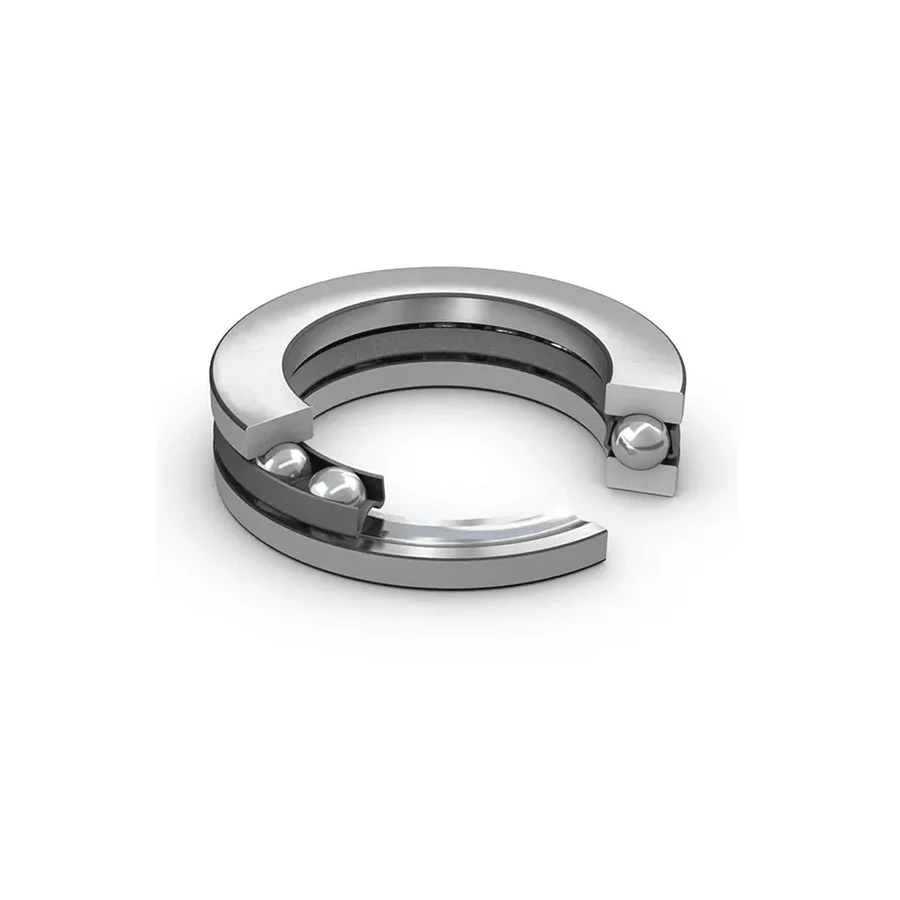
The 51316 thrust ball bearing (80 × 140 × 44 mm, ISO 104 Dimension Series 13) builds a thick 30 mm radial wall and heavy 44 mm total height (H) around an 80 mm forged hook shank. Purpose-matched to 25–40 ton overhead bridge-crane forged swivel hook blocks, it lets riggers spin heavy suspended steel coils, molds, and machinery smoothly by hand at crawl speed under strictly unidirectional downward axial deadweight (Fr = 0)—with zero tapered bore options.
| ISO 104 Series 13 Parameter | Symbol | 51316 Nominal Spec | Crane Hook Block Context |
|---|---|---|---|
| Shaft Washer Bore | d | 80 mm | Mounts tightly on 80 mm forged hook shank |
| Housing Washer OD | D | 140 mm | Heavy 30 mm single-side radial wall |
| Assembled Total Height | H | 44 mm | Height H (not B); stout Series 13 stack |
| Load Direction Rule | Pure Axial Deadweight | Fr = 0 Unidirectional | No radial support; square trunnion seat required |
| Separable 3-Piece Rings | Shaft vs Housing | Housing Bore D1 > 80 mm | Strict anti-inversion check inside crosshead |
| Static Safety & Cage | C0a / Ca / Retainer | Factory Drawing Verified | Static C0a & brass/steel cage at quotation |
51316 Static Safety & Smooth Swiveling Inside 25–40 Ton Crane Hooks
When a 32-ton overhead traveling crane hoists a heavy stamping die or steel slab off the mill floor, the entire suspended tonnage hangs straight down through the forged hook nut onto a single thrust bearing seated inside the crosshead trunnion. Dynamic fatigue rpm barely registers because hooks turn slowly and intermittently—instead, static axial load capacity (C0a) governs safety. If dynamic hoist braking shock dents the flat raceways (brinelling), operators feel rough notchiness while aligning loads and must fight dangerous load swing. The heavy Series 13 51316 places large-diameter hardened balls inside a massive 140 × 44 mm cross-section, offering dramatically greater indentation resistance than light 51116 (105 × 19 mm) or medium 51216 (115 × 28 mm) alternatives.
Crane-block designers must uphold two immovable mechanical rules: the crosshead trunnion bore guides the 80 mm hook shank against any lateral cable jerk so the 51316 receives strictly pure axial tension (Fr = 0), and the crosshead seat must be faced completely flat and perpendicular because a flat-seat thrust ball bearing tolerates zero angular tilt. Machined solid brass cages (or heavy pressed steel retainers), verified static C0a and dynamic Ca figures, and housing clearance bore D1 are confirmed on our formal engineering drawing prior to production.
51316 Brand Equivalency & Legacy 8316 Crane Spares Reference
Crane builders, steel-mill rigging crews, and port maintenance depots inspecting 80 × 140 × 44 mm hook blocks against legacy Chinese blueprints (8316) cross-check these ISO 104 Series 13 identifiers:
| Manufacturer / Standard | ISO 104 Code | Hoist Block Verification Notes |
|---|---|---|
| ZQM Bearings | 51316 | Factory print verifies C0a/Ca, D1 bore & brass/steel cage |
| SKF | 51316 / 51316 M | M = machined brass cage; verify static safety C0a |
| FAG / Schaeffler | 51316-MP | MP = solid window-type brass retainer for crane shock |
| NSK / NTN / KOYO | 51316 | Confirm heavy Series 13 cage & corrosion packaging |
| Legacy GB Code | 8316 | Classic Chinese bridge-crane hook blueprint code |
Safety & Dimensional Boundary Notice: Matching 51316 across brands confirms nominal ISO 104 boundary geometry (80 × 140 × 44 mm) exclusively. Because static capacity C0a, steel cleanliness, and cage construction differ by manufacturer, crane-hook replacements must always be approved against formal lifting drawings and applicable hoist safety factors.
Crosshead Washer Orientation, Corrosion Grease & Roller Upgrade Path
During scheduled statutory hook inspections across overhead crane and heavy lifting fleets, crane inspectors dismantle the three-piece 51316 to check ball grooves for brinell marks and moisture rust. On reassembly inside the crosshead, verify washer bores strictly: the shaft washer has the exact 80 mm bore that seats squarely beneath the rotating forged hook nut/collar, while the housing washer carries a noticeably larger bore (D1 > 80 mm) resting stationary against the crosshead trunnion floor so the rotating hook shank never rubs the stationary ring.
Because outdoor gantry cranes and humid foundry bays condense moisture inside hook covers, pack the enclosed cavity thoroughly with water-resistant, rust-inhibited EP2 grease and check top dust boots after every overhaul. Finally, where extreme ladle cranes, shipyard jibs, or 50+ ton hooks face severe side-pull tilt or impact overloading beyond flat ball-bearing limits, evaluate upgrading to a self-aligning 29316 or 29416 spherical roller thrust bearing.
Ordering 51316 Bearings for Crane OEMs & Rigging Inspections
To receive a prompt technical quotation, provide crane rated capacity (e.g., 25 t / 32 t / 40 t), hook-shank diameter (80 mm), preferred machined brass vs pressed steel retainer, indoor vs coastal/foundry environment, and required quantity. ZQM issues a signed factory drawing detailing D1 bore and static/dynamic axial capacities before dispatch.
Request 51316 Crane-Hook Drawing & Quote
51316 Technical FAQ for Overhead Crane Hook Blocks
Related Selection & Comparison: Compare lighter 80 mm thrust options 51116 (105 × 19 mm) and 51216 (115 × 28 mm), explore self-aligning Thrust Roller Bearings for tilting ladle hooks, or browse all Thrust Ball Bearings.
Why do 25–40 ton bridge-crane hooks choose heavy 51316 instead of 51116 or 51216?
Although all three share an 80 mm bore, the heavy Series 13 51316 (140 × 44 mm) houses much larger balls and thicker washers to withstand static suspended tonnage and hoist braking shock without raceway brinelling.
Which way do the shaft washer and housing washer sit inside a forged hook crosshead?
Place the larger-bore housing washer (D1 > 80 mm) flat on the stationary crosshead floor so the hook shank passes through with clearance, and seat the tight 80 mm shaft washer directly under the rotating hook-shank nut collar.
Why is static axial rating (C0a) more decisive than high-speed fatigue on crane hooks?
Crane hooks turn only a few slow revolutions while positioning suspended loads, yet experience peak downward force at standstill and during hoist brake stops—making static indentation safety C0a paramount.
How can steel-mill and shipyard cranes prevent rust pitting inside 51316 hook blocks?
Completely fill the enclosed crosshead housing with water-repellent, rust-inhibited EP2 grease during annual hook teardowns and keep top rubber dust boots intact to block rain and condensation.
When should a heavy crane hook upgrade from 51316 to a 29316 or 29416 spherical roller thrust bearing?
If crane operations involve heavy side-pull misalignment, extreme impact shocks, or ladle tonnages where flat-seat ball bearings approach static brinelling limits, transition to self-aligning 293/294 spherical roller thrust bearings.