
Slab and bloom continuous casting segments operate under one of steelmaking’s most unforgiving combinations: low rotational speed (often under 15 r/min), extreme ferrostatic roll loads, radiant heat from glowing steel strands, water-spray scale ingress, and wide shaft-to-housing temperature gradients. Heavy-section 240 and 241 series spherical roller bearings—such as 24164 CA/K30/W33 (320 × 540 × 218 mm) and 24064 CA/K30/W33 (320 × 480 × 160 mm)—are the global standard on caster drive and idle rolls. Yet two preventable maintenance errors account for a large share of premature segment change-outs: confusing 1:30 (K30) with 1:12 (K) tapered bores, and under-sizing C4 thermal clearance and floating-chock axial travel.
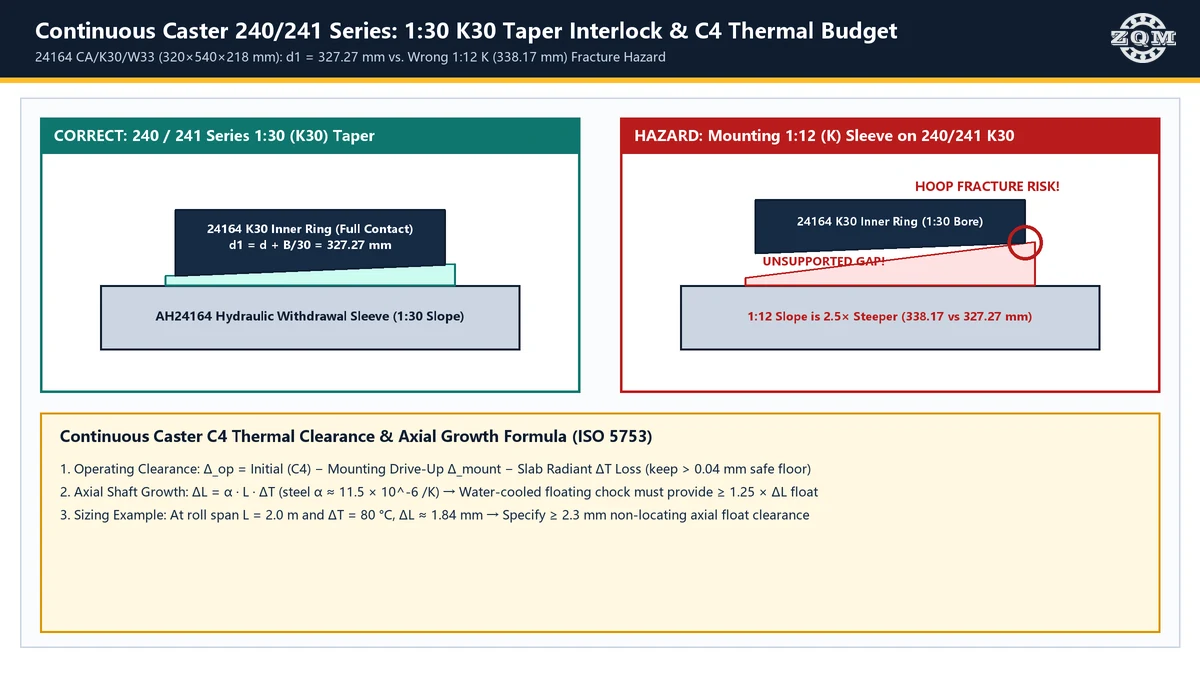
1. Why 240/241 Series Use a 1:30 (K30) Taper Instead of 1:12 (K)
Conventional spherical roller series (222, 223, 230, 231, 232, 239) standardize on a 1:12 tapered bore (suffix K). In contrast, heavy-width 240 and 241 series bearings have a much larger width-to-bore ratio (B/d). If a steep 1:12 taper were machined across a 218 mm wide inner ring, the large-end wall section beneath the raceway would become dangerously thin under heavy caster roll loads.
ISO therefore specifies a gentler 1:30 taper (suffix K30) exclusively for 240 and 241 tapered-bore bearings. Look at the exact dimensional mismatch if a 1:12 sleeve is mistakenly forced into a 24164 CA/K30/W33 (d = 320 mm, B = 218 mm):
| Representative Caster Model | Boundary Size (d × D × B) | Correct 1:30 (K30) Large-End d1 | Wrong 1:12 (K) Large-End d1 | Mismatch Risk |
|---|---|---|---|---|
| 24064 CA/K30/W33 | 320 × 480 × 160 mm | 320 + 160/30 = 325.33 mm | 320 + 160/12 = 333.33 mm | +8.00 mm slope error → hoop fracture |
| 24164 CA/K30/W33 | 320 × 540 × 218 mm | 320 + 218/30 = 327.27 mm | 320 + 218/12 = 338.17 mm | +10.90 mm slope error → hoop fracture |
| 24172 CA/K30/W33 | 360 × 600 × 243 mm | 360 + 243/30 = 368.10 mm | 360 + 243/12 = 380.25 mm | +12.15 mm slope error → hoop fracture |
Because a 1:12 slope is 2.5× steeper than 1:30, forcing a K-taper sleeve into a K30 bearing leaves the narrow end unsupported while overloading the large-end rim in severe circumferential hoop tension—resulting in immediate or early-service inner-ring axial cracking. Always pair 240/241 K30 bearings with dedicated 1:30 hydraulic withdrawal sleeves (e.g., AH24164) or 1:30 tapered journals, where axial drive-up is roughly 38–45× the target radial clearance reduction (Δr).
2. Budgeting ISO 5753 C4 Clearance Against Radiant Slab Heat
On a continuous caster roll, the inner ring absorbs heat conducted through the roll neck from the glowing strand, while the outer ring sits inside a water-cooled chock housing. That positive inner-to-outer temperature differential (ΔT) shrinks radial internal clearance in operation:
Δ_op = Initial Clearance (C4) − Mounting Drive-Up (Δ_mount) − Thermal Loss (Δ_temp)
- Why C4 Beats CN/C3 on Hot Segments: Starting with C4 internal clearance (ISO 5753) preserves a positive operating clearance floor (> 0.04 mm) even after hydraulic sleeve drive-up and 40–70 °C ring temperature differentials. Verify your exact bore-group range with the ZQM ISO 5753 Clearance Calculator.
- W33 Lubrication & Grease Purge: Standard W33 outer-ring annular grooves and three lubrication holes allow continuous high-temperature EP grease purging—essential both for boundary film protection at low speed and for pushing scale and steam away from the lip seals.
3. Preventing Axial Lock-Up: Roll Thermal Expansion Formula
Even with perfect C4 radial clearance, a caster roll will seize rapidly if axial thermal growth is blocked by the non-locating chock. Carbon-steel rolls expand linearly according to:
ΔL = α · L · ΔT (with steel thermal expansion coefficient α ≈ 11.5 × 10^-6 /K)
Worked Sizing Example: For a segment roll bearing span L = 2.0 m (2,000 mm) running ΔT = 80 °C above cold assembly temperature, axial growth equals 11.5 × 10^-6 × 2,000 × 80 = 1.84 mm. Best practice specifies a water-cooled floating housing clearance of at least 1.25 × ΔL (≥ 2.3 mm)—or a CARB-style / cylindrical floating arrangement—so axial thermal force never cross-loads the locating spherical roller bearing. See our Smelting & Continuous Casting Bearing Hub and Steel Rolling Mill Bearings for complete steel-plant lineups.
Verified Related Models & Direct Wafangdian Engineering Support
Verified 240/241 heavy wide-series spherical roller models (specify 1:30 K30 taper & C4 thermal clearance on RFQ):
| Model Designation | Nominal Dimensions (d × D × B) | Specification |
|---|---|---|
| 24056 CA/W33 | 280 × 420 × 140 mm | View Spec → |
| 24072 CA/W33 | 360 × 540 × 180 mm | View Spec → |
| 24156 CA/W33 | 280 × 460 × 180 mm | View Spec → |
| 24164 CA/W33 | 320 × 540 × 218 mm | View Spec → |
| 24036 CA/W33 | 180 × 280 × 100 mm | View Spec → |
Note: Dimensions follow ISO nominal boundary standards; confirm exact clearance, taper (1:12 K vs 1:30 K30), and drawing fit before direct OEM interchange.
Frequently Asked Questions
For representative 400 mm bore geometry in this duty class, review the 23980 CA/W33 Spherical Roller Bearing specification sheet.
For representative 300 mm bore geometry in this duty class, review the 23260 CA/W33 Spherical Roller Bearing specification sheet.
Why do 240 and 241 spherical roller bearings use a 1:30 (K30) taper instead of 1:12 (K)?
240 and 241 series bearings are significantly wider relative to bore diameter than 222/232 series. A 1:30 taper prevents excessive thinning of the inner-ring wall at the large end while maintaining uniform seating across wide journals.
What happens if a 1:12 (K) adapter or withdrawal sleeve is mounted into a 24164 CA/K30/W33 bearing?
A 1:12 taper is 2.5× steeper than 1:30 (338.17 mm vs. 327.27 mm at the large end on 24164). The inner ring rests only on the high edge, leaving an unsupported gap and creating severe hoop tensile stress that can fracture the inner ring.
How much axial drive-up is required when mounting a 1:30 (K30) tapered-bore bearing?
Because the slope is 2.5× shallower than 1:12, axial drive-up is roughly 38–45 times the required radial internal clearance reduction (Δr), versus 15–18× Δr for a 1:12 K taper. Always measure final feeler-gauge clearance before commissioning.
Why is C4 internal clearance standard on continuous caster segments?
Continuous caster rolls conduct intense radiant heat to the inner ring while water-cooled chocks keep the outer ring cooler. C4 clearance compensates for both mounting interference and the inner-to-outer thermal gradient so the bearing never preloads into seizure.
Can ZQM Bearings supply 240/241 CA/K30/W33 C4 bearings for steel-plant MRO schedules?
Yes. ZQM Bearings manufactures heavy 240/241 spherical roller bearings in straight bore and 1:30 K30 tapered bore with C3/C4 clearance and factory inspection documentation. Request sizing or lead times via our Contact page or [email protected].
Planning your next continuous caster segment overhaul? Check dimensions in our Bearing Catalog or reach ZQM engineering at /contact/ ([email protected]).