
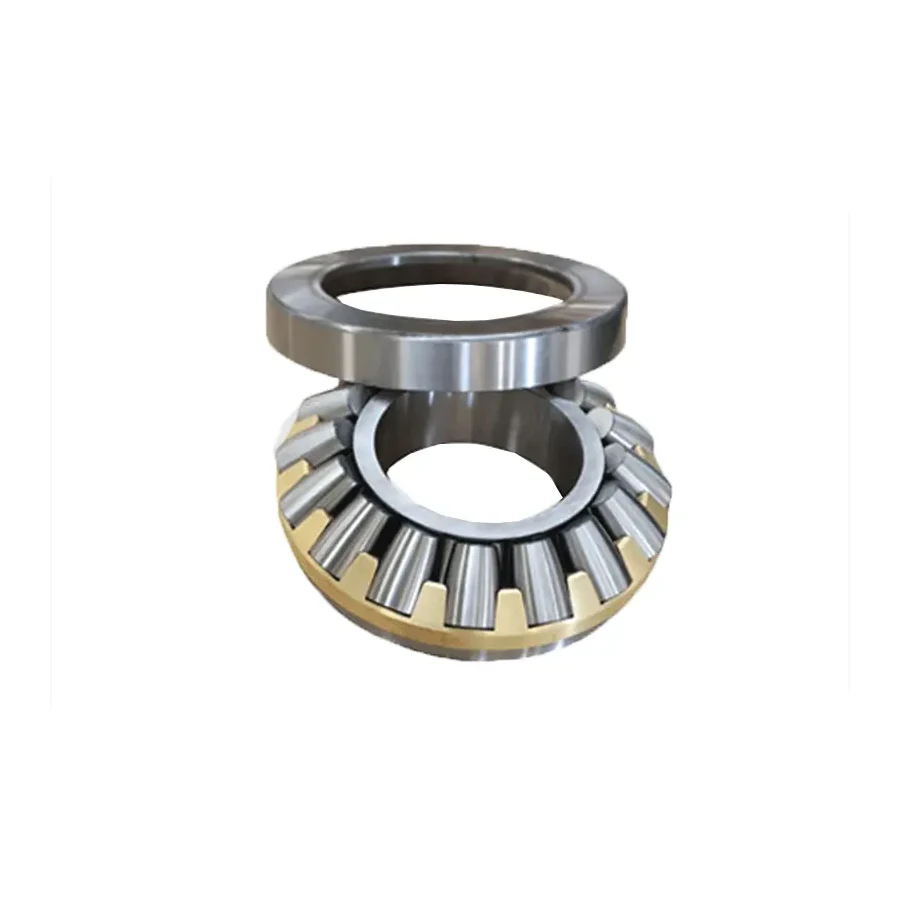
Pushing high-viscosity engineering resins, filled masterbatches, or cross-linked polyolefins through fine screen-changer packs drives massive sustained melt backpressure straight rearward into the splitter gearbox of a heavy twin-screw extruder. Stepping up to the ISO 104 heavy 294 series on a 160 mm shaft, the ZQM 29432 spherical roller thrust bearing expands to 320 mm OD × 95 mm height (B = 34 mm, C = 46.9 mm) and 32.8 kg solid mass—delivering 1,740 kN dynamic axial rating (Ca), 5,400 kN static endurance (C0a), and 1,000 rpm oil-flood capability (750 rpm grease).
29432 Technical Specifications & Dimensions
| Parameter Category | Technical Parameter (Symbol) | Catalogue Reference Value |
|---|---|---|
| Boundary Dimensions & Weight | Bore diameter (d) | 160 mm |
| Boundary Dimensions & Weight | Outside diameter (D) | 320 mm |
| Boundary Dimensions & Weight | Overall height (H) | 95 mm |
| Boundary Dimensions & Weight | Inner-ring width (B) | 34 mm |
| Boundary Dimensions & Weight | Outer-ring width (C) | 46.9 mm |
| Boundary Dimensions & Weight | Inner-ring rib / raceway diameter (d1) | 285 mm |
| Boundary Dimensions & Weight | Outer-ring rib / raceway diameter (D1) | 218.5 mm |
| Boundary Dimensions & Weight | Reference mass (Weight) | 32.8 kg |
| Load Ratings & Limiting Speeds | Basic dynamic load rating (Ca) | 1740 kN |
| Load Ratings & Limiting Speeds | Basic static load rating (Coa) | 5400 kN |
| Load Ratings & Limiting Speeds | Limiting speed (grease) | 750 rpm |
| Load Ratings & Limiting Speeds | Limiting speed (oil) | 1000 rpm |
| Abutment & Fillet Dimensions | Shaft abutment diameter (da) | 230 mm |
| Abutment & Fillet Dimensions | Housing abutment diameter (Da) | 265 mm |
| Abutment & Fillet Dimensions | Minimum chamfer dimension (r12) | 5 mm |
| Abutment & Fillet Dimensions | Maximum fillet radius (ra) | 4 mm |
| Abutment & Fillet Dimensions | Axial offset (S) | 99 mm |
Data source: ZQM Bearings online catalogue database (factory PDF catalogue v1). Load ratings, limiting speeds, and parameters without individual test records serve as catalogue reference values; verify shaft/housing shoulders (da, db, Da), tolerances, internal clearance, and drawings prior to ordering.
Why Heavy Extruder Gearboxes Escalate from 29332 to 29432
When high-output compounding lines run 24/7 at 350–450 bar die-head pressures, switching from a 29332 to a 29432 on the identical 160 mm output shaft delivers an order-of-magnitude fatigue life leap:
- +72% Dynamic Thrust Capacity on 160 mm Bore: Jumping from 1,010 kN (29332) to 1,740 kN raises calculated L10h rolling-fatigue life by roughly sixfold under constant polymer melt thrust—extending planned extruder gearbox overhauls from single years to multi-year campaigns.
- 5,400 kN Cold-Start & Screen-Plug Protection: If a resin freeze-off or blocked die plate causes momentary pressure surges during line restart, the 5,400 kN static barrier absorbs peak loads cleanly.
- 46.9 mm Heavy Housing Washer Support: Thick housing washer mass resists elastic dishing across heavy bolted thrust-block backplates, preserving uniform load sharing across every barrel roller.
- Controlled Radial Pinion Tolerance (Fr ≤ 0.55 Fa): Helical splitter-gear radial separating forces are accommodated alongside primary screw backpressure as long as lateral load stays below 55% of concurrent axial thrust.
ISO 104 Heavy-Series Lookup Matrix for 29432
| Manufacturer | Part Code | d (mm) | D (mm) | H (mm) | Extruder Gearbox Notes |
|---|---|---|---|---|---|
| ZQM | 29432 | 160 | 320 | 95 | ISO 294 heavy baseline; cage & oil-porting per quote |
| SKF | 29432 E | 160 | 320 | 95 | Stamped steel window cage Explorer geometry |
| FAG / Schaeffler | 29432-E1 | 160 | 320 | 95 | High-capacity asymmetrical roller design |
| NSK | 29432 / 29432M | 160 | 320 | 95 | Solid machined brass or steel cage series |
| Timken / NTN | 29432EM / 29432 | 160 | 320 | 95 | High-thrust industrial compounding execution |
Engineering lookup boundary: Above equivalents share ISO 104 nominal boundary dimensions (160 × 320 × 95 mm) strictly for initial cross-referencing. Cage guide geometry, internal oil-flow channels, and washer chamfers differ across producers; cross-check thrust-cartridge stack height and oil nozzle clearances against the extruder gearbox blueprint prior to substitution.
Extruder Output-Shaft Fits, Shoulders & Forced Oil-Flood Setup
- Machine Heavy Backing Abutments & Large Fillets: Provide a rigid shaft abutment of at least da = 230 mm and keep the housing pocket shoulder at or below Da = 265 mm, holding corner fillets neatly beneath the generous rmin = 5.0 mm minimum chamfer to avoid stress risers on high-torque output shafts.
- Enforce Separate Dimensional & Runout Checks: Grind the 160 mm cylindrical output shaft journal to ISO 286-1 IT6 tight interference fit, while independently inspecting ISO 1101 shoulder axial runout and thrust-plate parallelism—even slight wedge misalignment multiplies edge pressure under 1,740 kN dynamic thrust.
- Mandate Forced Cooled Oil-Flood Lubrication: At 32.8 kg rotating mass and sustained polymer melt heat conducted down the screw splines, grease is unsuitable for continuous extrusion. Inject cooled, 10-micron filtered ISO VG 220 or VG 320 synthetic PAO gear oil directly at the inner bore side, letting centrifugal roller pumping sweep oil radially outward to a high-flow cooled sump return (supporting operation up to 1,000 rpm).
- Maintain Minimum Spring Preload During Dry Screw Purging: Whenever operators run empty barrel-cleaning cycles with die pressure near zero, coil or disc springs must keep minimum axial seating force active on the 29432 so heavy rollers never skid.
Thermal Stability, Oil Cleanliness & Vibration Diagnostics
Extruder thrust bearings fail early primarily from oil viscosity collapse above 85 °C or brass/steel wear debris migrating from upstream helical pinions. Install dedicated inline duplex filters and an RTD probe against the stationary 320 mm housing washer back face. Trending bearing housing temperature against melt-pressure transducer logs immediately exposes plugged oil-cooler heat exchangers or rising radial gear misalignment before catastrophic spalling interrupts pelletizing production.
Polymer-Line Rebuild Intake & Quotation Desk
To expedite a verified quotation on 29432 heavy thrust assemblies, share four operating details: (1) peak continuous melt pressure and axial screw force (kN), (2) screw operating speed (rpm) and gear-oil ISO VG grade, (3) single-bearing versus tandem multi-stage thrust cartridge layout, and (4) preferred cage execution (machined brass vs steel). Reach our specialists via the ZQM extruder-gearbox quotation page.
Technical Tools & Cross-Links: Check cage and internal-design suffixes in our Bearing Suffix Decoder, verify factory records at 29432 Catalog Listing, explore Thrust Roller Bearings, or browse drivetrain guides under Industrial Gearboxes.
Twin-Screw Extruder Gearbox 29432 Engineering Q&A
Why does a twin-screw extruder gearbox require forced cooled oil instead of static oil bath for the 29432?
Continuous polymer compounding conducts significant heat rearward from 200–300 °C barrels while high axial melt pressure generates intense roller-flange sliding friction. Forced cooled oil-flood circulation actively strips away thermal load and keeps lubricant film thickness healthy up to 1,000 rpm.
How much fatigue life gain comes from upgrading a 160 mm extruder shaft from 29332 to 29432?
Because roller bearing fatigue life scales with (Ca/Pa)10/3, increasing dynamic axial capacity from 1,010 kN (29332) to 1,740 kN (29432) boosts theoretical fatigue life by more than six times at the same melt backpressure—assuming housing space accommodates the 320 × 95 mm envelope.
Can the 29432 simultaneously carry high radial helical-gear separating forces?
Only up to the strict limit of Fr ≤ 0.55 Fa. High-torque twin-screw gearboxes rely on dedicated radial cylindrical roller bearings to absorb pinion separating loads so the 29432 remains focused on axial polymer thrust.
Why is the 29432 minimum chamfer rmin = 5.0 mm notably larger than lighter series?
High-torque 160 mm extruder output shafts transmit immense torsional stress through splined couplings. The 5.0 mm chamfer permits generous shaft shoulder fillets that suppress torsional fatigue cracking while keeping the washer seated flush against the 230 mm abutment.