

When radial envelope limits prevent upsizing the shaft or housing, engineers often replace a caged cylindrical unit with an NCF NNC NNCL cylindrical roller bearing. By removing the cage and packing rollers shoulder-to-shoulder around the raceway, full-complement assemblies maximize radial load density inside narrow sections such as crane rope sheaves, planetary gear carriers, and steel-mill auxiliary rolls. However, choosing incorrectly between NCF, NNC, and NNCL rib layouts causes axial binding or unintended housing drift under thermal growth.
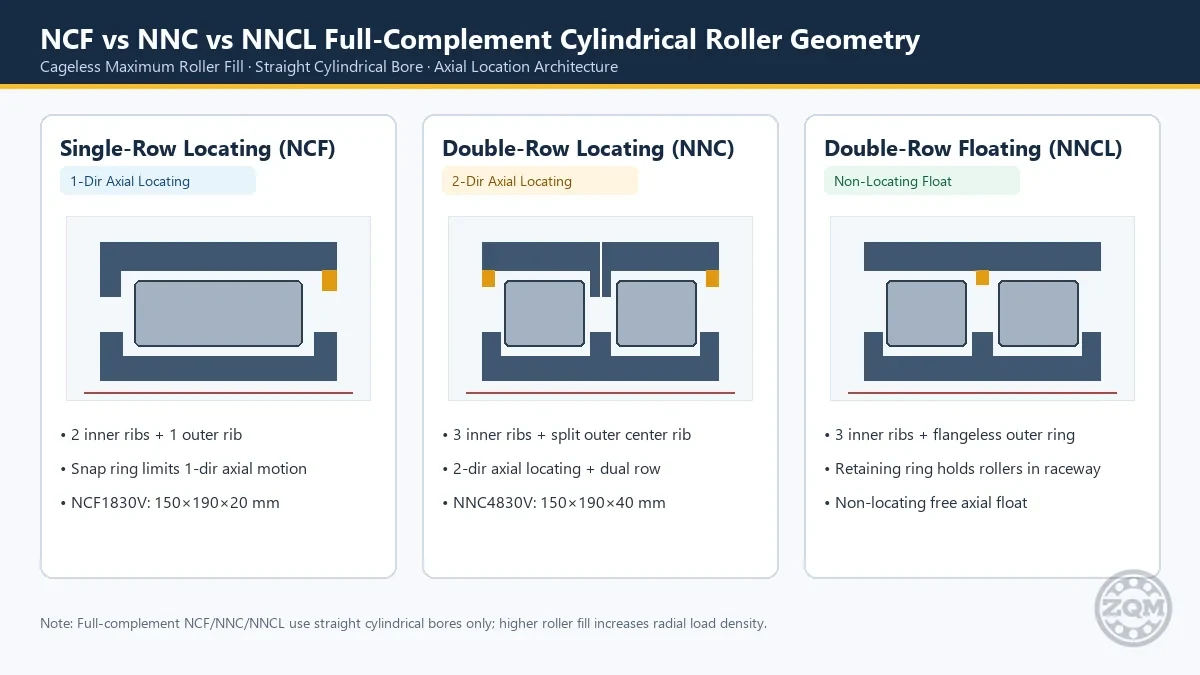
NCF vs NNC vs NNCL Structural & Axial Location Logic
Although every NCF NNC NNCL cylindrical roller bearing shares a straight cylindrical bore (never tapered) and full-complement suffix V, their ring rib configurations define completely different axial locating roles:
- Supports heavy radial forces plus axial positioning in one primary direction.
- Outer retaining ring prevents the outer ring from separating during handling.
- Compact single-row width such as 20 mm on
NCF1830V.
- Double-Row Locating (NNC4830V): Three inner ribs and a split outer ring with a central rib locate the shaft axially in both directions.
- Double-Row Floating (NNCL4830V): Three inner ribs paired with a flangeless outer ring let thermal shaft growth float inside the bore.
- Doubled roller rows multiply static radial capacity inside the same 150 × 190 mm footprint.
In paired crane-sheave or gearbox shafts, designers frequently combine one two-direction locating double-row unit at the fixed journal with one floating flangeless-outer unit at the opposite journal. That arrangement accommodates shaft elongation without sliding the outer ring inside the bore, avoiding housing fretting under cyclic loads. For single-row applications requiring high-speed caged separation rather than maximum static density, compare our published NJ226EM or NJ2320M assemblies, or explore standard caged layouts in the NU series catalog.
Verified Catalogue Dimensions: NCF1830V, NNC4830V & NNCL4830V vs Caged NJ
The table below compares three verified 150 mm bore full-complement models from the ZQM catalogue database (conforming to ISO 15 boundary plans) alongside caged single-row and multi-row rolling-mill benchmarks:
| Catalogue Model | Envelope (d × D × B) & Mass | Capacity (Cr / Cor) & Speed (Grease / Oil) |
|---|---|---|
| NCF1830V (Full-complement, 1-dir locating) | 150 × 190 × 20 mm · 1.3 kg (da min 157.5 mm, Da max 182.5 mm, r1,2 min 1.1 mm) | Cr 108 kN / Cor 200 kN · 700 / 1,500 rpm |
| NNC4830V (Full-complement, 2-dir locating) | 150 × 190 × 40 mm · 2.90 kg (da min 156.5 mm, Da max 183.5 mm, r1,2 min 1.1 mm) | Cr 233 kN / Cor 585 kN · 700 / 1,500 rpm |
| NNCL4830V (Full-complement, non-locating) | 150 × 190 × 40 mm · 2.90 kg (da min 156.5 mm, Da max 183.5 mm, r1,2 min 1.1 mm) | Cr 233 kN / Cor 585 kN · 700 / 1,500 rpm |
| NJ226EM (Caged M brass, 1-dir locating) | 130 × 230 × 40 mm · 7.38 kg (Fw 153.5 mm, db min 146 mm, Da max 212 mm) | Cr 290 kN / Cor 410 kN · 2,200 / 2,800 rpm |
| FCDP5678275/YA3 (4-row pin cage mill unit) | 280 × 390 × 275 mm · 105 kg (Fw 308 mm, r1,2/r3,4 min 3.0 mm) | Cr 2,720 kN / Cor 6,130 kN · Speed: Contact us for specifications |
Notice the trade-off revealed by the numbers: doubling width from NCF1830V (20 mm, Cr 108 kN) to NNC4830V or NNCL4830V (40 mm, Cr 233 kN) increases dynamic capacity by 115% and nearly triples static rating to 585 kN within the identical 150 mm bore and 190 mm outer diameter. Yet limiting speed stays at 700 rpm on grease and 1,500 rpm on circulating oil—roughly one-third to one-half the thermal ceiling of caged NJ226EM (2,200 / 2,800 rpm). For unspecified abutment fields on NJ226EM (Db, da, Ew), contact us for specifications prior to machining shoulders.
Lubrication, Speed Limits & Mounting Guardrails
Because adjacent rollers in an NCF NNC NNCL cylindrical roller bearing rub directly against one another in opposite surface-velocity directions at their pitch contact line, friction heat climbs steeply as shaft speed rises. Follow four shop-floor engineering rules whenever deploying full-complement cylinders:
- Prioritize Circulating Oil Above 50% Speed Limit: While grease suffices for slow oscillating crane sheaves and hoist drums below 300–400 rpm, continuous rotation near 700–1,500 rpm benefits strongly from filtered EP oil circulation (ISO VG 150 to VG 220) to shear heat away from roller-to-roller contacts.
- Verify Retaining Snap-Ring Seating on Double-Row Units: Never strike the outer retaining ring during press mounting. Apply induction heating (100–110 °C) to the inner ring for straight-bore shaft seating and confirm axial clearance before closing end covers.
- Respect Axial Thrust Limits: Full-complement outer/inner ribs are designed for light locating forces and transient shock, not sustained heavy thrust. Pair heavy axial drives with dedicated four-point contact ball units or opposed tapered assemblies.
- Keep Bore Geometry Strictly Cylindrical: Full-complement assemblies use straight cylindrical bores only; specify ISO 286 shaft interference directly on the journal and review full series options in the ZQM bearing catalog.
Frequently Asked Questions
When should I specify an NCF NNC NNCL cylindrical roller bearing instead of a caged NJ or NU unit?
Choose an NCF NNC NNCL cylindrical roller bearing when radial space is tightly constrained, rotational speed stays below 700 rpm grease or 1,500 rpm oil, and static shock or crane-sheave load density exceeds what a caged unit of the same cross-section can survive. Choose caged EM or M designs such as NJ226EM when speed exceeds 1,500 rpm.
What is the practical difference between NNC4830V and NNCL4830V at 150 × 190 × 40 mm?
Both share 150 mm bore, 190 mm outer diameter, 40 mm width, 233 kN dynamic rating, 585 kN static rating, and 2.90 kg mass. The two-way locating variant uses a split outer ring with a central rib, whereas the floating variant uses a flangeless outer ring so the shaft can float axially during thermal expansion.
Why are limiting speeds lower on full-complement cylindrical assemblies?
Without cage pockets separating the rolling elements, neighboring rollers slide against each other in opposite directions along their contact zone, generating higher boundary friction and heat. Reliable EP grease or circulating oil delivery is mandatory to prevent smearing and premature cage-free scuffing.
Related ZQM Engineering Tools & Product Hub
- Bearing Suffix Decoder — decode
NCF,NNC,NNCL,Vfull-complement, andNJ / NU / NUPrib/cage designations instantly. - Cylindrical Roller Bearings Category Hub — compare full-complement and heavy machined-brass caged
NJ / NU / NUPindustrial models. - ISO 281 Bearing Life Calculator — check radial fatigue life
L10hunder low-speed high-load crane sheave and gearbox duty.
Need Help Sizing Full-Complement or Caged Cylindrical Assemblies?
Send your shaft diameter, housing bore, peak radial load, and operating speed. ZQM engineers confirm radial clearance (C0, C3, or C4), lubrication ports, and factory supply lead times against your engineering drawings.