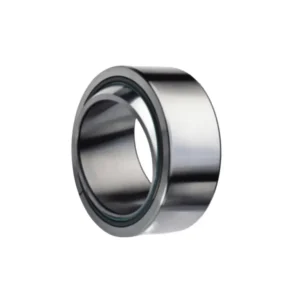
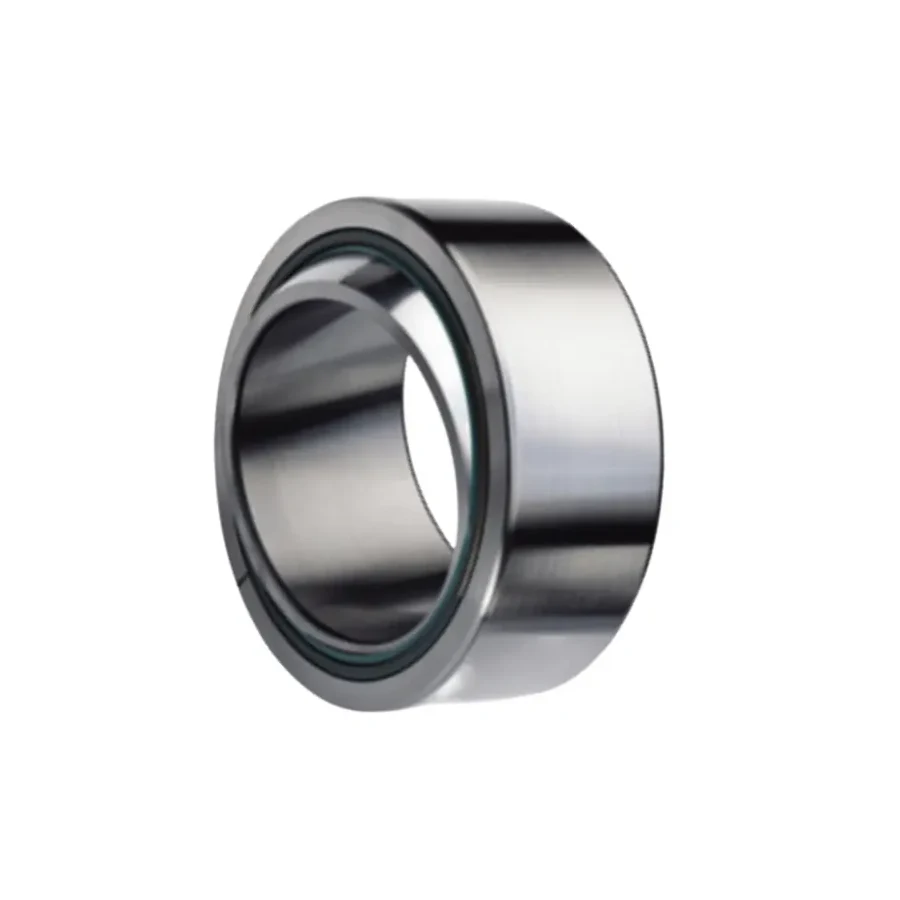
Dimensioned to ISO 12240-1 Series E, the GE80ES-2RS (GE 80 ES-2RS) sealed radial spherical plain bearing supports an 80 mm heavy pivot shaft inside a 120 mm outside diameter, combining a 55 mm inner-ring width (B) with a 45 mm outer-ring width (C). Built around hardened bearing-steel sliding contact treated with phosphate and MoS₂, annular lubrication channels in both rings, and twin -2RS contact seals, it serves steel-mill continuous-casting mold oscillator levers, ladle-turret lifting cylinders, and tundish car linkages where radiant thermal stress meets abrasive iron-oxide scale.
GE80ES-2RS ISO 12240-1 Nominal Boundary Envelope
| Specification | Verified ISO 12240-1 Series E | Metallurgical Service Note |
|---|---|---|
| Designation | GE80ES-2RS | Sealed steel-on-steel radial spherical plain bearing |
| Bore Diameter (d) | 80 mm | Nominal oscillator / turret hinge pin diameter |
| Outside Diameter (D) | 120 mm | Nominal lever-arm / clevis housing bore |
| Inner Ring Width (B) | 55 mm | Spherical inner ring width |
| Outer Ring Width (C) | 45 mm | Single-fractured outer ring width |
| Sliding Contact Pair | Hardened bearing steel / steel | Phosphate + MoS₂ surface finish; continuous centralized MoS₂ EP greasing |
| Sealing & Lubrication | -2RS contact seals + ES oil ports | Double-sided seals; annular lubrication grooves & holes in both rings |
| Load Ratings, Clearance & Seal Temp | Confirmed on factory drawing | Sliding capacities, radial clearance group (e.g., C3 for heat) & elastomer grade confirmed at quote |
Caster Mold Oscillation (p·v), Thermal Clearance & 90° Split Rule
Continuous slab and billet caster mold tables oscillate rapidly across tiny stroke amplitudes to strip solidifying steel shells cleanly from copper molds, while ladle-turret lifting rams cycle slowly under massive molten-steel deadweight. Both joints operate exclusively in sliding contact—never rolling contact—meaning bearing longevity tracks the specific contact pressure × sliding velocity (p·v) regime and uninterrupted high-temperature molybdenum-disulfide grease delivery that combats fretting under short oscillatory arcs.
As with all Series E radial steel-on-steel bearings, the GE80ES-2RS outer ring carries a single radial fracture for assembly. Melt-shop maintenance crews rebuilding oscillator arms or turret cylinder clevises must align this fracture strictly at 90° to the primary radial oscillation or lifting load axis, ensuring cyclic stress reversals never open the fracture seam.
Mill-Scale Exclusion & Radiant Heat Considerations in Melt Shops
Cooling spray mist, corrosive mold-powder dust, and razor-sharp iron-oxide scale blanket every joint below the casting floor. The -2RS double-lip seals form a vital barrier against abrasive scale ingestion across the misalignment envelope enabled by its 10 mm width differential (55 mm inner vs. 45 mm outer). Because ambient radiant heat near molten tundishes and ladles narrows internal clearance and stresses standard nitrile elastomers, melt-shop engineers should verify both enlarged radial clearance (such as C3) and high-temperature elastomer seal options with ZQM prior to outage installation, feeding the ES oil grooves continuously from centralized mill lubrication pumps.
Learn how ZQM supports integrated steelmakers across casters and rolling stands on our metallurgical & steel-mill industry page.
GE80ES-2RS Metallurgical Cross-Reference Matrix
| Brand / Standard | Reference Designation | ISO 12240-1 Series E Alignment (80 × 120 × 55/45 mm) |
|---|---|---|
| ZQM / GB/T 9163 | GE80ES-2RS | Hardened steel/steel, phosphate & MoS₂ treated, oil grooves/holes, -2RS seals |
| SKF | GE 80 ES-2RS | Steel-on-steel radial spherical plain bearing, lip seals both sides |
| INA / Schaeffler | GE80-DO-2RS | Series E maintenance-type steel-on-steel (DO), double-sided lip seals |
| IKO | GE80ES-2RS | ISO Series E sealed steel-on-steel spherical plain bearing |
| Fluro | GE 80 ES-2RS | Relubricatable steel/steel joint bearing with -2RS lip seals |
Steel-Mill Outage Disclaimer: Equivalents in this table align solely on nominal ISO 12240-1 Series E boundary geometry (80 × 120 × 55/45 mm). Melt-shop applications demand explicit confirmation of seal elastomer thermal limit, enlarged radial clearance (C3), sliding load capacity, and surface phosphating via ZQM’s formal factory drawing prior to planned caster maintenance.
Ordering GE80ES-2RS for Caster Outages & Steel-Plant MRO
To lock in the right GE80ES-2RS build ahead of your scheduled caster turnaround, specify ambient operating temperature at the linkage, centralized grease pump specification, preferred radial clearance group (CN vs. C3), and outage delivery date. ZQM issues formal factory drawings verifying sliding capacities, clearance tolerances, and elastomer seal grades at quotation stage. Send your melt-shop spare list via our metallurgical quotation desk.
GE80ES-2RS Continuous Caster & Steel-Mill FAQ
Related Selection & Comparison: Compare adjacent heavy industrial bores GE70ES-2RS (70 mm) and GE100ES-2RS (100 mm), and explore caster & mill pivot solutions in our Steel & Rolling Mills Hub.
Why must steel-mill maintenance teams verify seal compound and clearance on GE80ES-2RS before caster outages?
Radiant heat from molten steel can shrink bearing radial clearance and harden standard rubber lips. Confirming enlarged clearance (such as C3) and appropriate high-temperature seal material on the factory drawing prevents hot-running seizure during continuous casting.
How does GE80ES-2RS resist abrasive iron-oxide mill scale on oscillator linkages?
Twin -2RS contact lip seals sweep across the hardened spherical inner ball to keep abrasive mill scale and cooling-water mist outside the contact area, while centralized high-temperature MoS₂ grease fed into the ES grooves maintains an outward purging barrier.
How must the GE80ES-2RS outer-ring fracture be oriented inside an oscillator lever or ladle cylinder?
Always position the single radial assembly fracture at 90° to the primary cyclic radial load direction so alternating casting-floor forces do not flex the split seam open or damage the inner ball.
How does ZQM document exact sliding load capacities and clearance tolerances for steel-mill QA?
Dynamic and static sliding capacities, radial clearance class, permissible tilt angle, and phosphate/MoS₂ surface finish are formally specified on the ZQM factory drawing provided upon quotation, alongside standard dimensional and hardness inspection records at shipment.