

Industrial Gearbox, Heavy Reducer and Power Transmission Bearings
Engineered for hardened-gear helical and planetary reducers, rubber/plastics extruders, wind-turbine gearboxes, paper mill drives, and heavy industrial blowers. ZQM supplies straight-bore NJ / NU / NUP cylindrical rollers, ISO 355 322 / 323 / 331 tapered rollers, and 230 / 231 / 232 spherical roller bearings covering input pinions to low-speed output shafts.
Bearing Selection by Gearbox Shaft and Transmission Stage
Balance gear-mesh stiffness, helical axial thrust, thermal shaft growth, and continuous oil lubrication across every reduction stage.
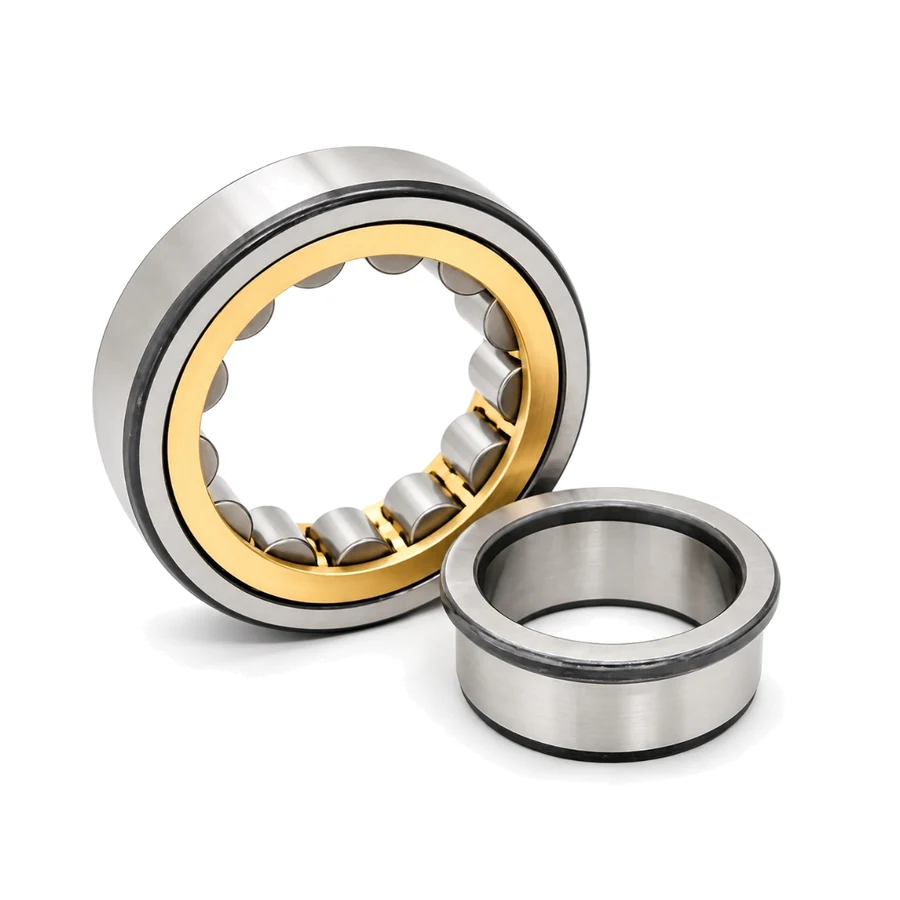
High-speed input pinions require high radial capacity, clean oil-flow geometry, and tight shaft positioning. Straight-bore NJ (one-direction locating; add HJ angle ring or opposing NJ for bidirectional control) and NUP (bidirectional locating) cylindrical rollers carry radial gear separating forces with low friction.
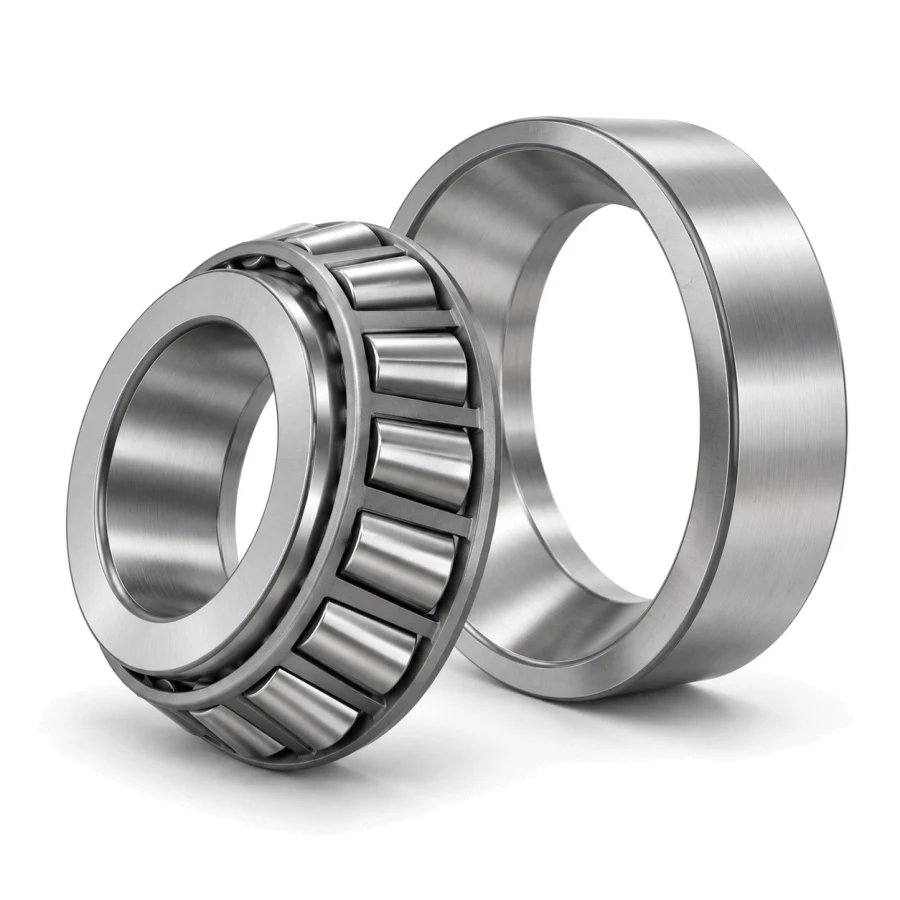
Helical and spiral-bevel intermediate stages generate sustained bidirectional axial gear thrust alongside radial mesh loads. Paired 322, steep-angle 323, and compact 331 straight-bore tapered roller bearings (ISO 355) hold gear tooth contact patterns accurately under DB or DF axial setting.
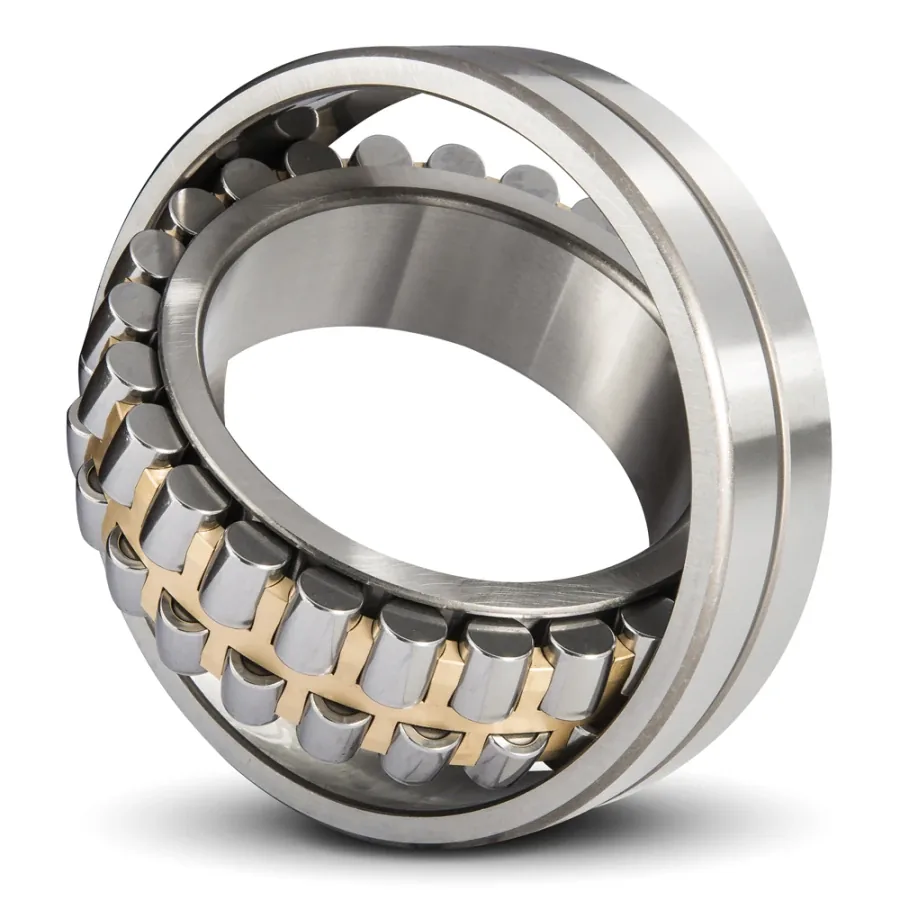
Low-speed, high-torque output shafts, planetary carriers, and rubber/plastics extruder main shafts endure shock torque and housing deflection. Large-bore 230, 231, and 232 CA/W33 spherical roller bearings handle high radial loads and angular misalignment cleanly.
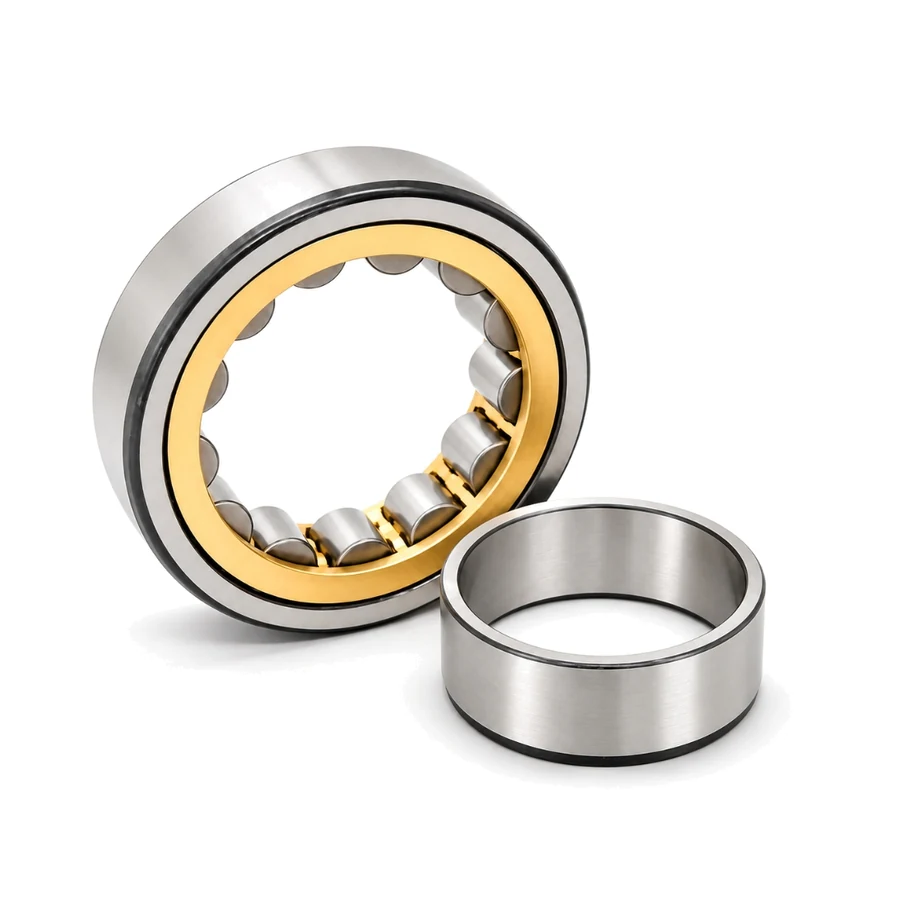
Gear shafts running warm inside cast-iron or welded steel housings elongate axially relative to the case. Straight-bore NU cylindrical roller bearings allow frictionless axial displacement internally between rollers and the rib-free inner ring—preventing axial binding at operating temperature.
| Model | d × D × B / T (mm) | Cr / C0r (kN) | Mass (kg) | Typical Gearbox Stage & Bore Note | Details |
|---|---|---|---|---|---|
| NJ228EM | 140 × 250 × 42 (B) | 395 / 515 | 9.43 | Input / intermediate shaft, 1-dir locating (Fw 169 mm, straight bore) | View Specs |
| NU228EM | 140 × 250 × 42 (B) | 395 / 515 | 9.36 | Floating pinion end, internal axial float (Fw 169 mm, straight bore) | View Specs |
| NJ326EM | 130 × 280 × 58 (B) | 615 / 735 | 19.5 | Heavy helical pinion shaft (Fw 167 mm, straight bore) | View Specs |
| NUP230EM | 150 × 270 × 45 (B) | 450 / 595 | 13.0 | Bidirectional locating cylindrical stage (Fw 182 mm, straight bore) | View Specs |
| 33120 | 100 × 165 × 52 (T) | 325 / 523 | 4.29 | Compact helical / bevel stage (ISO 355 overall T, straight bore) | View Specs |
| 32224 | 120 × 215 × 61.5 (T) | 440 / 635 | 9.0 | Standard gearbox bevel / helical pair (ISO 355 overall T, straight bore) | View Specs |
| 32324 | 120 × 260 × 90.5 (T) | 770 / 1,060 | 21.8 | Steep-angle high-thrust bevel pinion (ISO 355 overall T, straight bore) | View Specs |
| 23044 CA/W33 | 220 × 340 × 90 (B) | 1,090 / 1,980 | 29.7 | Reducer output & extruder shaft (straight; optional 1:12 K) | View Specs |
| 23060 CA/W33 | 300 × 460 × 118 (B) | 1,920 / 3,700 | 70.5 | Heavy low-speed reducer output shaft (straight; optional 1:12 K) | View Specs |
| 23148 CA/W33 | 240 × 400 × 128 (B) | 1,790 / 3,100 | 66.9 | High-torque mixer & mill drive output (straight; optional 1:12 K) | View Specs |
Radial cylindrical and spherical dimensions conform to ISO 15 (width B); single-row tapered roller bearings conform to ISO 355 (overall assembly width T). NJ, NU, NUP, and standard tapered roller bearings use straight cylindrical bores exclusively. Optional tapered bores on 230 / 231 / 232 spherical series use 1:12 (K).
Power Transmission Engineering Notes for Industrial Gearboxes
Prevent thermal preload lock-up, gear-mesh noise, and lubrication starvation across continuous multi-shift reducers.
1. DB vs DF Tapered Setting Under Gearbox Thermal Delta
When steel gear shafts run hotter than the housing, axial shaft growth tends to tighten DF (face-to-face) preload whereas axial elongation widens DB (back-to-back) endplay. Set shims or ground spacers via measured axial play or rolling drag torque—never by radial feeler gauges on tapered rollers.
Read Tapered Preload & Clearance Guide2. Locating vs Floating Cylindrical Shaft Layouts
Pair a floating NU bearing at one shaft end with an NJ + HJ angle ring, NUP, or opposed tapered pair at the locating end. Verify Fw roller envelope diameter and axial displacement allowance before interchanging cylindrical sub-assemblies.
Read NJ / NU / NUP Engineering Guide3. Radial Clearance Selection for Oil-Bath & Splash Reducers
Heavy shaft interference fits (to prevent inner-ring creep under high torque) and shaft-to-housing temperature differences consume internal radial clearance. Evaluate CN vs C3 against actual fit interference and oil-sump cooling rather than guessing by shaft RPM alone.
Read C3 Radial Clearance Guide4. ISO Cross-Reference Discipline for Gearbox Overhauls
Overhaul shops frequently replace legacy or mixed-brand bearings across industrial reducers. Nominal ISO 15 / ISO 355 dimensions alone do not guarantee identical cage geometry, roller profile, or clearance—confirm full suffixes before ordering.
Read ISO Cross-Reference GuideFactory Coordination and Gearbox OEM / MRO Supply
Consistent batch tolerances, order-matched clearance checks, and flexible export consolidation for gearbox builders.
Pre-Order Checklist for Gearbox & Transmission Buyers
Include these five technical details with your RFQ for fast engineering confirmation:
- Complete bearing BOM with full suffixes (e.g., NJ/NU/NUP design, EM/M cage, CA/W33, CN/C3 clearance, straight vs 1:12 K)
- Shaft stage & arrangement (input pinion, bevel intermediate DB/DF pair, planetary carrier, or low-speed output shaft)
- Lubrication method (splash oil bath, forced circulating oil, or grease) and operating duty cycle
- Special matching or drawing requirements (spacer-matched tapered sets, specific tolerance class, or custom Fw checks)
- Kit quantity (single gearbox overhaul kit, MRO stock replenishment, or recurring OEM production schedule)
Related Gearbox Technical Guides
Engineering articles covering cylindrical location, tapered setting, and clearance control.
Frequently Asked Questions
Key selection and assembly questions for gearbox designers and overhaul technicians.
When should a gearbox shaft use NJ or NUP cylindrical roller bearings instead of NU bearings?
Use NU bearings (rib-free inner ring) exclusively at the non-locating end so shaft thermal growth slides freely within the bearing’s axial displacement limit. Use NJ (one inner rib) for one-direction axial location—paired with an opposing NJ or HJ angle ring for two-way location—or NUP (integral inner rib plus loose flange ring) where one cylindrical bearing must locate the shaft bidirectionally.
Why should tapered roller bearing clearance in gearboxes never be set with radial feeler gauges?
Because tapered roller geometry links radial and axial play along the cup contact angle, standard setting requires seating the rollers by rotating the shaft under light axial load and measuring axial endplay (with a dial indicator or shim-pack gap) or rotational drag torque for preloaded DB/DF pairs.
Are industrial gearbox cylindrical and tapered roller bearings straight bore or tapered bore?
Standard NJ, NU, NUP cylindrical roller bearings and 302, 322, 323, 331 single-row tapered roller bearings all use straight cylindrical bores. Tapered bores (1:12 K) are optionally specified mainly on sleeve-mounted 230 / 231 / 232 spherical roller bearings.
Can ZQM supply complete multi-stage bearing kits for a single heavy gearbox overhaul?
Yes. ZQM supports both single-gearbox MRO overhaul kits (combining cylindrical, tapered, and spherical models in one consolidated shipment via Ningbo/Shanghai logistics) and scheduled OEM batch production.
Building or Overhauling Heavy Industrial Gearboxes?
Send your bearing BOM or shaft drawings. ZQM engineers verify ISO 15 / ISO 355 boundary dimensions, radial clearance, and cage specifications before issuing a formal quote.