
Steam-heated drying cylinders in modern board, kraft, and tissue paper machines operate continuously at 120–160 °C internal steam temperatures across bearing center spans of 3,500 to 6,000 mm. Because live steam enters through the hollow journal while ambient air cools the cast-iron pillow block, the bearing inner ring routinely runs 25–45 °C hotter than the outer ring—shrinking operating radial internal clearance far beyond normal gearbox assumptions.
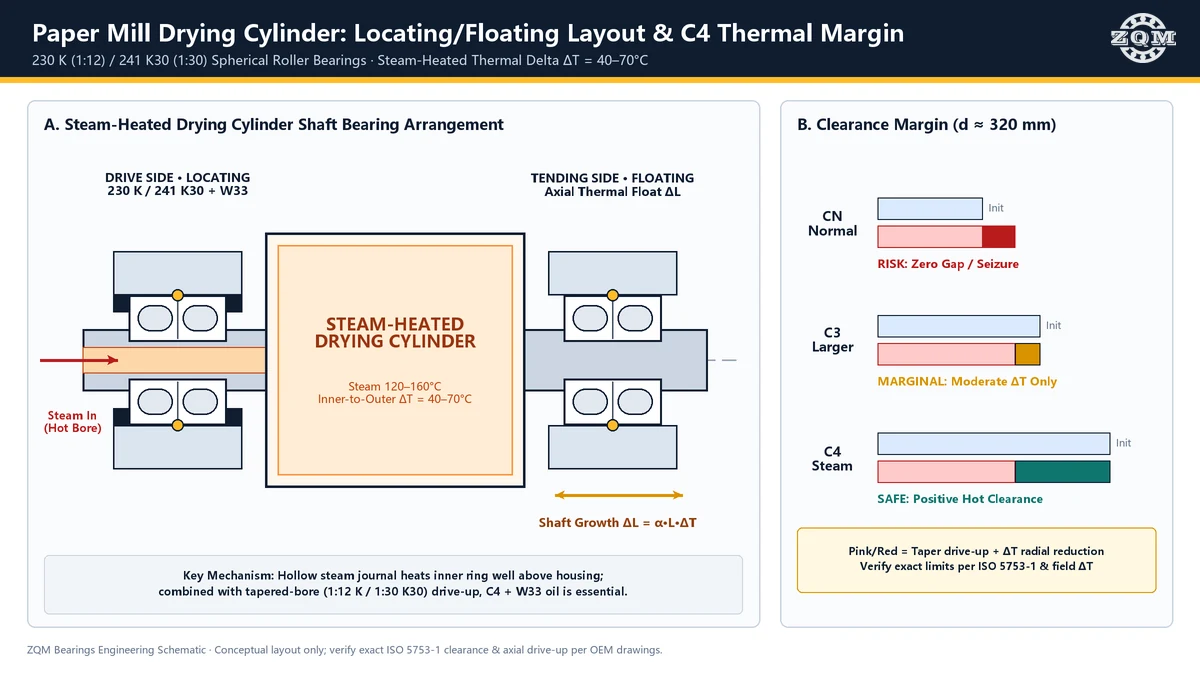
1. Why Steam-Heated Drying Cylinders Demand C4 Clearance
In a standard solid-shaft industrial gearbox, an interference fit on a 320 mm shaft plus a modest 10–15 °C ring temperature gradient is comfortably absorbed by C3 internal clearance. On a paper machine drying cylinder, two simultaneous mechanisms strip radial clearance away:
- Mounting interference expansion: Driving a tapered-bore spherical roller bearing (
23064 CAK/W33or24164 CAK30/W33) up its tapered journal or withdrawal sleeve expands the inner ring by roughly0.16–0.22 mmdepending on ISO 5753 bore group. - Steady-state radial thermal gradient (ΔT = 25–45 °C): For a 320 mm bore steel ring (
α ≈ 11.5 × 10⁻⁶ /°C), a 35 °C hotter inner ring expands radially by an additional~0.13 mmrelative to the housing-cooled outer ring, and transient warm-up peaks can be higher if steam pressure ramps too quickly.
Starting from unmounted C4 radial internal clearance preserves a safe positive operating clearance after both mounting reduction and steam-heat expansion, preventing roller skidding, raceway smearing, and catastrophic inner-ring cracking. Use our Tapered Bore Clearance & Thermal Growth Calculator to verify exact ISO 5753 unmounted C3/C4 bands and target residual clearance before mounting.
2. Calculating Axial Thermal Expansion (ΔL = α · L · ΔT) and Non-Locating Design
Beyond radial clearance loss, the entire cast-iron drying cylinder and hollow steel journals elongate lengthwise as steam heats the roll. For steel (α = 11.5 × 10⁻⁶ /°C), a 4,500 mm bearing center span experiencing a 55 °C axial temperature rise expands by:
ΔL = 11.5 × 10⁻⁶ × 4,500 × 55 ≈ 2.85 mm
To prevent massive parasitic axial thrust from crushing the roller rows, paper machines strictly separate bearing roles:
- Drive Side (Locating End): Axially locates the cylinder using locating rings in the pillow block housing while transmitting drive gear torque and steady axial positioning loads.
- Tending Side (Non-Locating End): Must float freely across the full
2–4 mmthermal expansion range—typically via a low-friction rocker/sliding housing assembly or a toroidal/cylindrical non-locating roller bearing depending on OEM dryer frame design. Never install locating rings on both ends of a steam dryer.
3. Series-Locked Taper Rules: 230 Series (1:12 K) vs. 240 / 241 Series (1:30 K30)
Mixing tapered bore ratios during maintenance overhauls is one of the costliest errors in pulp and paper mills. ISO 15 locks the standard taper ratio strictly by bearing dimension series:
- 230, 231, 232, and 222/223 Series —
K= 1:12 taper: Common on high-speed drying cylinders (23064 CAK/W33 C4) and calendar/press rolls where lower cross-section height and higher speed capability are required. - 240 and 241 Series —
K30= 1:30 taper: Standard on wide heavy-duty press rolls, suction rolls, and heavy pulp refiners (24056 CAK30/W33,24164 CAK30/W33) where the shallower 1:30 angle allows tighter radial control without over-thinning wide inner rings.
Before ordering replacement bearings or hydraulic withdrawal sleeves (such as AH 3064 vs. AH 24164), confirm both the journal taper gauge and the suffix via our Bearing Suffix Decoder.
4. W33 Circulating Oil Lubrication & Verified ZQM Catalog Reference Models
Because drying cylinders run hot continuously, centralized circulating oil systems (typically ISO VG 220 or VG 320 synthetic or mineral gear/paper-machine oil) are standard to carry heat out of the loaded zone, flush moisture condensate, and maintain an EHL oil film. All large ZQM CA/W33 spherical roller bearings feature a machined one-piece solid brass cage (stable above 120 °C without polymer embrittlement) and an outer-ring circumferential lubrication groove with three oil holes (W33) for direct center-feed oil injection.
| ZQM Designation | d × D × B (mm) | Dynamic Cr (kN) | Static C0r (kN) | Ref. Mass (kg) | Taper Option & Dryer Position |
|---|---|---|---|---|---|
| 23064 CA/W33 | 320 × 480 × 121 | 1,960 | 3,850 | 75.6 | 1:12 K · Steam drying cylinder |
| 24056 CA/W33 | 280 × 420 × 140 | 1,880 | 3,800 | 66.4 | 1:30 K30 · Compact heavy press roll |
| 24164 CA/W33 | 320 × 540 × 218 | 3,550 | 6,650 | 196.0 | 1:30 K30 · Suction / jumbo press roll |
| 23264 CA/W33 | 320 × 580 × 208 | 3,900 | 6,900 | 239.0 | 1:12 K · Heavy main drive / yankee gear |
Engineering Note: Nominal dimensions and load ratings above match the ZQM Bearing Catalog (wp_zqm_models_v1). Always confirm heat-stabilization specification (e.g., S1 up to 200 °C where required by machine OEM), C4 clearance group, bore taper (cylindrical vs. K vs. K30), and circulating oil flow rate against your paper machine drawings prior to procurement. Browse full sector recommendations on our Pulp & Paper Mill Bearings page or compare dimensions in the 230 Series Catalog and 241 Series Catalog.
Frequently Asked Questions: Drying Cylinder Bearings
Why is C4 clearance specified instead of C3 on steam-heated paper drying cylinders?
Live steam passing through the hollow cylinder journal makes the bearing inner ring run 25–45 °C hotter than the air-cooled outer ring. Combined with tapered-bore mounting interference, this thermal gradient consumes more radial clearance than C3 provides; C4 preserves safe positive operating clearance and prevents thermal seizure.
Can I mount a 241 series bearing on a 1:12 tapered drying cylinder journal?
No. Under ISO 15, standard tapered bores in the 240 and 241 series have a 1:30 taper (suffix K30), whereas 230, 231, and 232 series use a 1:12 taper (suffix K). Always verify the journal or withdrawal sleeve taper angle before ordering.
How much axial thermal expansion occurs on a 4,500 mm drying cylinder?
Using α = 11.5 × 10⁻⁶ /°C for steel across a 4,500 mm bearing span and a 55 °C axial temperature rise yields ΔL ≈ 2.85 mm. The tending-side non-locating bearing assembly must accommodate this axial float without inducing axial preload.
Why are machined solid brass cages (CA/MB) preferred over polyamide cages in paper dryers?
Paper machine dryer sections run continuously at elevated temperatures with circulating oil and occasional steam-condensate moisture exposure. Machined solid brass cages (CA) remain dimensionally stable at elevated temperatures and resist chemical or thermal aging.
What details should I include when requesting a quote for paper mill dryer bearings?
Provide the full bearing designation including bore suffix (cylindrical, K, or K30) and clearance group (C3 or C4), journal diameter, steam operating temperature, lubrication method (circulating oil vs. grease), and whether matching adapter or withdrawal sleeves are needed via our Contact page.
Need drawing verification or C4 heat-stabilized supply for an upcoming paper machine shutdown? Share your dryer roll list and target delivery schedule on our Contact & Quote Request Page.
For representative 200 mm bore geometry in this duty class, review the 24040 CA/W33 Spherical Roller Bearing specification sheet (240/241 series tapered option uses 1:30 K30).