
Heavy centrifugal process pumps in refineries, ethylene crackers, and chemical plants run at 1,480 to 3,550 r/min while coping with fluctuating suction pressures, impeller balance-drum wear, and start-up thrust reversals. Premature pump downtime is rarely caused by radial fatigue alone—it is most often triggered by excessive axial shaft shuttle destroying the mechanical seal faces or improper preload in paired thrust bearings.
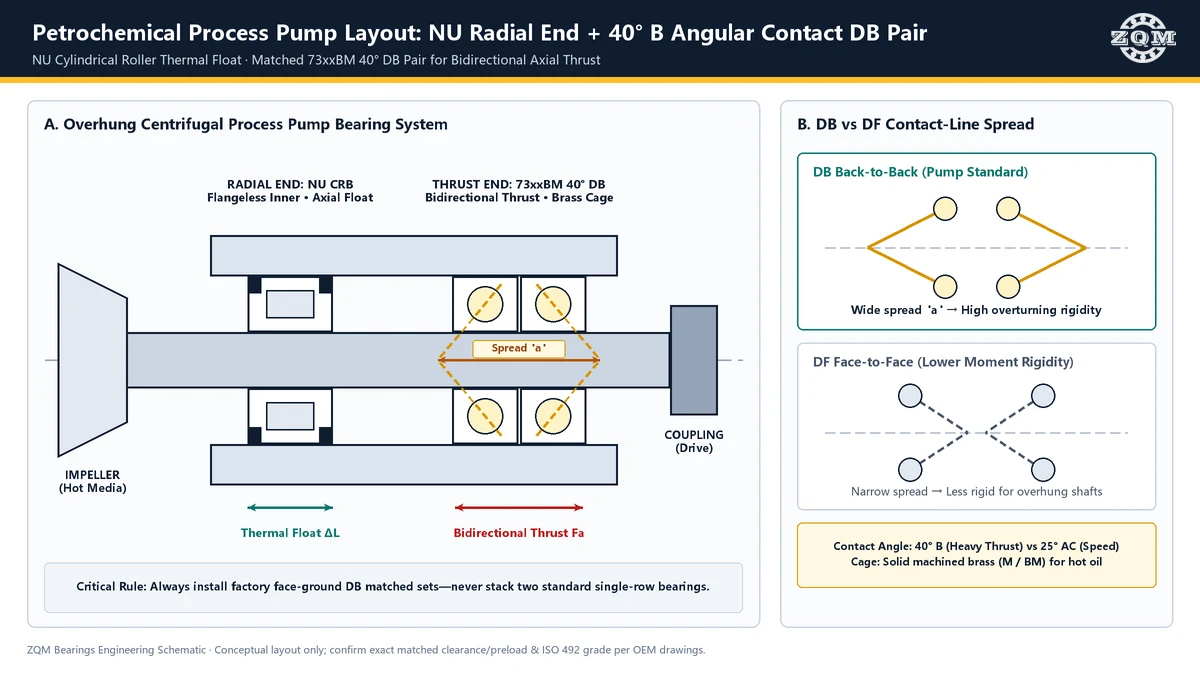
1. Why Heavy Process Pumps Use 40° Contact Angle (B Suffix) Paired Back-to-Back (DB)
Standard single-row deep groove ball bearings have limited axial stiffness when hydraulic thrust reverses during pump start-up, throttling, or partial-flow cavitation. Process pump designs referencing API 610 / ISO 13709 practices therefore favor two matched 40° angular contact ball bearings (such as 7326BM or 7330BM, contact angle factor e = 1.14) mounted in a Back-to-Back (DB) arrangement:
- Bidirectional thrust retention: One bearing takes primary discharge-to-suction hydraulic thrust while the opposing bearing arrests start-up and transient reverse thrust without unloading the rolling elements.
- Maximum moment rigidity (wide load-line spread
a): In aDBpair, the pressure cones diverge outward, increasing the effective support span between load centers. This resists shaft bending near the impeller and minimizes axial/radial deflection at the mechanical seal faces. - Thermal stability under shaft heating: Because pump shafts typically run slightly warmer than the finned/water-cooled bearing housing, inner-ring expansion acts along the diverging
DBload lines with lower risk of runaway thermal preload compared with Face-to-Face (DF) sets.
2. DB vs. DF vs. DT Paired Arrangements at a Glance
- Back-to-Back (
DB/<>): Standard default for centrifugal process pumps—handles bidirectional axial thrust and provides the highest overturning moment stiffness. - Face-to-Face (
DF/><): Narrower load-line spread; tolerates slightly more housing misalignment but has lower moment stiffness and tightens more rapidly when the inner ring heats relative to the outer ring. - Tandem (
DT/<<): Doubles axial load capacity in one direction only—must be paired with an opposing third bearing (e.g.,DBT) if any reverse thrust occurs during start-up or shutdown.
Critical procurement note: Always specify matched universal/paired grind sets (UA/CB axial clearance or light preload per pump OEM drawing) rather than placing two random single-row bearings back-to-back. Decode pair suffixes anytime with our Bearing Suffix Decoder.
3. Radial End (Impeller Side): NU Cylindrical Roller vs. Heavy 63xxM Deep Groove Ball
While the thrust end locks axial shaft position near the coupling, the radial bearing near the impeller must absorb radial hydraulic volute forces while letting the shaft expand axially as process fluid heats the rotor:
- Heavy Overhung & High-Load Pumps —
NUCylindrical Roller (e.g.,NU2330EM): Outer ring has two integral ribs while the inner ring is ribless, allowing friction-free internal axial displacement within ISO 246 permissible limits alongside very high radial capacity (Cr = 1,160 kNonNU2330EM). Verify minimum radial load so rollers do not skid at light load. - Moderate-Load / High-Speed Process Pumps —
63xxMDeep Groove Ball (e.g.,6330M): Low friction, machined solid brass cage (M), and lower sensitivity to light radial loads—provided the outer ring has a clean sliding housing fit (e.g., ISO H6/H7) to allow thermal float.
4. Brass Cage (BM/EM/M), Oil-Bath / Oil-Ring Speed Checks & Verified ZQM Catalog Models
Refinery pump brackets typically use oil-ring, oil-bath, or pure oil-mist lubrication (ISO VG 32/46/68 depending on speed factor n·dm). Machined solid brass cages (BM on 73 series, EM on reinforced NU series, M on 63 series) are widely specified in petrochemical service for their heat resistance and compatibility with sulfur/EP oil additives. Run live L10h life and n·dm lubrication checks in our ISO 281 Bearing Life & Lubrication Calculator.
| ZQM Designation | Type & Cage | d × D × B (mm) | Dynamic Cr (kN) | Static C0r (kN) | Ref. Mass (kg) |
|---|---|---|---|---|---|
| 7326BM | 40° ACBB · Brass (BM) | 130 × 280 × 58 | 251 | 270 | 17.5 |
| 7330BM | 40° ACBB · Brass (BM) | 150 × 320 × 65 | 289 | 340 | 26.7 |
| NU2330EM | Float CRB · Brass (EM) | 150 × 320 × 108 | 1,160 | 1,600 | 41.5 |
| 6330M | Heavy DGBB · Brass (M) | 150 × 320 × 65 | 274 | 284 | 26.0 |
Engineering Disclaimer: Dimensions and load ratings above reflect the ZQM Bearing Catalog (wp_zqm_models_v1). References to API 610 / ISO 13709 describe standard industry bearing configurations and do not constitute third-party API certification; always confirm matched DB axial clearance/preload class, ring material, and lubrication requirements against the pump OEM drawing. Explore more refinery equipment solutions on our Petrochemical Pumps & Compressors Bearings page and the 73 Series Catalog.
Frequently Asked Questions: Process Pump Bearings
Why do centrifugal process pumps prefer Back-to-Back (DB) over Face-to-Face (DF) angular contact pairs?
Back-to-Back (DB) mounting separates the load-line apexes further apart, maximizing moment stiffness to stabilize shaft deflection at the mechanical seal while being less prone to thermal preload tightening when the shaft runs warmer than the housing.
Can I assemble two standard single-row 7330BM bearings into a DB pair?
Only if the bearings are universally ground for matched pairing (or supplied as a factory-matched DB set with controlled axial clearance/preload). Unmatched standard single-row bearings can bind or exhibit excessive axial play when clamped tight.
When should the radial end of a process pump use NU2330EM instead of 6330M?
Choose an NU cylindrical roller bearing (like NU2330EM) when heavy overhung radial volute loads exceed ball-bearing life targets or when internal friction-free axial shaft float is required; choose 6330M when loads are moderate and speed is higher.
What does the BM suffix mean on 7326BM and 7330BM?
B designates a 40° nominal contact angle engineered for high axial thrust capacity, and M designates a machined solid brass cage suitable for continuous elevated-temperature oil-bath or oil-mist process pump duty.
What parameters should I provide for a petrochemical pump bearing inquiry?
Include the full bearing designations, required pairing/clearance code (e.g., DB / CB / C3), operating RPM, lubrication method (oil bath, oil ring, or oil mist), and required delivery timeline on our Contact page so our engineers can confirm matching specs.
Sourcing matched 40° 73xxBM pairs or NU/63xxM radial bearings for refinery turnaround stock? Submit your pump bearing BOM on our Contact & Quote Request Page.
Explore Full Dimensions in the ZQM Online Engineering Catalog
Browse verified bore, OD, width, and load-rating tables for Petrochemical Process Pump Angular Contact Bearings (73 & 72 Series): 73 Series Catalog · 72 Series Catalog · Request Engineering Quote.