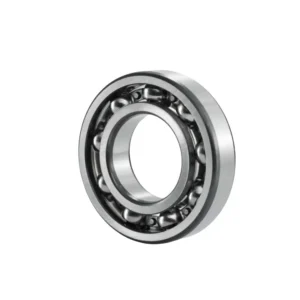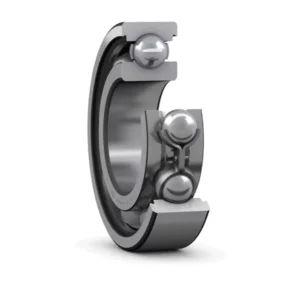

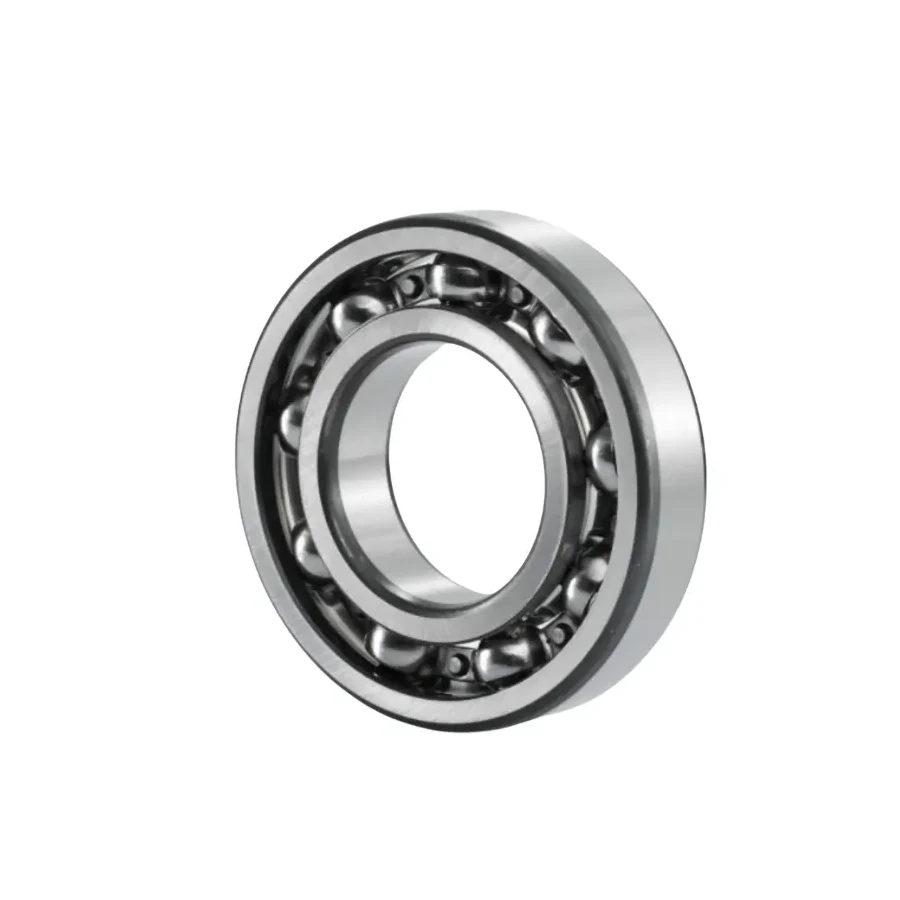
Pulling scorching flue gas laced with fly ash through an industrial power-plant induced-draft (ID) boiler fan—or spinning a multi-stage centrifugal process compressor—imposes continuous aerodynamic rotor vibration, substantial shaft thermal growth, and high peripheral cage velocities. Engineered inside the massive ISO 15 heavy 63 series at 150 × 320 × 65 mm and 26.0 kg, the ZQM 6330M deep groove ball bearing pairs thick deep-groove rings with a solid machined brass cage (M) to deliver 274 kN dynamic capacity (Cr), 284 kN static resistance (C0r), and verified limiting speeds of 1,900 rpm grease or 2,400 rpm oil.
6330M Technical Specifications & Dimensions
| Parameter Category | Technical Parameter (Symbol) | Catalogue Reference Value |
|---|---|---|
| Boundary Dimensions & Weight | Bore diameter (d) | 150 mm |
| Boundary Dimensions & Weight | Outside diameter (D) | 320 mm |
| Boundary Dimensions & Weight | Width (B) | 65 mm |
| Boundary Dimensions & Weight | Reference mass (Weight) | 26.0 kg |
| Load Ratings & Limiting Speeds | Basic dynamic load rating (Cr) | 274 kN |
| Load Ratings & Limiting Speeds | Basic static load rating (Cor) | 284 kN |
| Load Ratings & Limiting Speeds | Limiting speed (grease) | 1900 rpm |
| Load Ratings & Limiting Speeds | Limiting speed (oil) | 2400 rpm |
| Abutment & Fillet Dimensions | Shaft abutment diameter (da) | 166 mm |
| Abutment & Fillet Dimensions | Housing abutment diameter (Da) | 304 mm |
| Abutment & Fillet Dimensions | Minimum chamfer dimension (r12) | 4.0 mm |
| Abutment & Fillet Dimensions | Maximum fillet radius (ra) | 3 mm |
| Calculation Factors | Calculation factor (f0) | 14 |
Data source: ZQM Bearings online catalogue database (factory PDF catalogue v1). Load ratings, limiting speeds, and parameters without individual test records serve as catalogue reference values; verify shaft/housing shoulders (da, db, Da), tolerances, internal clearance, and drawings prior to ordering.
Solid Machined Brass Cage (M) Stability Under Fan & Compressor Vibration
When abrasive ash buildup slowly unbalances a 3-meter boiler fan impeller between cleaning cycles, standard riveted sheet-steel cages fatigue rapidly at pocket corners. The 6330M resolves these high-energy rotating hazards structurally:
- High-Vibration Brass Cage Integrity (M): Precision-machined solid brass withstands severe harmonic impeller vibration, rapid turbine-drive acceleration, and elevated flue-gas ambient temperatures far beyond stamped steel or polyamide limits—without shedding loose rivets into the raceway.
- Heavy 63-Series Capacity (274 kN Cr / 284 kN C0r): Weighing 26.0 kg across a 65 mm width, large-diameter steel balls absorb rotor deadweight, aerodynamic surge shocks, and bidirectional compressor thrust reversals cleanly.
- High-Speed Thermal Stability (Up to 2,400 rpm Oil): Low-friction sliding contact between hardened chrome-steel balls and self-lubricating machined brass pockets curbs cage-guided heat generation during continuous 1,480–1,800 rpm fan and compressor service.
- Locating-End Precision Amid Shaft Growth: On hot ID fans whose shaft expands millimeters axially toward the floating pedestal, the 6330M anchors the drive-end datum tightly while resisting axial aerodynamic pull.
ISO 15 Heavy-Series Cross-Reference Matrix for 6330M
| Brand | Reference Designation | d (mm) | D (mm) | B (mm) | Brass-Cage Execution Note |
|---|---|---|---|---|---|
| ZQM | 6330M | 150 | 320 | 65 | Solid machined brass cage (M); C3 clearance per order |
| SKF | 6330 M / 6330 M/C3 | 150 | 320 | 65 | Ball-centered machined brass cage heavy series |
| FAG / Schaeffler | 6330-M / 6330-M-C3 | 150 | 320 | 65 | Solid brass cage for boiler fans & compressors |
| NSK | 6330M / 6330MC3 | 150 | 320 | 65 | Heavy-duty machined brass cage execution |
| NTN / Koyo | 6330L1 / 6330FY | 150 | 320 | 65 | Equivalent machined copper-alloy cage suffixes |
Interchange boundary notice: Every code above matches strictly on ISO 15 nominal envelope boundaries (150 × 320 × 65 mm) for preliminary cross-referencing. Brass-cage guidance (ball-centered vs ring-guided), chemical oil-additive compatibility, and clearance group (CN vs C3) vary across makers; verify exact fan or compressor OEM specs before substituting.
Pedestal Machining, Thermal Clearance & Hot-Shaft Installation Playbook
- Verify Rigid Split-Pedestal Abutments & 4.0 mm Chamfers: Machine shaft backing shoulders to at least da = 166 mm and split plummer-block or compressor casing lips to no more than Da = 304 mm, holding mating corner fillets strictly beneath the rmin = 4.0 mm bearing chamfer so the heavy 65 mm rings seat without distortion.
- Keep ISO 286-1 Fits Separate from ISO 1101 Roundness Checks: Grind the 150 mm straight cylindrical fan shaft journal to ISO 286-1 m6 (or n6 under heavy unbalance) interference fit, while independently verifying ISO 1101 bore circularity inside split pillow-block pedestals so cap-bolt clamping never pinches the 320 mm outer ring oval.
- Confirm C3 Clearance for Hot Flue-Gas Shafts: Radiant heat travelling from a 150–250 °C boiler flue duct down the solid steel fan shaft narrows radial operating clearance sharply. Most ID fans mandate C3 clearance alongside water-cooled bearing pedestals or shaft-mounted cooling discs.
- Inductive Heating for Safe 26.0 kg Assembly: Lift the 26.0 kg 6330M with soft slings onto a large-yoke induction heater, warm evenly to 100–110 °C, slide cleanly against the 166 mm shaft shoulder, and clamp locknuts firmly after cooling.
EP-Additive Compatibility, Oil-Bath Cooling & Cage-Wear Monitoring
Two lubrication traps shorten brass-cage life in fans and compressors: overly reactive sulfur-phosphorus EP additives operating above 100 °C (which chemically etch copper alloys) and oil-ring slingers starved by clogged cooling jackets. For speeds above 1,500 rpm or elevated flue temperatures, select non-corrosive ISO VG 68/100 synthetic circulating or bath oil rated specifically safe for yellow metals (ASTM D130 1a/1b copper-strip compatibility). Track oil-analysis copper ppm trends alongside tri-axial pedestal vibration velocity to schedule impeller balancing before cage pocket wear accelerates.
Boiler-Fan & Compressor Procurement Checklist
When quoting 6330M replacements for power-plant fans, cement kiln ID blowers, or centrifugal compressors, verify four details: (1) radial clearance class (CN vs C3 for thermal shaft growth), (2) shaft operating rpm and lubrication system (grease, oil bath with cooling coil, or forced oil), (3) pedestal type (split plummer block vs solid compressor cartridge), and (4) required inspection paperwork. Submit your equipment tag list directly through our ZQM heavy-fan & compressor bearing desk.
Engineering Calculators & Related Pages: Model fan-shaft L10h intervals in our ISO 281 Bearing Life Calculator, verify full factory specs at 6330M Catalog Record, browse Deep Groove Ball Bearings, or inspect heavy rotating-machinery drivetrains in Industrial Gearboxes & Rotating Drives.
Induced-Draft Boiler Fan & Compressor 6330M FAQ
Why does an induced-draft boiler fan specify 6330M with a brass cage instead of standard pressed steel?
Fly-ash accretion periodically unbalances large ID fan rotors, generating severe continuous vibration and elevated flue-duct temperatures. A solid machined brass cage (M) resists pocket fatigue cracking and high-speed centrifugal deformation far more reliably than a riveted sheet-steel cage.
What lubricant precaution applies specifically to the machined brass cage on a 6330M?
Avoid aggressive active-sulfur EP gear oils or greases at sump temperatures above 95–100 °C, as active sulfur corrodes copper alloys. Specify yellow-metal-safe synthetic turbine/circulating oils or high-temperature polyurea/lithium-complex greases.
When must a 6330M switch from grease to oil lubrication on a centrifugal compressor?
Although grease lubrication reaches 1,900 rpm in clean cool duty, continuous centrifugal compressors and hot ID fans running near 1,500–2,400 rpm rely on circulating or water-cooled oil bath lubrication (up to 2,400 rpm rating) to shed thermal load and flush debris.
How do split pillow-block cap bolts accidentally ruin a newly installed 6330M?
Over-torquing housing bolts or mixing mismatched pedestal caps pinches the 320 mm outer ring across the split line, erasing radial clearance horizontally and creating localized overheating. Always verify ISO 1101 bore roundness with cap bolts torqued to spec before setting the shaft in place.