

In hydraulic cylinder rod eyes, crane luffing trunnions, aerial boom lifts, excavator linkages, and forestry grapples, pivot joints endure slow oscillating movement, heavy shock loads, and structural misalignment that would rapidly destroy rolling bearings. ISO 12240-1 Series E steel-on-steel radial spherical plain bearings (GE25ES-2RS through GE120ES-2RS) solve those pivot duties through a hardened convex spherical inner ring sliding inside a single-fractured concave outer ring. Because their physics are governed by sliding wear (p·v) rather than rolling fatigue, reliable field life depends on understanding three practical engineering rules: why ISO 281 does not apply, how to verify dual widths B and C inside a clevis fork, and why the 90° outer-ring fracture-plane orientation and MoS₂ grease purging are mandatory.
1. Why p·v Sliding Mechanics Replace ISO 281 Rolling Fatigue
A common engineering mistake when sizing hydraulic pivots is attempting to run a spherical plain bearing through an ISO 281 L10h fatigue-life calculator. ISO 281 describes subsurface Hertzian fatigue spalling in rolling-element bearings—it does not apply to sliding spherical plain bearings, which contain zero balls or rollers.
- Specific contact pressure
pscales with radial/combined load divided by the projected spherical sliding area. - Alternating loads (double-acting hydraulic cylinders) momentarily unload the contact zone and pull grease back in, whereas constant unidirectional loads squeeze lubricant out and require tighter relubrication intervals.
- Mean sliding velocity
vdepends on the spherical contact diameter, oscillation half-angle, and oscillation frequency rather than continuous shaft rotation. - The
p·vproduct governs frictional heat and adhesive/abrasive wear rate; allowable operating envelopes must be checked against actual duty cycle, surface treatment, and grease replenishment schedule.
In short, a properly sized GE..ES-2RS bearing in heavy construction machinery and hydraulic equipment does not fail by sudden subsurface spalling—it wears gradually through incremental increase in radial clearance. Controlling contact pressure, keeping oscillation speeds within the sliding regime, excluding abrasive grit, and maintaining an unbroken MoS₂ grease film directly multiply usable pivot hours.
2. Verified ISO 12240-1 Series E Dimensions (GE25ES-2RS to GE120ES-2RS)
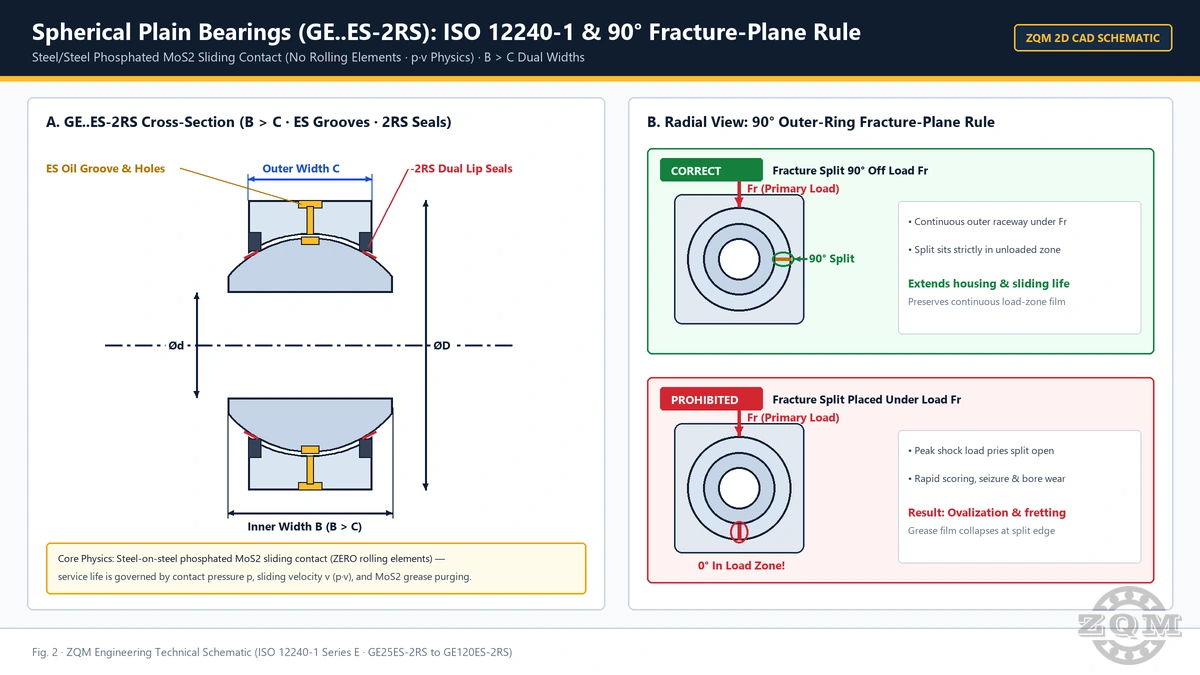
Every steel-on-steel sealed radial spherical plain bearing in our spherical plain bearing range follows ISO 12240-1 Series E boundary geometry. Note the deliberate difference between the wider inner ring (B) and the narrower outer ring (C) across the entire 25 mm to 120 mm bore series:
| Model (ISO 12240-1 Series E) | Bore d (mm) | Outer Dia D (mm) | Inner Ring Width B (mm) | Outer Ring Width C (mm) | Side Overhang (B − C)/2 (mm) |
|---|---|---|---|---|---|
| GE25ES-2RS | 25 | 42 | 20 | 16 | 2 |
| GE30ES-2RS | 30 | 47 | 22 | 18 | 2 |
| GE35ES-2RS | 35 | 55 | 25 | 20 | 2.5 |
| GE40ES-2RS | 40 | 62 | 28 | 22 | 3 |
| GE45ES-2RS | 45 | 68 | 32 | 25 | 3.5 |
| GE50ES-2RS | 50 | 75 | 35 | 28 | 3.5 |
| GE60ES-2RS | 60 | 90 | 44 | 36 | 4 |
| GE70ES-2RS | 70 | 105 | 49 | 40 | 4.5 |
| GE80ES-2RS | 80 | 120 | 55 | 45 | 5 |
| GE90ES-2RS | 90 | 130 | 60 | 50 | 5 |
| GE100ES-2RS | 100 | 150 | 70 | 55 | 7.5 |
| GE120ES-2RS | 120 | 180 | 85 | 70 | 7.5 |
Clevis Fork and Cylinder Eye Clearance Checks (B vs C)
Before machining a hydraulic cylinder rod eye or clevis fork, check three dimensional interfaces directly from the B and C columns above:
- Pin Clamping Width vs Inner Ring
B: Clevis fork spacing and pin spacer sleeves must locate cleanly against the inner-ring side faces (B) without binding against the outer ring or pinching the-2RSrubber seal lips. - Cylinder Eye Bore Width vs Outer Ring
C: The housing eye width and retaining-ring (circlip) groove spacing must match outer-ring widthCso the single-fractured outer ring sits squarely inside a full-width cylindrical bore. - Tilt Clearance Envelope: The side overhang
(B − C) / 2—ranging from2 mmon GE25ES-2RS up to7.5 mmon GE100ES-2RS and GE120ES-2RS—enables angular misalignment during boom twist. Verify that the cylinder eye chamfers clear the clevis walls across the full tilt angle under peak load.
3. Mandatory Installation Rule: 90° Outer-Ring Fracture-Plane Alignment
To assemble a one-piece spherical inner ring inside a one-piece steel outer ring, ISO 12240-1 Series E GE..ES bearings use an axially single-fractured outer ring. Once pressed into a properly toleranced cylindrical housing bore, the mating fracture faces close tightly and restore full circular geometry. However, the rotational orientation of that fracture line inside the housing eye is critical:
- Orient the Split 90° Perpendicular to Primary Load: Always position the outer-ring fracture plane at 90° to the main radial load vector (in the unloaded neutral axis of the cylinder eye or crane trunnion). Never point the split toward the hydraulic push/pull load axis.
- Why Putting the Split in the Load Zone Destroys the Joint: When heavy hydraulic thrust acts directly across the fracture seam, cyclic elastic breathing opens micro-steps along the split edges, scrapes away the MoS₂ lubricant film, scores the hardened inner sphere, and accelerates ovalization and fretting corrosion inside the housing eye bore.
- Align the Grease Port and Press Strictly on the Interference Ring: Line up the housing grease drilling with the outer-ring circumferential lubrication groove before pressing. Apply mounting force evenly to the outer-ring face when fitting into the eye (or to the inner-ring face when fitting onto a tight pin)—never transmit press force through the spherical sliding contact or the
-2RSseals.
4. Phosphated MoS₂ Run-In, Lithium EP Grease Purging and -2RS Seals
Understanding the designation suffixes—which you can also break down quickly using our Bearing Suffix Decoder—clarifies exactly how to maintain steel-on-steel joints in muddy, wet, or dusty outdoor service:
- Phosphated MoS₂ Surface Treatment: Both hardened steel sliding surfaces receive a manganese-phosphate coating paired with molybdenum disulfide (
MoS₂) run-in compound. That surface layer eases initial break-in and helps guard against adhesive galling during early high-pressure strokes, but it is not a permanent dry-running liner—active grease lubrication is mandatory. ESLubrication Grooves and Holes: TheESdesign incorporates annular lubrication grooves and feed holes on both inner and outer rings across this size range, allowing relubrication through either a cross-drilled pin or a housing grease nipple.- Lithium EP MoS₂ Grease Purging Practice: Fill the joint generously prior to commissioning with a water-resistant lithium-soap extreme-pressure (EP) grease containing MoS₂. During scheduled service, pump grease while the cylinder or crane linkage is unloaded or slowly oscillating until fresh grease purges dirty lubricant and grit cleanly out past the seals.
-2RSDouble-Sided Lip Seals: Integral elastomer lip seals on both sides retain grease while blocking jobsite mud, quarry dust, wood chips, and washdown spray in hydraulic cylinders, crane luffing trunnions, boom lifts, and forestry grapples.
5. Pre-Order Engineering Checklist for Spherical Plain Bearings
Before placing an order for ISO 12240-1 Series E spherical plain bearings (from GE25ES-2RS and GE50ES-2RS up to GE100ES-2RS and GE120ES-2RS), verify these six points:
- Exact Boundary Dimensions
d × D × B / C: Confirm both inner-ring widthBand outer-ring widthCagainst your pin clevis spacing and retaining-ring grooves—never order by bore diameter alone. - Sealing and Relubrication Execution: Verify whether double lip seals (
-2RS) and relubricatable steel-on-steel grooves (ES) match your contamination exposure and grease-line layout (versus openGE..ESor maintenance-free PTFE-lined variants). - Radial Internal Clearance Group: Standard radial clearance (
CN) suits most hydraulic pivots with standard housing fits; confirm if heavier housing interference or elevated temperatures requireC3radial clearance. - Pin and Housing Eye Tolerances: Check housing bore roundness, surface finish, and interference fit so the single-fractured outer ring closes cleanly without excessive clearance reduction, and verify pin hardness and fit against fretting.
- Load Direction and Oscillation Duty: Note whether the joint carries constant unidirectional load or alternating tension-compression shock so relubrication intervals can be planned realistically.
- Order-Matched Quality Verification: Confirm dimensional inspection, radial clearance verification, and protective rust-preventive packaging requirements under our quality inspection workflow before dispatch.
Frequently Asked Questions
Why cannot ISO 281 L10h bearing life formulas be used to calculate GE..ES-2RS spherical plain bearing life?
ISO 281 calculates rolling-contact subsurface fatigue life for ball and roller bearings. Radial spherical plain bearings such as GE25ES-2RS through GE120ES-2RS contain no rolling elements; their inner and outer rings operate in direct steel-on-steel spherical sliding contact. Service life is therefore governed by progressive sliding wear rather than rolling spalling, driven by specific contact pressure p, mean sliding velocity v, oscillation half-angle, load cycling direction, and MoS₂ grease replenishment intervals.
Why must the single outer-ring fracture plane of a GE..ES-2RS bearing be oriented 90° from the primary load?
Single-fractured steel outer rings are split axially at one point so the one-piece hardened spherical inner ring can be assembled inside. If that fracture line sits directly inside the primary radial load zone, high hydraulic contact pressure wedges against the split edges, disrupts the boundary lubricant film, accelerates spherical surface galling and ovalization, and induces outer-ring fretting against the cylinder eye bore. Orienting the fracture plane 90° perpendicular to the main load keeps the loaded hemisphere continuous and fully supported by the housing.
What is the engineering purpose of the wider inner ring (B) compared to the narrower outer ring (C) on ISO 12240-1 Series E bearings?
On every ISO 12240-1 Series E spherical plain bearing, the inner ring width B projects symmetrically beyond the outer ring width C on both sides—for example, B = 35 mm vs C = 28 mm on GE50ES-2RS, or B = 70 mm vs C = 55 mm on GE100ES-2RS. That axial overhang provides the geometric clearance needed for the rod eye or housing to tilt around the pin under boom twist and shaft deflection without colliding with the clevis fork cheeks or crushing the -2RS lip seals.
How should steel-on-steel GE..ES-2RS spherical plain bearings be lubricated during commissioning and service?
Steel-on-steel GE..ES-2RS bearings require lubrication prior to first motion and periodic relubrication throughout service, even though their sliding surfaces carry a phosphated MoS₂ run-in treatment. Pump lithium-soap extreme-pressure (EP) grease fortified with MoS₂ through the ES lubrication grooves and holes while the joint is unloaded or oscillating slowly, purging fresh grease until contaminated old grease exits cleanly past the -2RS double lip seals.
Do alternating hydraulic loads wear GE..ES-2RS spherical plain bearings differently from constant unidirectional loads?
Yes. Under a constant unidirectional load, grease is steadily squeezed out of the loaded contact hemisphere, making periodic unloaded purging critical to prevent dry metal-to-metal scoring. Under alternating tension-compression loads—such as double-acting excavator or crane cylinders—the brief unloading phase on each reversal opens microscopic clearance that helps draw fresh MoS₂ grease back into the contact zone, generally improving wear life when pin fits and seals are properly maintained.
Sourcing GE25ES-2RS to GE120ES-2RS Bearings for Hydraulic Cylinders or Cranes?
Send your required ISO 12240-1 Series E sizes, clevis B/C dimensions, clearance group, and operating environment. ZQM engineers confirm dimensional tolerances, sealing execution, and inspection documentation before quoting.